
Table of Contents
The Oera Linda Book is a manuscript in Old Frisian that was first published in 1872 by J. G. Ottema. It claims to be a 13th-century copy of much older family writings. Its writers say their history began when a land called Aldland, or Atland, sank into the sea. Many scholars, among them Goffe Jensma (De gemaskerde god, 2004), treat the manuscript as a 19th-century fabrication. This page reads it on its own terms and asks when that sinking could have been.
All quotes on this page come from William R. Sandbach’s English version of 1876, made from Dr J. O. Ottema’s Dutch translation. The full text is on my page The Oera Linda Book.
The Oera Linda Book timeline (as the book tells it)
The book counts its years from the sinking of Atland, which it also calls Aldland. Hiddo’s letter at the start of the book dates his copy to “the three thousand four hundred and forty-ninth year after Atland was submerged” and to the year 1256. Subtracting 1256 from 3449 gives 2193 BC. Dr J. O. Ottema, who verified the Frisian text and translated it into Dutch, uses 2193 BC as year 0 in his footnotes. A book date marked “computed” is 2193 minus the book’s count of years after Atland.
The book’s own dates count from 2193 BC. My alternative dates count from 9,564 BCE, the year W. Scott-Elliot gives for the sinking of Poseidonis, the last island of Atlantis, in The Story of Atlantis. Each alternative date is 9,564 minus the book’s count of years after Atland, in BCE. Page numbers refer to William R. Sandbach’s English version of 1876. The full text is on my page The Oera Linda Book.
| Book’s date | Alternative date | What the book says | Written by |
|---|---|---|---|
| Year 0 2193 BC, computed | 9,564 BCE | “Aldland, called by the seafaring people, Atland, disappeared” (Sandbach page 71). Fires and floods go on for three years. | Adela’s book |
| Year 101 2092 BC, computed | 9,463 BCE | “One hundred and one years after the submersion of Aldland a people came out of the East” (page 73): the Magyars and the Finns. Eighty years later they invade, and Wodin, Teunis and Inka lead the defence (page 75). Ottema’s footnote: “2193–101 is 2092 before Christ”. | Adela’s book, Waraburgt inscription |
| Year 193 2000 BC, computed | 9,371 BCE | Teunis reaches “the Phœnician coast, one hundred and ninety-three years after Atland was submerged,” and founds Thyrhisburgt (page 83). Inka sails on and is not heard of again (page 81). | Adela’s book, Waraburgt inscription |
| Year 563 1630 BC, computed | 9,001 BCE | Min-erva, called Nyhellenia, presides at Walhallagara (page 87). The text itself says “that is, 1600 years before Christ.” Ottema’s footnote: “2193–563 is 1630 years before Christ”. | Adela’s book, Walhallagara inscription |
| Year 1005 1188 BC, computed | 8,559 BCE | Ulysses, “a king of the Jonischen Islands,” brings jewels from Troy to Texland, then stays for years with Kalip at Walhallagara (pages 105 to 107). | Adela’s book, Fryasburgt inscription |
| Year 1602 591 BC, computed | 7,962 BCE | “How our Denmark was lost to us 1602 years after the submersion of Atland” (page 111). Two years later the Magy steals the lamp of Texland (page 113). | Adela’s book |
| Year 1866, computed 327 BC, from Ottema | Not counted in the text | Alexander comes down the Indus when “we had been settled 12 times 100 and twice 12 years in the Five Waters” (page 165). Liudgert sails “alone with Nearchus” (page 167). | Liudgert’s diary, copied by Frethorik |
| Year 1888 305 BC, computed | 7,676 BCE | Storms, ice and floods wreck the citadels, and only Fryasburgt survives. “This happened 1888 years after the submersion of Atland” (page 161). | Frethorik |
| Year 1890 303 BC, in the text | 7,674 BCE | “Two years after Gosa had become the mother (303 B.C.)” Friso arrives with the returning Geertmen (page 163). | Frethorik |
| Year 3449 AD 1256, in the text | 6,115 BCE | Hiddo copies the wet books “on foreign paper” and dates the copy (page 3). The book’s own dates rest on this date. | Hiddo over de Linda |
Several people in the book have no year. Minno, the sea-king who “gave laws to the Cretans,” is undated, and Ottema identifies him with Minos. Jon sails with Min-erva, so he belongs to her lifetime, but the text gives no year. Geert’s move to the Punjab has no year either. Ottema dates it to 1551 BC by counting back 1,224 years from Alexander. Konerêd, Beeden and Rika write after Friso without giving a year. The last writer describes Askar, “the fourth king after Friso,” whom Ottema dates from Furmerius to about 70 BC to AD 11. Liko’s letter is dated AD 803. Ottema’s Introduction follows the manuscript from 1820 to Cornelis over de Linden, who received it from his aunt in August 1848.
The motif of red cows with golden horns appears in various mythologies:
- Greek Mythology: The Ceryneian Hind, a sacred deer to Artemis, was described as having golden antlers and bronze hooves. Heracles' third labor involved capturing this creature. The Collector
- Egyptian Mythology: Hathor, the goddess of the sky, women, and fertility, was often depicted as a cow bearing the sun disk between her horns, symbolizing her role in the daily rebirth of the sun. Wikipedia
- Hindu Mythology: Kamadhenu, the divine bovine-goddess, is considered the mother of all cows and is often portrayed as a white cow with a female head and breasts, adorned with various ornaments.
In Timaeus, Plato describes the Demiurge (a benevolent creator) as eternal and good, creating the universe as a reflection of eternal forms.
Medieval Exegesis:
Medieval scholars often associated Noah's sons with the three known continents:
Shem: Linked to Asia.
Ham: Associated with Africa.
Japheth: Connected to Europe.
This tripartite division was more geographical than racial.
Pirke De-Rabbi Eliezer (7th–9th Century):
This Jewish text describes the descendants of Noah's sons with specific color attributes:
Shem's descendants: "Black but comely."
Ham's descendants: "Black like the raven."
Japheth's descendants: "Entirely white."
Atlantis (Plato's Critias): Atlantean laws were inscribed on a golden pillar in the temple of Poseidon.
The Ten Commandments: Biblical laws, while on stone, are often symbolically linked to divine splendor akin to gold.
Table of the Sun (Herodotus): A golden table in Ethiopia symbolized divine offerings and cosmic order.
Laws of Manu: Hindu laws from Manu carry symbolic ties to prosperity and divine truth, often associated with gold.
Book of Mormon: Joseph Smith claimed to translate sacred laws from golden plates revealed by the angel Moroni.
The fallen angels (Watchers) bring chaos and war, spilling blood and causing humanity's suffering, which contributes to God's decision to send the flood.
In the Mahabharata, the Kurukshetra War is described with graphic imagery of bloodshed, suggesting the earth is soaked in blood.
During the war between the Olympian gods and the giants (Gigantomachy), the earth is said to be soaked with the blood of the giants.
In Aztec cosmology, the gods spill their own blood to create and sustain the world. The creation of humanity involves a cataclysmic flood of blood during the fifth sun.
Irish Mythology: The Second Battle of Mag Tuired between the Tuatha Dé Danann and the Fomorians involves vast bloodshed described in vivid, poetic terms. The earth and rivers run red with the blood of the defeated.
Finns: Likely referring to Finno-Ugric peoples. The claim suggests cultural exchange or influence from the Frisians to northern European groups.
Thyriers: Possibly referring to a people related to or influenced by the Norse (Thyr could connect to Tyr, a Norse god).
Thyriers fits Tyre both phonetically and symbolically, particularly given Tyre’s historical prominence in writing, trade, and cultural dissemination.
Krekalanders: A name for the Greeks (Krekaland = Greece). This suggests an assertion that Greek script or writing traditions may have derived from Frisian sources.
Meteor Impact-Induced Catastrophe: A massive meteor impact could explain both the prolonged cloud cover and the described disasters. The impact would eject vast amounts of dust and aerosols into the atmosphere, creating dense, persistent clouds that block the sun, as noted in the earlier text. The resulting atmospheric disruption could cause a damp, oppressive mist and calm air due to altered weather patterns. The impact’s shockwave might trigger earthquakes and volcanic eruptions, as described with mountains opening and spewing fire. Some landmasses could sink due to crustal destabilization, while others rise from tectonic shifts. The impact could also generate tsunamis, with “wild waves” flooding and submerging Aldland/Atland, burying everything in water.
Axial Tilt Shift and Geological Upheaval: A drastic shift in Earth’s axial tilt, possibly caused by a massive meteor impact or internal geophysical processes, could disrupt climate and geology on a global scale. The altered tilt might trap a region in a zone of persistent cloud cover and heavy, damp mist due to shifted atmospheric circulation, explaining the sun’s absence and oppressive air. This shift could destabilize the Earth’s crust, triggering earthquakes and volcanic activity, as seen in the mountains vomiting fire and sinking or rising landmasses. The resulting geological chaos might cause coastal flooding or tsunamis, submerging Aldland/Atland under “wild waves,” with the combined effects of fire, water, and earth movements accounting for the widespread destruction and loss of life.
When the Romans encountered Greek culture, they adopted and adapted many Greek deities into their pantheon. Athena was identified with Minerva as part of this process of syncretism
Hiddo’s letter and the date of 6,115 BCE
The book opens with two letters. In the first, Hiddo over de Linda tells his son Okke why he copied the books.
Written at Liuwert, in the three thousand four hundred and forty-ninth year after Atland was submerged—that is, according to the Christian reckoning, the year 1256. Hiddo, surnamed Over de Linda.—Watch.
The Oera Linda Book, tr. Sandbach (1876), page 3
If Atland sank in 9,564 BCE, adding 3,449 years places Hiddo’s count in 6,115 BCE, not AD 1256. That is the date in the title of this page.
In the second letter, dated AD 803, Liko over de Linda begs his heirs never to let a monk see the writings.
The maps
Three maps on this page come from Jürgen Spanuth’s Atlantis: The Mystery Unravelled, which I review in my post on Spanuth’s Atlantis. Spanuth places another northern Atlantis near Heligoland around 1200 BC.
I think I found the winner!
Frya and her sisters
The oldest story in the book is a creation story. The god Wr-alda makes time, and time makes the earth. The earth then gives birth to three maidens, the mothers of all peoples.
After the twelfth Juulfeest she brought forth three maidens:— Lyda out of fierce heat. Finda out of strong heat. Frya out of moderate heat.
Sandbach, page 13
Frya is the mother of the Frisians. Before she rises to her “watch-star”, she gives her children her laws, the Tex. The Frisians write it on the walls of their citadels.
How the bad time came
The book’s account of the sinking is short. In this account the summer had been dark and still. Then the earth shook.
In the midst of this stillness the earth began to tremble as if she was dying. The mountains opened to vomit forth fire and flames. Some sank into the bosom of the earth, and in other places mountains rose out of the plain. Aldland, called by the seafaring people, Atland, disappeared, and the wild waves rose so high over hill and dale that everything was buried in the sea.
Sandbach, page 71
The fires and floods went on for three years. Forests burned, rivers changed their course, and the peoples of Finda moved into the empty land.
Inka goes looking for Atland
After the invasion, the sea-kings Teunis and Inka sail south with a fleet of Finns and Magyars. At Cadiz they disagree. Teunis wants to serve the Egyptian king. Inka hopes that part of Atland is still above water.
Inka thought that perchance some high-lying part of Atland might remain as an island, where he and his people might live in peace.
Sandbach, page 81
Most of the Finns and Magyars follow Inka, and the book never mentions him again. Teunis goes on to the Phoenician coast.
Min-erva, called Nyhellenia
The book’s Min-erva is a priestess at Walhallagara, which Ottema identifies with Middelburg on Walcheren. The sailors call her Nyhellenia. Readers of the book link the name to Nehalennia, a goddess known from Roman-era altars found in Zeeland, at Domburg and Colijnsplaat.
Related on this site
- The Oera Linda Book: the full English text, with Ottema’s introduction and the timeline.
- The Story of Atlantis: W. Scott-Elliot’s account, which dates the sinking of Poseidonis to 9,564 BCE.
- Where Was Atlantis: other places where people have looked for Atlantis.
- Jürgen Spanuth’s Atlantis: The Mystery Unravelled: another northern Atlantis, placed near Heligoland around 1200 BC.
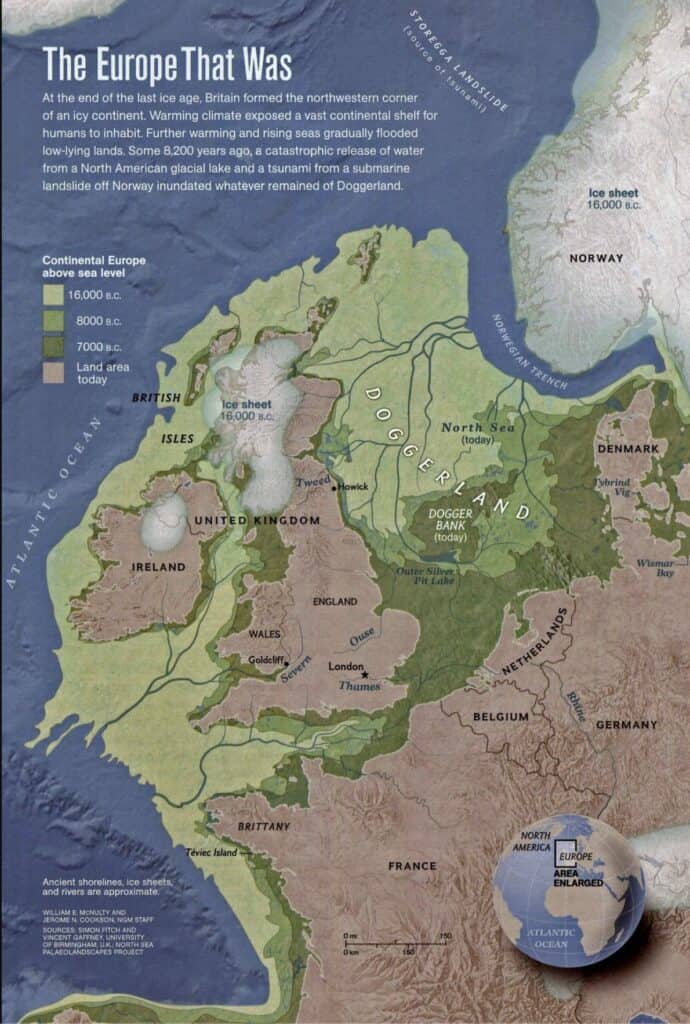
- Life on Doggerland Documentary: the land that once joined Britain to mainland Europe, before the sea covered it.

