
Table of Contents
Hathor (Egyptian ḥwt-ḥr) was one of the great goddesses of ancient Egyptian religion. In her gentle form she brought beauty, music, dancing, gladness, love and a mother’s care. Cow goddesses much like her already show up in Egyptian art in the fourth millennium BC, yet Hathor herself may first appear only in the Old Kingdom (about 2686 to 2181 BC). Barbara Lesko writes that she rose fast in the Fourth Dynasty, and Carolyn Graves-Brown notes that Egypt gave Hathor a larger number of temples than any other goddess.
Mother, Sky and Sun
Barbara Lesko describes Hathor as both the mother and the wife of Horus, and says that once she was paired with the sun god Ra she became the divine mother of the pharaoh. Hathor was seen as a mother figure to the king and all of Egypt. Carolyn Graves-Brown points out that, being the king’s wife and the mother of the next king, she was the model in heaven for the queens on earth. Geraldine Pinch describes the Eye of Ra, a role Hathor shared with several goddesses, as the power that shielded the sun god from his foes.
Robert Ritner explains that having children safely mattered greatly in everyday religion, so families kept Hathor and Taweret in shrines at home. Fekri Hassan notes that women hoping for a child often turned to Hathor with private prayers and gifts.
Music, Joy and Drunkenness
Ragnhild Finnestad lists titles that make Hathor the lady of music, dance, garlands, myrrh and drunkenness. Lise Manniche shows that the sistrum, a shaken rattle, held a special place in her rites.
A text from the Temple of Edfu
the gods play the sistrum for her, the goddesses dance for her to dispel her bad temper.
Temple of Edfu text, translated in C. J. Bleeker, Hathor and Thoth, Brill, 1973, p. 57 (short excerpt for review and study)
Carolyn Graves-Brown describes the Festival of Drunkenness, called Tekh by the Egyptians, as a feast for the homecoming of the Eye of Ra. Temples of Hathor and of the other Eye goddesses kept it on day twenty of the month Thout. Graves-Brown traces it to the Middle Kingdom, though most of what is known about it comes from the Ptolemaic and Roman eras.
Images of Hathor
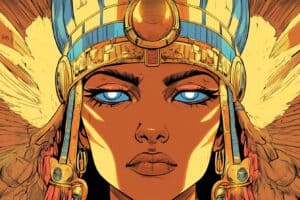
Richard Wilkinson describes three main ways artists drew her. She could be a cow with the sun’s disk held in her horns, often while she suckles the king. She could be a woman with a cow’s head. Most often she was a woman whose crown was a pair of cow horns around a sun disk. Geraldine Pinch notes that she often carried a sistrum or a menat, and George Hart describes the menat as a necklace of many strings of beads, rattled during her ceremonies.
Temples
Dendera in Upper Egypt was her chief temple (View Map). Robyn Gillam writes that in the Old Kingdom the Memphis area was the heart of her cult, and that “Hathor of the Sycamore” had many shrines across the burial grounds of Memphis. See also Egypt and Osiris.

