
Table of Contents
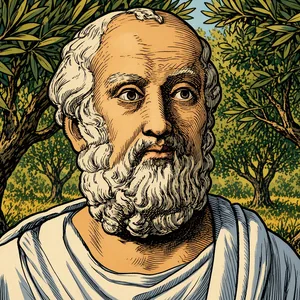
Plato (about 428 to 347 BC) was a philosopher in Athens. He founded the Academy, a school of philosophy in Athens. He wrote his works as dialogues, which are conversations between named speakers.
Plato introduced the Atlantis story in two of these dialogues, Timaeus and Critias. In them, Critias, one of the speakers, tells a story he says came from Egyptian priests by way of the lawgiver Solon.
The story describes a sea power beyond the Pillars of Heracles that tried to conquer the Mediterranean lands. Athens stopped it, and Atlantis then sank in a single day and night. The text of Critias breaks off before the end.
The site also carries his last dialogue, the Laws, which does not mention Atlantis. The books on this site are Timaeus and Critias and The Laws.
Books
The 2 books on this site by or about Plato.

The Laws
Timaeus and Critias
Bashar on the priests of Egypt
Why Plato studied in Egypt
Asked why Greek thinkers such as Plato and Socrates studied in Egypt, Bashar, channeled by Darryl Anka, points to the Egyptian priesthood. This fits the account in the Timaeus, where an Egyptian priest at Sais tells Solon the story of Atlantis (at 34:20).
Because the ancient priests of Egypt knew the secrets of Atlantis. And they passed them along.
Bashar

Heindel on Plato and the World-Soul
Max Heindel, the Danish-born occultist who founded the Rosicrucian Fellowship, set out his teaching in The Rosicrucian Cosmo-Conception (1909). He opens a chapter with a saying he attributes to Plato.
The World-Soul is crucified
Heindel calls Plato an Initiate who gave out occult truths. He reads the saying as an image of the cross, with the plant as its lower limb rooted in the mineral soil.
Plato, who was an Initiate, often gave out occult truths. He said "The World-Soul is crucified."
The lower limb of the cross indicates the plant with its root in the chemical mineral soil.
Max Heindel, The Rosicrucian Cosmo-Conception, 3rd ed. (1911), part I, chapter III, p. 85
Donnelly on Plato’s Atlantis story
In Atlantis: The Antediluvian World (1882), Ignatius Donnelly treats the story preserved in the Timaeus and Critias as a record of a real island, not as a fable invented for a moral.
A record from antiquity
He opens his chapter on Plato by calling the Atlantis history one of the most valuable records that have come down from the ancient world.
Plato has preserved for us the history of Atlantis. If our views are correct, it is one of the most valuable records which have come down to us from antiquity.
Ignatius Donnelly, Atlantis: The Antediluvian World (1882), Part I, Chapter II

A plain and reasonable history
Later he argues that the narrative has none of the marvels of Greek myth, and that it reads as the history of a people who built temples, ships, and canals, and who lived by agriculture and commerce.
There are in Plato's narrative no marvels; no myths; no tales of gods, gorgons, hobgoblins, or giants. It is a plain and reasonable history of a people who built temples, ships, and canals; who lived by agriculture and commerce: who in pursuit of trade, reached out to all the countries around them.
Ignatius Donnelly, Atlantis: The Antediluvian World (1882), Part I, Chapter III

