
Table of Contents
Cleito is the mortal woman at the very root of Plato’s Atlantis: the daughter of an earth-born couple, the wife of Poseidon and the mother of its first kings. These are the pages where I wrote about her.
Cleito in Plato’s Critias
On Who Were the 12 Kings of Atlantis? I give her origin in Benjamin Jowett’s English, as Critias tells it:
In this mountain there dwelt one of the earth born primeval men of that country, whose name was Evenor, and he had a wife named Leucippe, and they had an only daughter who was called Cleito. The maiden had already reached womanhood, when her father and mother died; Poseidon fell in love with her
Plato, Critias, translated by Benjamin Jowett
On the same page I stress that Cleito becomes mother of the five twin pairs but is not a king herself in Critias. On Timaeus & Critias – Plato’s Island of Atlantis she appears under the Greek spelling Kleito, daughter of Euenor and Leukippe.
The hill and the rings
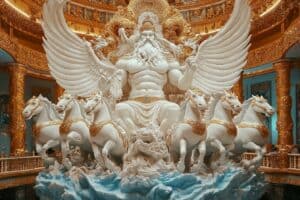
On The beginning of Atlantis Poseidon encloses her dwelling on a central hill with alternating zones of sea and land for protection, creates springs of hot and cold water and ensures abundant food from the soil. On Poseidon: High Priest of Atlantis and God of the Seas he marries the mortal Cleito, fathers ten sons who become the kings of Atlantis, and creates the concentric rings of water and land around the place where she lives.
Mother of kings
On Atlas: the firstborn son of Poseidon and earth-born Cleito I follow her firstborn, Atlas. On Critias, the story of Atlantis the Atlantean kings descend from Poseidon and Cleito, who had five pairs of twin sons. On The Egyptian Colony Ignatius Donnelly takes “the twelve great gods” to mean the twelve gods of Atlantis: Poseidon, Cleito and their ten sons.
The temple of Poseidon and Cleito
On Main city of Atlantis the temple to Poseidon and Cleito is a stadium long and half a stadium wide, with an ivory roof and decorations of gold, silver and orichalcum. On Critias, the story of Atlantis the most important temple was dedicated to Poseidon and Cleito and surrounded by a golden enclosure.
A Peruvian Cleito
In The Problem of Atlantis Lewis Spence finds Plato’s story of Poseidon and Cleito in a Peruvian myth of the god Pariacaca and the girl Choque Suso. In both a god comes to a hill, wins a woman and waters the land.
Pariacaca, the demi-god who had emerged from one of the eggs or “arks,” as related above, came, like Poseidon, to a hill-country, where he was insulted by the people. In wrath he sent a flood upon them so that their village was destroyed. In the neighbourhood he met a very beautiful girl, Choque Suso (the Cleito of Plato ?) weeping bitterly. He inquired of her why she wept, and she told him that the maize-crop was dying for lack of water. He fell in love with her, and assured her that if she would return his passion he would provide the much needed water. She consented to his suit, and he irrigated the whole land, as did Poseidon in Atlantis. Pariacaca eventually turned his wife into a statue.
This myth agrees almost in every detail with that of Plato. We have in both cases the hill, the finding of the beautiful girl, the making of an irrigation zone, and finally the appearance of the loved one as a stone image or idol. Could the resemblance be closer ?
Lewis Spence, The Problem of Atlantis (1925), chapter 15, pp. 195-196
Related pages
- Who Were the 12 Kings of Atlantis?
- Timaeus & Critias – Plato’s Island of Atlantis
- The beginning of Atlantis
- Poseidon: High Priest of Atlantis and God of the Seas
- Atlas: the firstborn son of Poseidon and earth-born Cleito
- Critias, the story of Atlantis
- The Egyptian Colony
- Main city of Atlantis
For every page I tagged with Cleito, see the Cleito tag archive.

