
Table of Contents
Book contents. Next: Diodorus, Book I, part 1.
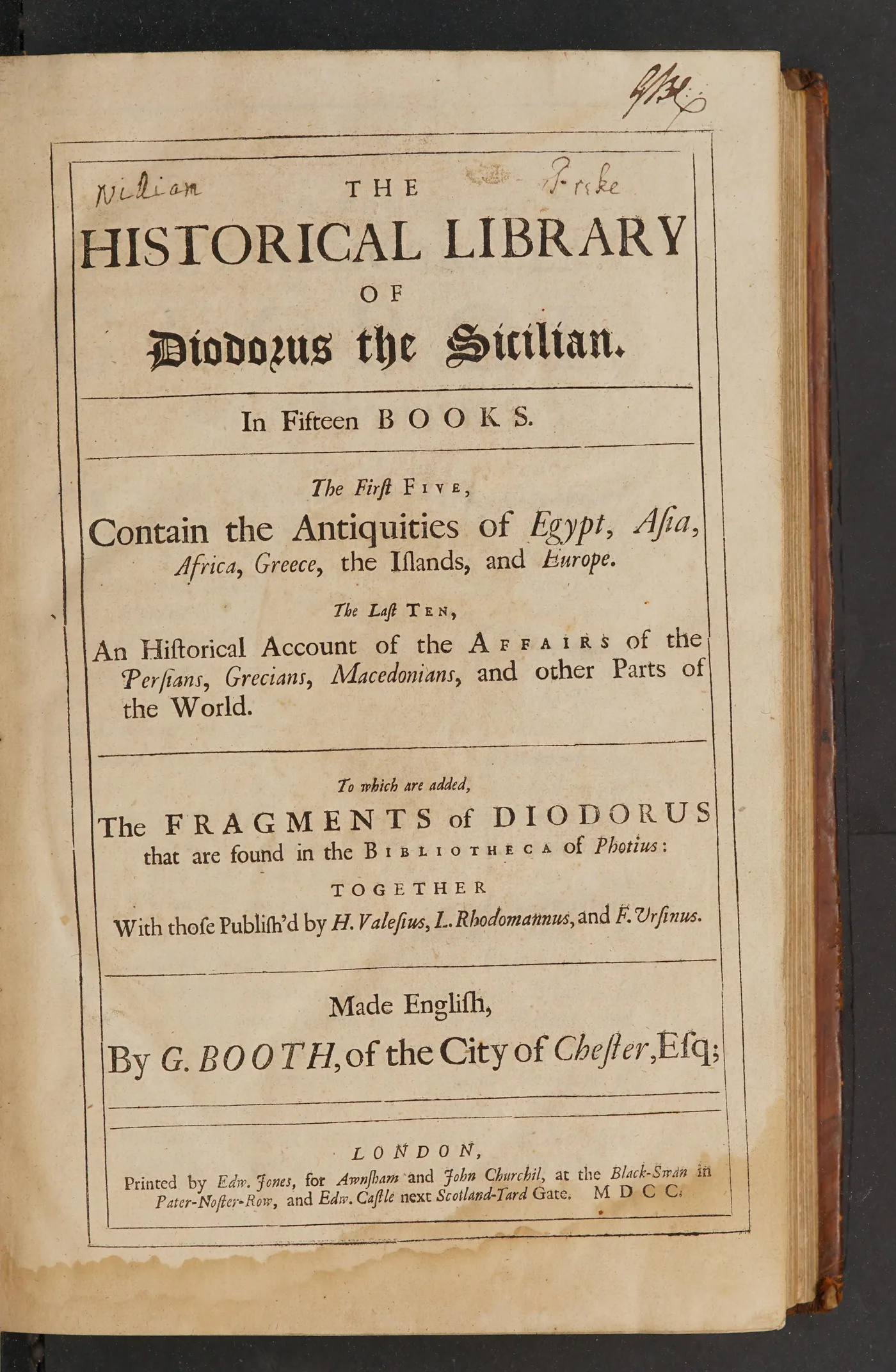
THE HISTORICAL LIBRARY OF Diodorus the Sicilian.
In Fifteen BOOKS.
The First FIVE, Contain the Antiquities of Egypt, Asia, Africa, Greece, the Islands, and Europe.
The Last TEN, An Historical Account of the AFFAIRS of the Persians, Grecians, Macedonians, and other Parts of the World.
To which are added, The FRAGMENTS of DIODORUS that are found in the BIBLIOTHECA of Photius: TOGETHER With those Publish'd by H. Valesius, L. Rhodomannus, and F. Ʋrsinus.
Made English, By G. BOOTH, of the City of Chester, Esq;
LONDON, Printed by Edw. Jones, for Awnsham and John Churchil, at the Black-Swan in Pater-Noster-Row, and Edw. Castle next Scotland-Yard Gate. M D C C.
TO THE RIGHT HONOURABLE GEORGE, Earl of Warrington.
THIS Translation of Diodorus, (the Fruits of some vacant Hours,) when first attempted, was as early design'd by a Dedication to be shrowded under the Shelter and Protection of Your Lordship's Honourable Father, whose Publick Spirit ever prompted him to those Generous and Worthy Actions, (without Self-seeking,) that might any ways Advance and Further the Publick Good, in the Preservation of the Peace and Happiness of his Country. Besides the Honour of his particular Respect to my self, his Noble Imitation of the Patterns of Virtue here presented, so far Encourag'd me, as not in the least to doubt of a Favourable Acceptance; especially from him who breath'd (as it were) the same Spirit and Soul with those Noble Hero's (that are long since gone) for the Defence of the Laws and Liberties of his own Country, as they in their several Generations did in theirs. As Your Lordship therefore is an Immediate Branch of that Honourable Stock, and next in Succession to his Estate; so I hope, and have great Reason to believe his Virtues, and Generous Qualifications, as well as his Honour and Lands, are Your Lordship's Inheritance: In Confidence therefore of the like Acceptance, as from him, I intreat Your Lordship's Favourable Entertainment of this Greek Stranger, (now Cloath'd, as well as I could, in an English Dress.) He'll be no Burthen, but a Diverting and Profitable Companion, useful not only to the Expert General, and Honest Statesman, but to all Degrees for a Prudent Conduct of their Lives, by Examples of other Mens Harms. In all which Respects, that it may be Serviceable to the Publick, and, as such, Accepted and Approv'd by Your Lordship, is the Ambition of,
MY LORD,
Your Lordship's Most Affectionate Kinsman, And Humble Servant, G. BOOTH.
TO THE READER.
SO many are the Encomiums of History, both by Ancient and Modern Authors, that little or nothing can be further added to what is already extant upon that Subject; and therefore I shall wave troubling my Self or the Reader with Discourses of that kind, but leave every Judicious Person to his own Experience, which is the best Judge, and will give the surest Testimony to the Truth of these Commendations. He that rests barely in the Matter of Fact related in History, pleases his Fancy for a Moment while he is Reading, but never Improves his Judgment to make it Usefull in Conversation, or in the Management of Publick Affairs. He gains no more than Children by hearing a Winter Tale, and Strange Stories of this brave Hero, and that mighty Giant, who did Wonders in the Land of Ʋtopia. The Profitable Reader is He that not only seeks to please his Fancy, but makes use of his Reason in observing chiefly the Wonderful Providence of God, in Ruling and Governing the World in all Ages to this day; His Setting up, and Pulling down of States, Kingdoms and Empires in certain Periods of Time; His Justice in punishing Wickedness, and therein the Confirmation of his Truth and Holiness; to see and consider his Wisdom, in Ordering and Disposing of one Event for the Effecting of his Purpose in another. To observe the Causes, Progress, and End of this or that Accident, this War, that Revolution, this Success and that miserable Disaster, are the main and chief Ends and Designs of Reading of History; whereby the Understanding and Memory are not only furnish'd with Notions of Things done, and long since past; but the Judgment is improv'd with that Moral Prudence (and sometimes Religious too) as to be careful to avoid the Rocks others have before split upon; and to imitate the Virtue and honourable Actions of others, (at least for the sake of Reputation that attends upon them in this World.) Here may be found Examples which may justly put Christians to the Blush, who come not up to the Moral Virtues of poor Heathens heretofore famous (upon that account) in the Ages wherein they liv'd; as Themistocles for his Faithfulness to his Country, Aristides for his Justice, Scipio for his Chastity, Cato for his Sobriety, and several others for Eminent and Virtuous Qualifications. As to this present Author, and his History, he's well known among the Learned to be a Treasury of Ancient History. Amongst others, Henry Stephen, in his Tract of Diodorus, gives him this honourable Encomium: Quantum Solis lumen inter Stellas, tantum inter Omnes, quotquot ad nostra tempora pervenerunt, Historicos (si utilitas potius, quam voluptatis aurium habenda est ratio) noster hic Diodorus eminere dici potest. And Justin Martyr, and some others, call him the most famous Author of all the Greek Historians. Amongst other Excellencies of this Author, he is peculiarly observable to have a Regard and Respect to the Providence of God in the Affairs of the World; and is the Only ancient Author that takes notice in the Course of his History of the Times, wherein the most famous Historians, Philosophers and Poets flourish'd. Our Author himself liv'd about Threescore Years before our Saviour's Birth, in the time of Julius Caesar, and the Reign of Augustus; and writ a General History from the beginning of the World to his own time, in Forty Books call'd the Historical Library, of which only Fifteen are extant, the rest lost by the Injury of Time. The Five first are properly the Mythological Part of the History, more incertain, and full of Egyptian and Grecian Fables; but very useful for the Understanding of Ancient Authors, and the Knowledge of the Assyrian Monarchy. They give an Account of the Affairs of the World from the Beginning of Time (known to the Heathens) to the Trojan War exclusively: The Five next in order are perish'd, which is the reason the Eleventh Book immediaelty follows, which begins with the Expedition of Xerxes into Greece, and from thence the History is continued in Five Books to the beginning of the Reign of Philip King of Macedon, Father of Alexander the Great; and from the Reign of Philip in Five more, to the Expedition of Seleucus Nicanor in Capadocia, containing an Account of Things done for the space of 179 Years.
The Books are divided into Chapters, for the Ease of the Reader, who may thereby the better Pause and Breath when he thinks fit; and to supply a Chronological Table in the Ten last Books, the distinction of Times is observ'd in the Margin, both by the Olympiads, and the Christian Aera; for the Relations in the first Five Books, were long before the Olympiads began, and the History is so ancient, that the certain Times of Persons and Things there related, are for the most part unknown or very uncertain.
To the present Translation, is added that of the Excerpts or Pragments of some of those Books of Diodorus Siculus that are lost, Collected by Photius in his Bibliotheca, and by others, annexed at the end of the Edition of Diodorus Publish'd by Rhodomannus. You have here likewise a further Addition of Valesius his Excerpts, Publish'd by him in the Year of Our Lord 1634.
After the Fragments, there's a Supplement taken out of Quintus Curtius and Arrianus, to fill up a great Chasm in Diodorus, lib. 17. p. 557. where that part of his History is lost. As those Authors had their Materials from him, (as is not doubted among the Learned) so 'tis but a piece of common Gratitude to help him over the Ditch by a Staff made out of his own Pile. That the Matter contained in this Supplement is that which is wanting in Diodorus, is apparent not only from some Part of the broken History that is there, but from the Index immediately before the 17th Book in Rhodomannus's Edition, where the Heads of the Subject Matter are to be found in their Order together, but nothing of 'em in the Body of the History. The said Heads are placed over every distinct Subject in the said Supplement.
But as to the Translation of the Whole, it may be very well expected some Apology should be made, or Reason given, for Translating the Five first Books, which appeared in the English Tongue above Forty Years ago. To give therefore Satisfaction in that Particular, we can truly and sincerely say, it was not undertaken without some Regret, not willing to seem a captious Censurer of other Mens Labours; therefore to obviate that Suspicion, we are willing to be an Advocate to excuse what was before done in this Kind, as to those Five Books; for the Errors and Defects that appear in the former Translation, are chiefly occasion'd by an old Latin Edition of Diodorus, whereunto the Translator wholly apply'd himself, having at that time (without doubt) no better an Edition to direct him. At the first it was design'd to have spar'd so much time, because they had been before Translated, but often hearing the former Censur'd, and a new Translation desir'd of those Five Books (which thro' a Mistake are divided by the old Latin Edition into Six, by taking the First Book to be two, because it's in two Parts) we were the more inclin'd, and at length resolv'd to endure the Toil, tho' withal we might, perhaps, fall under Censure, in undertaking to Reform the Errors of another, and yet prove as much, if not more Faulty in the same Things our selves.
But whatever it be, here we Present it to the Judgment of the Ingenuous Reader, together with the other Books, intreating him to accept what he Judges worthy his Approbation, and, with a Favourable Censure, to pass by the Errors and Mistakes he may espy in the Perusal. As for the Carping Momus, if the whole were in all respects Exact and Compleat, (which were a Vanity to pretend,) it were far more likely from such to meet with a Cavilling Sarcasm, than to be Indulg'd with any Favourable Acceptance.
Note: The Pages plac'd in the Margin, are the same with Stephanus his Edition, to which Authors generally refer; and by these, any thing may be readily found in Rhodomannus his Edition.
Note also: That from Page 1, to Page 69, and also from Page 508, to Page 640, there wants (by Mistake of the Press) the Pages in the Margin that refer to the Greek Copy.
ERRATA.
PReface, Book 1. Line 29. read the return of the Heraclides. Page 1. line 25. for is, read and. p. 2. l. 19. r. incredible. p. 8. l. ult. r. every place. p. 10. l. 12. r. Mysteries. p. 12. l. 36. r. at Nysa in Arabia. p. 54. l. 36. r. Success. p. 63. l. 45. for not, read hot. p. 70. l. 1. for Jupiters, r. Interpreter. p. 71. l. 34. add these words, and then followed Arsaeus, who reigned 40 years. p. 91. l. 3. r. along. p. 127. in the Margin, for 1688. r. 1288. p. 133. l. 5. r. lurrying. p. 147. l. 41. r. dropt him. p. 148. in the Margin, r. before Christ 1254. p. ibid. l. 49. r. Argo before he took her. p. 162. l. 12. r. Brothers. p. 169. l. 2. r. Teeth. p. 183. l. 1. for the Island, r. and. p. 206. l. 12. r. Themisteuein. p. 207. l. 28. r. God. p. 220. l. 45. dele they should. p. 234. l. penult. r. none of the. p. 246. l. 9. r. Some Authors say, that Xerxes. p. 255. l. 1. r. were freed. p. 260. l. 3. r. This Law. p. 267. l. 1. r. Wreaths. p. ibid. l. 10. dele had. p. 269. l. 17. r. in it much. p. 274. l. 29. r. second time. p. 282. l. 34. r. Creek Criseus. p. 293. l. last save 4, r. subjoin'd. p. 299. l. 10. r. premising. p. 312. l. 39. r. if we are. p. 314. l. 11. for trusts, r. suggests. p. ibid. l. 37. r. was here. p. 319. l. 17. dele his. p. 332. l. 46, 47. r. was new possessed. p. 336. l. 37. r. sent to by. p. 347. l. 17. r. the sole. p. 350. l. 13. r. and the taking up of the. p. 362. l. penul•. dele with. p. 363. l. 9. for new, r. now. p. 364. l. 6. r. Etna. p. 366. l. 41. r. Chirosophus. p. 379. l. •1. r. Marius. p. 189. l. 19. aole because. p. 432. l. 1. r. this their Army. p. 474. l. 19. r. for he had. p. 481. l. antepenult. dele was by. p. 486. l. 40. r. straiten'd. p. 499. in the Contents, r. Hermias. p. ib. l. 45. dele of. p. 509. l. 19. r. set upon. p. 512. l. 3. r. baffling. p. 517. l. 42. r. Ariobarzanes. p. 517. l. 53. r. Cleomantis. p. 532. l. 2. r. Towers and two Flankers, p. 535. l. 50. r. Antixyes, and Rheomitres. p. 545. l. 39. r. encounter. p. 556. l. 9. r. sent against him. p. 562. the 7th l. from the bottom, r. Four thousand. p. 568. l. 14. r. the River. p. ibid. l. 16. r. in a Line. p. 578. l. 12. r. by his Messengers. p. ibid. l. 36. r. when the Ambassadors. p. ibid. l. 37. dele yet. p. 588. l. 7. r. at stake. p. 624. in the Margin, r. 〈Greek〉; and 〈Greek〉. p. 627. l. ult. dele the first and. p. 629. in the Margin, r. seven Quarts. p. 638. l 31. r. upon his. p. 652. l. 17. r. the return. p. 663. l. 4. dele of. p. 665. l. 27. add the. p. ibid. l. 34. r. settle. p. 666. l. 7. r. near his Quarters fortified his. p. 680. l. 25. r. into. p. 683. l. 47. for But, r. Out. p. 693. l. 13. r. by Cables. p. 700. l. 1. r. forc'd them. p. 702. l. 38. r. Colophonians. p. 782. l. 3. r. Tryphon's Name. p. ibid. legat. 34. r. Saturninus. p. 784. line 31. r. too little to be. p. 785. l. 40. r. join'd with them. p. 786. l. 45. add above. p. 790. l. 34. add the. p. 794. l. 5. r. which were. p. 796. l. 21. dele the second his.
THE CONTENTS Of the First Five Books of Diodorus the Sicilian.
Chap. 1. OF the first Generation of Men. How the World first began. Mens first manner of Life, and who were the first Men. First Men in Egypt. Who were the most ancient Gods of Egypt. Of their Demi-Gods. Sol, Saturn, Rhea, Jupiter, Juno, Vulcan, reign'd in Egypt. Of Osiris and Isis. the Acts of Osiris and Isis. Hermes his Inventions. Osiris prepares for his Expedition through the World, and to that end raises a great Army. Page 1
Chap. 2. The Continuation of Osiris his Expedition through Ethiopia; all Arabia, India, and Europe: Bury'd by Isis and Mercury. How he was kill'd. His Death reveng'd by Isis and Orus. Two Bulls, Apis and Mnevis, worship'd in Egypt. Places discuss'd where Osiris and Isis were bury'd. Stories of the Egyptian Priests. Their Tears, Lunar Tears, Giants, Laws about Marriage. Osiris and Isis, their Pillars and Inscriptions. Colonies out of Egypt. 7
Chap. 3. The Description of Egypt. Of the Lake of Serbon. The Nature of the River Nile. The Cataracts. The Mouths of Nile. The Fruits of Egypt. The Beasts, Crecodile, &c. Several Opinions concerning the Inundation of Nile. 14
Chap. 4. The first way of Living of the Egyptians: Gods and Demi-Gods, their Reigns in Egypt. The ancient Kings of Egypt, Moenis, &c. Their several Works. Thebes built by Busitis. The stately Sepulchres, Obelisks, and Temples there. A Description of Osymanduas his Sepulchre. Memphis built by Uchoreus. Moeris his Lake. Sesostris or Sesoosis, his famous Expedition, and great Works. 22
Chap. 5. The Acts of Sesostris the Second: Of Ammosis, Actisan, Mendes, Proteus or Cetes, Remphis, Chemmis, (the great Pyramids built by him:) Cephres, Mycerinus Bocchoris, Sabach. The Reign of Twelve Kings in Egypt. Psammeticus Saites, one of the Kings, gain'd the whole; Two hundred thousand of his Army forsake him, and settle thmeselves in Ethiopia. Apries succeeds long after. Amasis rebels, and next succeeds; and Apries is strangled by the People. Amasis the last King, to the time of the Conquest of Egypt by Cambyses. 31
Chap. 6. The Customs of the Egyptians. Of their Kings: As their hourly Employment, Sacrifices, Diet, &c. Burials. Division of Egypt. Their Trades in Egypt. Courts of Justice; their Law-Proceedings. The several Laws of Egypt; Beasts and Birds ador'd as Gods in Egypt, as Lions, Wolves, Cats, the Bird Ibis, Kites, &c. Costs in their Burial of these Creatures. Reasons given of this Adoration. 36
Chap. 7. Why the Crocodile is worship'd? Some sorts of Herbs and Roots not eaten. Why other Creatures are worship'd? The manner of their Burials. The Law-makers in Egypt. Learned Men of Greece made Journeys into Egypt, as Orpheus, Homer, Plato, Solon, Pythagoras, &c. Several Proofs of this, as their Religious Rites, Fables, &c. in Greece of Egyptian Extraction. The exquisite Art of the Stone-Carvers in Egypt. Page 46
Chap. 1. NInus, the first King of Assyria, his Acts; invades Babylonia, Media, and over-runs several other Countries. Nineveh built by him; the Description of it; Marries Semiramis; Her Descent. Derceta, the Philistines Dagon. His Expedition against Bactria; He dies. Semitamis builds Babylon, and several strange Works there, as a Passage under Water, Jupiter's Temple, &c. Hanging Gardens in Babylon. A vast Stone cut out. The strange Property of a Morass. Her several Expeditions. The wonderful Lake in Ethiopia; Their Burials there. Semiramis's Expedition into India; Her Mock-Elephants. Her Expedition proves fruitless. She surrenders her Kingdom to Ninyas her Son: Her End. 53
Chap. 2. Ninyas succeeds Semiramis: His close and slothful manner of Life. The Reign of Sardanapalus: His Luxury and Effeminacy: His Epitaph: Deposed by Arbaces the Mede: And the Assyrian Empire overturn'd. Nineveh raz'd. 64
Chap. 3. Of the ancient Chaldeans, and their Philosophy. The Planets, and their Course. The Empire of the Medes, and their Kings. A Description of India. The ancient Manners and Customs of the People. Their Laws; Tribes; Description of Scythia. Of the Amazons. Of the Hyperboreans. 69
Chap. 4. A Description of Atabia the Desart. Happy, &c. Metals, Precious Stones, Beasts, &c. AD scription of Taprobana in the Southern Ocean, now call'd Ceylon or Zeilan: The strange Things there: How discover'd by Iambulus. 78
Chap. 1. OF the Ethiopians: Their Letters, Laws, Arms, Religion, Funerals: The Description of several Parts of the Country. Manner of making of Gold. Of the Icthyophages, their several sorts and ways of Living. 85
Chap. 2. Chelonophages: The manner of taking Sea-Tortoises: The Cetivores, or Whale-Eaters. The Sea-Coasts over-against Babylon; Their manner of taking of Fish. The Rizophages, or Root-Eaters. Those call'd Spermaphages, and Hylophages, Hylogones or Hunters, their taking of wild Beasts: The Elephant-Fighters; how they are taken: The Simoes, Struthophages, Acridophages or Locust Eaters; their miserable Deaths. Cynomolges. The Country of the Troglodites. Wild Beasts: The terrible wild Bull: Serpents; that great one brought alive to Alexandria. 94
Chap. 3. A Description of the Coasts and Countries on both sides the Arabian Gulf, or Red Sea. The Perfumes of Arabia the Happy. The Fortunate Islands. A Description of part of Lybia: The Spectras near the Syrtes. 102
Chap. 4. Of the Amazons of Africa: Their Acts: Rooted out by Hercules, and the Gorgonians by Perseus. The Atlantides, and the Gods among them. The Original of the Titanes. The Acts of Basilea, or Cybele, said to be born in Phrygia. The Original of Atlas and Saturn. A long Account given of Bacchus, and the several Bacchuses there were. The Description of the Grota in Nysa, where he was brought up. The building of the Temple of Hammon by him. The several Herculeses. The Monsters Aegides and Campes kill'd by Minerva and Bacchus. Page 110
Chap. 1. WHat the Grecians say further of Bacchus. The Story of Priapus. Of Hermophroditus. Of the Muses. The Birth of Hercules; and his Twelve Labours injoin'd him by Eurystheus. His wandring Expeditions through Africk, Spain, France, Italy, Sicily; His setting up two Pillars at Gades, and his other Acts by the way. The Story of Orpheus. 127
Chap. 2. An Account of Atlas, and his Daughters call'd Atlantides and Hesperides. Amazons routed by Theseus in Attica. The further Acts of Hercules; goes against Laomedon King of Troy, and other Acts. The Story of Meleager Son of King Oeneus. Amalthae's Horn. Hercules his further Acts: His Death by a poison'd Shirt. 141
Chap. 3. Of the Argonauts, Medea and the Daughters of Pileus. How the Argonauts gain'd the Golden Fleece. The Pranks of Medea. The Acts of Jason. The Cruelty of Pelias towards Jason's Kindred; How he was kill'd by his Daughters through Medea's Charms. Medea burns the King of Corinth's Palace, and him in it. The miserable End of Jason. Of the Heraclidae, and their return to Peloponnesus. 148
Chap. 4. The Acts of Theseus: The Minotaur in Crete: Androgeos, the Son of Minos murder'd by Aegeus. Ariadna, Daughter of Minos, in love with Theseus; Ariadna's Crown. Aegeus, King of Athens kills himself. Theseus his Death. The War of Thebes by the Seven Captains. The Epigoni renew the War. Pedigrees of the Heroes at Troy: Of the Centaurs, and Lapithae. The Pedigrees of Aesculapius, Aeacus, Ajax, Pelops, Tantalus, Oenomeus; Dardanus his Posterity to Priam King of Troy. 159
Chap. 5. Of Daedalus and his Works in Crete, Sicily, and elsewhere. His Flight into Sicily; Minos invades Sicily; The manner of his Death there. The Famous Temple of the Curetes or Corybants in Sicily, built by the Posterity of the Cretians that came there with Minos. The Pedigree of Aristaeus; his Acts; his Son Actaeon. Of Eryx: Venus her Temple in Eryx in Sicily; the Fame of it. Of Daphnis the Shepherd; a Description of the Herean Mountains. Of Orion. Of the Straight of Messina. 168
Chap. 1. A Description of Sicily: The Aeolide Islands, or Lipari Islands; Of Malta, Gaulus, Cercina, Corsica, Sardinia, Pityusa, and the Baleares. 176
Chap. 2. Of Madera, Britain, Gallia, Celtiberia, Iberia, and Tyrrhenia; and of the Inhabitants, and their Laws and Customs. 184
Chap. 3. Of Gredosia: Of the Isles of the Arabian Sea: Of the Holy Island: Of Panchaea: Of Samothracia: Of Naxus, Syme, Nausus, Calydna, Nisyrus, Carpathus. Of Rhodes, and of Chersonesus. 194
Chap. 4. Of Crete; The first Inhabitants: Of the Idaei Dactyli; Of Jupiter, Saturn, Hyperion, Prometheus, Mnemosyne, Themis, Ceres, Neptune, Pallas: Jupiter's Race, as the Muses, Vulcan, Mars, &c. Of the ancient Hercules, Britomartis, Pluto, Rhadamanthus his Justice. Of Lesbos; Deucalion's Flood: Of the Blessed Islands; Of Tenedos, and the Cyclades. 204
THE CONTENTS Of the Last Ten Books of Diodorus the Sicilian,
Chap. 1. OF Xerxes his Expedition into Greece; and the Fight at Thermopyle, and Sea-Fight at Salamis. Page 215
Chap. 2. How the Carthaginians invaded Sicily, and were routed by Gelon: And the time of Pindar the Poet. 226
Chap. 3. The Victory of the Greeks over Mardonius at Platea. 230
Chap. 4. Of the Fight with the Persians by the Grecians at Mycale in Ionia. Herodotus ends with this Fight, and taking of Sestos. 233
Chap. 5. The Death and Commendation of Gelo of Syracuse, and the Rebuilding of Athens by the Policy of Themistocles. 235
Chap. 6. The enlarging of the Haven at Athens by Themistocles. The Treason of Pausanias; And the Justice of Aristides. 237
Chap. 7. Hiero, King of Sicily, prepares to besiege Agrigentum; Discovers the Treason of them of Himera to Thero their Prince; Expels the Cataneans and Naxians. 240
Chap 8. The Lacedemonians quarrel with the Athenians for the Dominion of the Sea. 241
Chap. 9. Hiero breaks the Power of the Hetruscans by Sea. 242
Chap 10. The War between the Tarrentines and the Japigians. ibid.
Chap. 11. The Death of Thero Prince of Agrigentum, and the Tyranny of his Son Thrasydeus, who abdicated the Government, and kill'd himself. Three hundred of the Family of the Fabii slain at one time. 243
Chap. 12. The Malice of the Lacedemonians against Themistocles, and his Banishment: His Praise. 244
Chap. 13. Cymon, the Athenian General, gains many Places for the Athenians: Routs the Persians by a Stratagem at Eury medentum. 247
Chap. 14. A great Earthquake in Sparta; The War upon them by the Helots and Mycenians. 248
Chap. 15. The War between the Argives and the Mycenians. 249
Chap. 16. The Death of Hiero. 250
Chap. 17. Thrasybulus, King of Syracuse, depos'd by force of Arms for his Tyranny. 250
Chap. 18. The Murder of Xerxes by Artabanus. 251
Chap. 19. The War between the Athenians and Aegineaus. 252
Chap 20. The Egyptians revolt from the Persians. New Troubles in Sicily. ibid.
Chap. 21. Persians Expedition into Egypt. Wars in Sicily. 254
Chap. 22. The War between the Epidaurians and Athenians. Page 255
Chap. 23. The War between the Corinthians and Megareans. 256
Chap. 24. The War between the Athenians and Boetians. 257
Chap. 25. The Athenians invade the Spartans by Tolmides. 258
Chap. 26. The War in Sicily between the Aegestines and the Lilybeans. The Custom of Writing upon an Olive Leaf the Names of such as were to be banish'd in Sicily, call'd Petalism. 259
Chap. 27. Pericles makes an Inrode into Peloponnesus: Besieg'd Sicyon. Phaylus in Sicily made Admiral against the Tyrrhenian Pirates: Is corrupted and banish'd. The Original of the Palici: And the Stories of the Temple, and Wonders of the Craters in Sicily. 260
Chap. 28. The Contests between Deucetius and the Agrigentines. His strange Submission to the Syracusians, who sent him to Corinth, with Promise to supply him with Necessaries. 262
Chap. 1. CYmon the Athenian Admiral, his Expedition into Cyprus. Peace concluded between the Persians and Athenians. Cymon dies in Cyprus. 264
Chap. 2. Megarians revolt from the Athenians, and are beaten. The Athenians revolted at Cheronea by the Beotians. Many Cities revolt. Peace concluded. 265
Chap. 3. The War between the Agrigentines and Syracusians in Sicily. The War between them of Crotona and the Siberites. Sibaris raz'd. The building of Thurium: Charondas his good Laws in Thurium: His remarkable Death. The Laws of Zaleuchus of Locris. 266
Chap. 4. Of the Decemviri in Rome chosen to make Laws. War between the Thurians and Tarentines. A sad Story of the Daughter of one Lucius Virginius in Rome, which caus'd a Disturbance and great Sedition. Law of the Twelve Tables. Peace all over the World. 272
Chap. 5. War between the Samians and Melesians. A Sedition in Samos, which revolts from the Athenians. War in Sicily by the Syracusians against the Trinacrians 273
Chap. 6. Corinthian War against Corcyra. Potidea revolts from the Athenians. Quarrels in Thurium. Meton's Year. Heraclea in Italy built. Potidea besieg'd by Phormio. 275
Chap. 7. Of the Peloponnesian War. Potidea revolts; besieg'd by the Athenians, and is surrendred upon Articles. Nicias made the Athenian Admiral. Gorgia, an excellent Orator, sent from Leontine in Sicily to Athens. A Peace concluded, after the War had continu'd ten Years. 278
Chap. 8. Continuation of the Peloponnesian War. War by the Romans against the Fidinates, for putting their Ambassadors to death. Quarrels between the Aegistines and the Selinuntines in Sicily. Expedition of the Athenians against Sicily under Nicias, being the 16th Year of the Peloponnesian War. 293
Chap. 1. THE Athenian Fleet equipp'd out for Sicily. Alcibiades accus'd: Flies: Is condemn'd: Goes to Sparta out of Italy. Syracusians send for Aid to Lacedemon: Gylippus is sent to them. Battel at Syracuse. 300
Chap. 2. The Lacedemonians invade Attica. Fight at Sea between the Syracusians and Athenians. Eurimedon and Demosthenes arrive in Sicily. A Plague in the Athenian Camp. Another Fight between the Syracusians and Athenians; the latter routed at Sea: The Athenians ruin'd in Sicily: Nicholaus his long Oration; Gylippus his Answer. Page 303
Chap. 3. Diocles instituted Laws for Sicily: Suffer'd by one of his own Laws. Three hundred appointed to Govern in Athens Athenians beaten at Sea by the Lacedemonians at Oropus. Alcibiades recall'd from Banishment. 315
Chap. 4. The Government by Four hundred abrogated in Athens: The Victory by the Athenians over the Lacedemonians at Sea, between Sestus and Abydos. The Persian Garrison driven out of Antandris by the help of the Lacedemonians. Twenty two years of the Peloponnesian War ended. Here Thucydides ends his History. 317
Chap. 5. Commotions in Sicily. Carthaginians invited thither by the Aegistines. A Sea-Fight at Dardanum between the Athenians and Lacedemonians. A Sedition in Corcyra. The Sea-Fight at Cyzicum; and at Cleros by Land, wherein the Athenians were Victors. 320
Chap. 6. The Spartans seek for Peace. The Speech of Endius. The Athenians refuse. 325
Chap. 7. Hannibal the Carthaginian invades Sicily. The miserable Destruction of Selinunte. The Ruin likewise of Himera. The Acts of Hermocrates in Sicily. 326
Chap. 8. Thrasybulus assaults Ephesus. The Lacedemonians besiege Pylus; and surrendred. Calcedon besieg'd by Theramenes; and afterwards Byzantium, which was betray'd to Alcibiades. 331
Chap. 9 Theramenes and Alcibiades return to Athens; are admir'd by the People. Lysander made General by the Lacedemonians. Antiochus, one of the Athenian Generals, beaten at Ephesus in a Sea-Fight. Agis surprizes part of the Walls at Athens, but was beaten off Alcibiades accus'd for assaulting Cuma, a Confederate City. Conon made Admiral in his Place. 333
Chap. 10. Hermocrates kill'd at Syracuse, attempting to surprize it. 336
Chap. 11. The Acts of Callicrates, the Lacedemonian General. The Fight at Sea in the Harbour at Mitylene, between Conon and Callicratides. 337
Chap. 12. Therma built in Sicily by the Carthaginians; They raise Forces to invade Italy: They land in Sicily. The noble Temple in Agrigentum: The ancient Grandeur of that City: The Riches of Gellias, a Citizen there, and some others. Agrigentum besiege'd. The Syracusians under Daphneus rout the Carthaginians near Agrigentum. Imilcar seizes the Syracusian Fleet, and takes all the Provision going to Agrigentum, which was afterwards quit by the Inhabitants: Their miserable Condition. The Phalarian Bull. 339
Chap. 13. The Syracusian Officers accus'd. Dionysius made General of the Syracusians: He moves to have the Exiles recall'd: He's invested with the sole Command: At length by several Artifices gains the Sovereignty. 345
Chap. 14. The famous Battel of Argineuse at Sea, wherein the Athenians were Victors: The Officers accus'd for not burying the Dead. The Speech of Diomedon. The Death of Sophocles and Euripides. 348
Chap. 15. Lysander made sole Admiral of the Lacedemonian Fleet: He takes Caramium. The Ruin of the Athenian Fleet at Aegos Potamos. Athens taken by Lisander. The end of the Peloponnesian War. 352.
Chap. 16. Agrigentum sack'd by Imilcar the Carthaginian. The Carthaginians besiege Gela. Dionysius goes to the Aid of Gela. The Skirmishes before Gela. Camarina deserted by order of Dionysius. The Soldiers enrag'd at Dionysius: He hastens to Syracuse. Imilcar makes Peace with Dionysius, and returns to Carthage. The end of the first Carthaginian War with Dionysius. 354
Chap. 1. A Peace between the Athenians and Lacedemonians. The Athenians disagree about the manner of their Government; The Government by 30; The Cruelty of the 30 Tyrants, and especially towards. Theramenes. Page 358
Chap. 2. Dionysius his Project to strengthen himself in the Sovereignty of Sicily. Syracusians revolt; are dispersed. 360
Chap. 3. Lacedemonians establish an Oligarchy in every City. Dionysius disarms the Syracusians. Alcibiades kill'd; manner of his Death. Clearchus his Tyranny in Bizantium; the Battel at Porus by him against his Countrymen the Lacedemonians. Lysander's Project to out the Heraclidae of the Sovereign Power. 361
Chap. 4. Dionysius his Actions in Sicily. The Oropians subdu'd by the Thebans. The Lacedemonians quarrel with the Elians. Dionysius fortifies the Epipodae. 364
Chap. 5. The War between Cyrus and his Brother Artaxerxes King of Persia. Cyrus Routed. The Grecian Forces in Straits: their brave Behaviour: and long and troublesome March out of Persia into Greece. 366
Chap. 6. Thrasybulus opposes the 30 Tyrants. The cruelty of Psamnificus King of Aegypt, towards his old friend Tamos that fled to him for succour from the Persians. Darcyllidas sent General against the Persians into Asia. Conon made Admiral of the Persian Fleet. 373
Chap. 7. The War between the Rhegians and Dionysius. He prepares to make War upon the Carthaginians. Most of the Cities submit to Dionysius. He returns to the Siege of Motya: Taken. Forces sent from Carthage against Dionysius. A Sea-fight between the Carthaginians and the Sicilians. Syracuse besieg'd. The Speech of Theodorus against Dionysius. A greivous Plague in the Carthaginian Army. A great Destruction of the Carthaginian Fleet in the Harbour of Syracuse. The miserable Condition of Imilco in his own Country. The Troubles of the Carthaginians. 376
Chap. 8. Agesilaus made General against the Persians by the Lacedemonians, goes to Ephesus: They send to the King of Egypt for Assistance. The Persians routed at Sipylus by Agesilaus. Tissaphernes his head cut off in a Bath at Larissa. The War between the Phoceans and Boetians. 392
Chap. 9. The Confederate War by the Argives and others against the Lacedemonians. The Battel at Aricas The fight at Nemea. Pisander the Lacedemonian Admiral routed in a Sea-fight at Cnidus by the Persian Fleet, commanded by Conon the Athenian. The Corinthian War against the Lacedemonians, and the great Sedition there. 394
Chap. 10. The Quarrel between the Rhegians and Dionysius. Mago the Carthaginian settles Affairs in Sicily. Routed at Abacena by Dionysius. Rhegium near surpriz'd by Dionysius. The Acts of Iphicrates at Corinth, Plias, and Sicyon. Amyntas lost his Kingdom of Macedonia, but was restor'd. The Romans take Veii: Dedicate a Golden Cup to Apollo. Their Ambassadors are taken by the Pyrats of the Lipari Islands, but discharg'd by Timastheus. 396
Chap. 11. The Acts of Thrasybulus the Athenian General. The Carthaginians under Mago begin a new War in Sicily against Dionysius. A Peace concluded. Rodes falls off from the Athenians. Evagoras becomes King of Salamis in Cyprus, makes War against the Persians. The Acts of Thimbro the Lacedemonian General in Asia. 398
Chap. 12. Dionysius his Expedition against Rhegium. The War between the Lucanians and Thurians in Italy. The Thurians cut off by their own Rashness. Leptines generously sav'd those that swam to his ships, tho' he was a Friend to their Enemies. Dionysius his second Expedition into Italy: besieges Caulonia, and routs Heloris. Makes Peace with the Rhegians. Razes Caulonia to the ground, and transplants the Inhabitants to Syracuse. Watches an occasion to be reveng'd on them of Rhegium. Besieges it. He sends rich Chariots to the Olympick Games. His Poetry ridicul'd. 401
Chap. 13. The Peace of Antalcidas. The War by the Persians against Evagoras in Cyprus. The miserable Condition of Rhegium. Surrendred. The cruel Usage of Philo the Governor of Rhegium, and of his Son. The Expedition of the Galls against Italy. The Romans routed by the Galls at the river Allia. Rome taken by the Galls. Romans besieg'd in the Capitol. The Volsci revolt from the Romans. The Galls routed by Marcus Furius in their Return. All cut off afterwards in the Plains of Trausium. 404
Chap. 1. THE Preface. Artaxerxes Expedition against Evagoras in Cyprus. The Actions there at Sea and Land. The Lacedemonians begin new Quarrels in Greece. As first with Mantinea. Dionysius gives himself to Poetry. Peace concluded with Evagoras by Orontes the Persian General. Terabazus brought to his Trial. Judgment upon corrupt Judges. Terabazus acquitted. 409, 410
Chap. 2. Mantinea besieg'd by the Lacedemonians. Dionysius aims to gain the Islands of the Adriatick Sea. The Parii built Pharos. Dionysius his Expedition into Hetruria. Prepares for War against the Carthaginians. The Sicilians routed at Cronion. The Quarrel between the Clazomenians, and them of Cuma about Leuca. The War between Amyntas and the Olynthians. The Lacedemonians seize the Citadel. Cadmea at Thebes. Eudamidas breaks into the Olynthians Country. 414
Chap. 3. Polypidas sent General by the Lacedemonians against the Olynthians. A great Plague in Carthage. The Boetian War. Cadmea retaken. A Confederacy of the Cities against the Lacedemonians. Cleombrotus attempts to surprize the Pyreum at Athens. The Athenians seize Actea in Eubaea. Agesilaus enters Boetia. The Sea-fight at Naxus. 418
Chap. 4. The Treballians make Incursions into Thrace. Chabrias the Athenian General assassinated. The Thebans rout the Spartans at Orchomena. Artaxerxes seeks to make Peace among the Grecians. Peace concluded. Thebans only disagreed. The Commendation of Epaminondas. Seditions in several Cities of Greece. 423
Chap. 5. The Persians send an Army into Aegypt to reduce the Revolters. Iphicrates a skilful Commander. Sedition at Zacynthus. Platea raz'd by the Thebans. The Lacedemonians seize upon the Island Corcyra. The Siege of Corcyra rais'd by the Athenians under Cresides. Evagoras in Cyprus murther'd by an Eunuch. Dreadful Earthquakes and Inundations in Peloponnesus. A great Comet seen in Greece. 425
Chap. 6. Artaxerxes sends again to make Peace among the Grecians. All comply'd but the Thebans. The Spartans raise an Army against the Thebans. Epaminondas made the Theban General. The famous Battel of Leuctra. The terrible Seditions and Cruelites in Argos. Jason of Pherae stirs up the Thessalians to gain the Soveraignty of Greece. Polydore Prince of Pherea in Thessaly poyson'd by his Brother Alexander. Plots to depose Alexander. King of Macedonia treated with to that purpose. 429
Chap. 7. The Lacedemonians send Politropus into Arcadia: who is slain, and his Party routed by Lycomedes. An Invasion by Epaminondas and Pelopidas into Peloponnesus. Sparta besieg'd. The Antiquity and History of Messena in Greece. Pallane taken by Arcadians. A wall drawn between Cenchrea and Lechcum to hinder the Thebans inroad into Peloponnesus. Epaminondas breaks through into Peloponnesus. Assaults Corinth. 434
Chap. 8. Dionysius sends Galls and Spaniards to the assistance of the Lacedemonians. Pelopidas and Ismenias clapt up by Alexander Tyrant of Pherea. The Boetians pursu'd by the Phereans: brought off by Epaminondas then a private Soldier. The Fight between the Arcadians and Lacedemonians. Dionysius falls upon the Carthaginian Territories in Sicily. Dionysius dyes. The cause of his death. The cruelty of Alexander the Pherean at Schotusa. Epaminondas breaks again into Peloponnesus. Coos peopled and Wall'd. The end of the Laconick and Boetick War by the Mediation of the Persian King. 438
Chap. 9. New Stirs in Greece. The Battel between the Eleans and Arcadians near Lassion. The Quarrel between the Pisate and them of Elis about the Olympick Games. A Fight at the Time and Place of the Games. The Thebans prepare a Fleet in order to gain the Dominion at Sea. Rhodes, Chios, and Byzantium brought in to the Thebans by Epaminondas. The Thebans make War upon Orchomenon. The Reason Orchomenon raz'd. The Thessalians War with Alexander the Pherean. Pelopidas kill'd. His Praises. 441
Chap. 10. The War between the Tegeans and Mantineans, Boetians side with the Tegeans. Epaminondas made General. The Battel at Mantinca, where Epaminondas was kill'd, but the Lacedemonians routed. The Commendation of Epaminondas. 443
Chap. 11. A Defection from the Persians in Asia. Tachos King of Aegypt declares War against the Persians. The War between Tachos, and his Son Nectabanus. The death of Artaxerxes Mnemon. Agesilaus routs the Aegyptians that pursu'd him: and restores Tachos to his Kingdom: Stirs again in Greece after the Battel of Mantinea between the Megalopolitans and the neighbouring Towns. Peparethos besieg'd by Alexander of Pherea, He routs Leostenes at Sea. Charietes the Athenian Admiral his Villanies. 473
Chap. 1. PHilip an Hostage at Thebes: makes his Escape; beats the Athenians, after makes Peace with them, subdues the Peons, and routs the Illyrians, and makes Peace with them. 477
Chap. 2. The Actions of Dionysius the younger, in Sicily and other parts. Dion's Flight to Corinth, and his Return to Sicily. Andromachus peoples Tauromenum. The Civil Wars in Eubea. The Social War between the Athenians and other Nations. Philip takes Amphipolis and other Cities. His Policies to gain the Olynthians and other Places in Greece. 479
Chap. 3. Dion's March, and Entring into Syracuse. Dionysius comes to the Island part of Syracuse. Assaults the Wall erected from Sea to Sea: is beaten by Dion. Alexander of Pherea murdered by his Wife and his two Brothers. Philip relieves the Thessalonians from the two Brothers. 481
Chap. 4. The first rise of the Brutii in Italy. Dionysius his Admiral invades the Leontines. A Fight at Sea between Heraclides and Philistus Admirals, one of Dionysius, the other of Dion. A Faction in Syracuse. Dion leaves the Syracusians. Their sad Condition. Reliev'd by Dion. 484
Chap. 5. A Continuance of the Social War. Iphicrates and Timotheus join'd Admirals with Chrates by the Athenians. Iphicrates and Timotheus accus'd by Chrates, and fin'd and remov'd. Chrates joins with Pharnabasus and routs the Persians. The end of the Social War. Philip subdues the Confederates. 487
Chap. 6. The Beginning of the Sacred War, or Phocian War. Philomelus seizes the Temple at Delphos after he had routed the Locrians. How the Oracle at Delphos was first discover'd, and the beginning of the Tripode. The Athenians and others join with Philomelus. 488
Chap. 7. The Battel at Phoedra between Philomelus and the Locrians. The Parties ingag'd in the Phocian War. The Battel between the Beotians and Phocians. Philomelus kill'd Onomarchus made General. His Dream, Successes and Death. 490
Chap 8. Phayllus continues the Phocian War, Aryca raz'd. Phayllus dyes of a Consumption. War between the Lacedemonians and Megapolitans. Chaeronea taken by Phalecus. War between the Persians Aegyptians and Phenicians. Salamis in Cyprus besieg'd. The cruelty of Artaxerxes Ochus towards the Sidonians. The Calamity of Sidon. 494
Chap. 9. Evagoras beheaded in Cyprus. Artaxerxes marches against Aegypt; and gains all Aegypt by the Policy of Mentor. Lost many of his Men at the Lake Sorbonis. Mentor advanc'd. Mentor's Stratagem to subdue Hemias Prince of Atarne. Zena rais'd by Philip. The King of Aegypt abdicates his Kingdom and flyes to Aethiopia. 499
Chap. 10. Philip takes Olynthus and other Cities in the Hellespont. The Athenians jealous of Philip and instigated by Demosthenes. Philip's Policies. The value of the Riches taken out of the Temple at Delphos. Dionysius sent presents to Delphos, and were taken by the Athenians. His Letter to the Athenians. The Temple burnt. The end of the Phocian War. The Punishments decreed by the Amph•tyons against the Phocians. The Miseries of the Sacrilegers. Timoleon sent to Syracuse. 502
Chap. 11. Timoleons Expedition into Sicily. The Carthaginians Army in Sicily. Dionysius returns to Syracuse, is beaten by Hircelas; Hircelas gains Syracuse. Timoleon's escape from Rhegium. Timoleon routs Hircelas, and gains Syracuse. Philip invades the Illyrians. Dionysius expell'd. Timoleon makes good Laws. Philip invades Thrace. 508
Chap. 12. The Acts of Timoleon in Sicily. The Preparations of the Carthaginians against Timoleon. The remarkable Siege of Perinthus by Philip. Pexodorus expells his Brother Adam from the Principality in Cana. Byzantium suddenly besieg'd by Philip. 510
Chap. 13. The Athenians aid Byzantium. Philip raises his Siege. The Carthaginians transport Forces into Sicily. The remarkable Victory of Timoleon over the Carthaginians. The Acts of Timoleon in Sicily. The Works of Hiero in Sicily. 512
Chap. 14. Elata taken by Philip: great Consternation in Athens for fear of Philip. The Boetians join with the Athenians through the Solicitation of Demosthenes. Python a famous Orator. The Battel at Cheronea between Philip and the Athenians; Lycides the Athenian General put to death. Philip rebuk'd by Demades; made General of Greece. Timoleon dyes. 515
Chap. 15. Philip consults the Oracle at Delphos. Philip Marries his Daughter Cleopatra to the King of Epirus. Encourag'd to the Persian War by Neoptolemus his Verses. Philip's Pride. His Murder. The Cause of it, and how it was done, and by whom. 517
Chap 1. COnspiracies of the Cities against Alexander. The Athenians send Ambassadors to Alexander to beg Pardon. He's made General by the Amphictyons. Attalus kill'd by Alexander's Command. The Wickedness of of Bagoas. Darius commended. Raises Forces. A Description of Mount Ida. Alexander invades the Illyrians and others. Thebes besieg'd by Alexander and raz'd. The Miseries of Thebes. Prodigies. Alexander demands Demosthenes and others to be deliver'd up to him by the Athenians: their Answer. He returns into Macedonia: and Feasts his Soldiers. 521
Chap. 2. Alexander lands his Army in Asia. The Battel at Granicum. The Forces of the Persians and of Alexander. Alexander kills Spithrodates; near being kill'd by Rosaces. Miletus besieg'd and taken. Ada Queen of Caria meets Alexander. Halicarnassus Besieg'd, Taken, and Sack'd. The strange Act of the Macedonians. 528
Chap. 3. Mytelene taken by Memnon Darius his General; his Successes He dyes. Charidemus the Athenian unjustly put to Death by Darius. Alexander falls sick, recover'd by Philippus. Alexander seizes Alexander of Lyncestas upon his Mother's Letters. Alexander takes Issus. The Memorable Battel at Issus, where the Mother, Wife, two Daughters and Son of Darius were taken. Alexander's noble carriage towards them. Darius his Letters and Offers to Alexander. Darius prepares another Army. 533
Chap. 4. Alexander marches towards Aegypt; Besieges Tyre. Prodigies at Tyre. The Tyrians bind Apollo with golden chains. The Inventions of the Tyrians to defend themselves. The advancement of Ballomynus a poor Man to be King of Tyre. The Acts of Agis and Amyntas; Amyntas kill'd, and all his Soldiers. Alexander takes Gaza by Storm; presented by the Grecians. 538
Chap. 5 Alexander makes a Journey to the Temple of Jupiter Hammon. He's presented by the Cyreneans. The Description of the place about the Temple. The wonderful Properties of the Fountain Solis. The Building of Alexandria. Alexander's Answer to Darius his Ambassadors. Alexander passes over the River Tygris with great Hazard. The Preparations on both sides for Battel. The Persians routed at that famous Battel at Arbela. 542
Chap. 6. The Grecians conspire to Revolt. Memnon rebels in Thrace. Antipater marches against him. The Lacedemonians raise an Army; are routed by Antipater, and Agis their King kill'd. 547
Chap. 7. Alexander comes to Babylon. The wealth found there. Views his Troops at Sitacana. Enters Susa. The Riches there. Thence goes in the Country of the Uxians. Marches towards Persepolis. A Company of maim'd Greeks met Alexander; His Bounty to them. He takes Persepolis; gives it up to the Plunder of the Soldiers. The Riches of the Citadel of Persepolis. Alexander his Feast at Persepolis. Persepolis burnt at the Instigation of Thais. Darius murder'd. 548
Chap. 8. Bessus stirs up the Bactrians. Alexander discharges the Greek Auxiliaries with Rewards. The River Stidoetes. He enters Hircania; Its Richness: Enters the Mardis Country: Loses his brave Horse but is restor'd. Thalestris the Amazon Queen meets him. He falls into the Effeminacy of the Persians. Enters Drangina. A Plot against Alexander. Philotas and others put to Death. Marches against the Arimispi. Subdues Arachosia. 552
Chap. 9. Alexander marches against the Paromisades. His troublesom March. Comes to Mount Caucasus. A Battel in Area by Alexander's Officers against Satibarzanes, who is kill'd in a single Combat by Erigyus. Bessus brought to Alexander; his Punishment. Alexander kills some Barbarians unexpectedly after they had surrender'd their City. He marches to the River Indus. Mophis his remarkable delivery up of himself and his Army. 556
Chap 10. Alexander overcomes Porus. How Apes are taken. Strange Serpents for Venom. Large Trees Marches against the Andrastians, Catheri, and against Sopithes. The Custom of them under Sopithes. Indian Dogs. Entertain'd by Phigeus. The Macedonians refuse to march against the Gandarides. Alexander leaves Monuments behind him at the River Hyphasis. Nicaea built, and Bucephalis. The Ibori present Alexander. Routs the Agalasians. In Danger in the River Indus by Whirlpools. Marches against the Oxidracans and Mallians. The King leaps off the Wall into the Town. A Duel between Coragus and Dioxippus. The Sambestae submit to Alexander; and the Sodrans and Mastanians. Subdues Musicanus, Porticanus, and Sambus. Poison'd Weapons. The King's Dream. Comes into the Main Ocean. Comes into Gedrosia. The Savages of the People. His Army near perishing in Gedrosia. Comes into Carmania. Punishes the Bormcial Goremours. Nearchus returns. Islands cover'd at High-Tides. The strange Death of Calanus. Alexander marrieth Statira. Harpalus his Luxury. He seizes with his own Hand them that mutiny'd. 561
Chap. 11. Alexander mixes Twenty thousand Persian Darters with his Army-Marches from Susa. Bagistames breeds abundance of Horses. Hephestion dies at Ecbatana. The Lamian War. He invades the Cosscans. Marches towards Babylon. The Caldean Astrologers disswade him from coming thither. He enters Babylon. 569
Chap. 12. Ambassadors come to Alexander from all Parts. He buries Hephestion with great State. The Prodigies before Alexander's Death. His Death. Darius his Mother starves her self. 570
Chap. 1. QUarrels about a Successor to Alexander. Aridaus made King. The Provinces divided amongst the Chief Commanders. Matters contain'd in Alexander's Note-Books. Meleager executed by Perdiccas. The Grecians revolt. A Description of Asia. Pithon sent against the Revolting Grecians, who were all cut off. The Lamian War: The Cause of it. Alexander's Epistle to the Exiles. Leosthenes the Athenian General. Lamia besieg'd. Leosthenes kill'd. Antiphilus plac'd in his room. 574
Chap. 2. Ptolemy gains Egypt: Leagues with Antipater. Lysimachus enters Thrace. Leonatus comes to Relieve Antipater, and is routed. The Grecians beaten at Sea. Perdiccas conquers Ariarathes Prince of Cappadocia, Crucifies him, delivers the Province to Eumenes. The Grecians quite routed by Craterus and Antipater. The Athenians at length submit after all the rest but the Aetolians. The End of the Lamian War. The War in Cyrene by Thimbro. Ophellas routs Thimbro. Cyrene gain'd by Ptolemy. Larinda sack'd. The Destruction of the Isaurians by themselves. Perdiccas affects the Kingdom of Macedon. Is oppos'd by Antigonus. The Etolians block'd up by Craterus and Antipater. Antigonus discover Perdiccas his Design. Peace made with the Etolians. Perdiccas marches against Ptolemy into Egypt. 580
Chap. 3. The Description of Alexander's Funeral Charriot. Ptolemy honour'd in Egypt. Perdiccas prepares for Egypt against Ptolemy. Eumenes beats Neoptolimus, who deserted. The Battel between Eumenes and Craterus, who was kill'd with Neoptolemus. Combat between Neoptolemus and Eumenes. Perdiccas comes into Egypt: Assaults the Fort call'd the Camel's Wall: His miserable Loss in the River Nile: Is kill'd. Ptolemy makes Arrideus and Pytho Protectors of the Kings. Eumenes condemn'd to die. The Etolians invade Thessaly. Polysperchon routs the Etolians. The Provinces again divided by Arrideus. Antigonus besieges Nora. Eumenes his Invention to Exercise the Horse. Ptolemy gains Syria and Phoenicia and Nicanor. 586
Chap. 4. Antigonus routs Alcitas in Pisidia, and takes Attalus. Alcitas receiv'd into Termessus, and there protected. He's murder'd there Treacherously; his Body inhumanly us'd by Antigonus. Antipater's Death. Antipater puts Demeas, one of the Athenian Ambassadors, to Death. Polysperchon made Chief in Macedonia. Cassander conspires to out him. Antigonus his Plots to be Sovereign of all. Arrideus secures himself in Phrygia: Besieges Cyzicum. Antigonus goes to raise it. Eumenes got out of Nora by Antigonus his Order. Antigonus his further Act. The various Fortunes of Eumenes. A Council in Macedonia call'd by Polysperchon against Cassander. The Decree of the Council. Polysperchon invites Olympias out of Epirus into Macedonia: Writes to Eumenes to join with the Kings. 593
Chap. 5. Polysperchon courts Eumenes to assist the Kings. Eumenes his Prudence amongst the Macedonian Captains. Ptolemy sends to the Captains and others not to assist Eumenes. Antigonus contrives to kill Eumenes; who marches into Phoenicia. Nicanor deceives the Athenians, and still keeps Munychia, and subtilly gets the Pyreum: Order'd by Olympias to deliver the Pyreum and Munychia to the Athenians, but he shifts it off. Alexander, Son of Polysperchon, enters Attica; secretly Corresponds with Nicanor, and displeases the Athenians. Phocion's hard Usage at his Trial in Athens, is Condemn'd, and Executed. Cassander arrives at the Pyreum. Polysperchon comes against him, but returns. Besieges Megalopolis, but is there much Damnifi'd; his Elephants spoil'd by a Stratagem. A Sea-Fight between Clitus and Nicanor. Nicanor beaten. Clitus afterwards routed by Nicanor, and is kill'd in his flight to Macedonia. Antigonus goes after Eumenes. Eumenes near losing his Army by the Breach of a Dyke in Babylonia. The Greek Cities revolt to Cassander. The Athenians make Peace with him. He kills Nicanor. 599
Chap. 1. A Gathocles his Parentage and Education. His Rise. His Stratagems. His bloody Massacre at Syracuse. He gains the Sovereign Power. The Affairs of Italy. Olympias returns into Macedonia by Polysperchon's Means. The Armies revolt to her. Her Cruelties. She murders Eurydice and Arideus her Husband. Affairs in Asia. Eumenes and Seleucus. Eumenes is join'd by many of the Captains. The number of their Forces. He comes to Susa. Attalus and others, Imprison'd by Antigonus in a strong Castle, seeks to escape. Are afterwards besieg'd, and taken. 608
Chap. 2. Antigonus marches after Eumenes to Tigris. Eumenes cuts off many of his Men at Pasitigris. Antigonus goes into Media. Eumenes comes to Persepolis. The Description of Persia. Pencestes his great Feast. Eumenes his Policy. His Tale of the Lion. Battel in Sareteceni between Antigonus and Eumenes. Antigonus returns into Media. The Story of Cereus his two Wives striving which should be burnt. Eumenes marches to Gabiene; Cassander to Macedonia. Olympias goes to Pydna, is there besieg'd. The Epirots forsake their King, and join with Cassander. Antigonus's design to surprize Eumenes, who stops his March by a Stratagem. The last Battel between them in Gabiene. Eumenes basely deliver'd up. Antigonus's return to Media. The dreadful Earthquakes in the Country of Rhages. 615
Chap 3. The Inundations at Rhodes: Antigonus kills Pitho, getting him into his Power by Dissimulation; then marches into Persia. Revolters from Antigonus cut off in Media. He divides the Asian Provences; and continues to destroy all the Argyraspides. Gets great Treasure in Susa. Cassander besieges Olympias in Pydna: The great Distress to which it was reduc'd. Amphipolis surrender'd to Cassander: He kills Olympias: Marries Thessalonices: Builds Cassandra: Imprisons Rhoxana and her Son Alexander. His Expedition into Peloponnesus against Alexander the Son of Polysperchon. The History of Thebes. Cassander rebuilds Thebes. 627
Chap. 4. Antigonus his Army feasted by Seleucus in Babylon. Falls out with Seleucus, who flies to Ptolemy, and is kindly receiv'd. Ptolemy, Seleucus, Cassander, and Lysimachus, join against Antigonus. They send Ambassadors to him, who Winters in Cilicia. He goes into Phoenicia, and there builds Ships: Besieges Tyre. The Praise of Phyla, Wife of Demetrius. Aristodemus raises Forces for Antigonus in Peloponnesus. The Acts of Ptolemy, one of Antigonus his Captains. Antigonus his Policy Tyre deliver'd. The Agreement of Ptolemy's Captains, and the rest at Cyprus. The Acts of Seleucus. A Fleet comes to Antigonus from the Hellespont and Rhodes. Things done in Peloponnesus. Cassander's Acts there, and in Greece. The great Victory by Sea and Land, obtain'd by Polyclitus, Seleucus his Lieutenant: He's Rewarded by Ptolemy. The Acts of Agathocles in Sicily. The Romans War with the Samnites. 632
Chap. 5. The Acts of Aristodemus. Antigonus his General in Peloponnesus: The D•means in Achaia seek to free themselves from Cassander's Garrison: They take the Cittadel. Alexander, Son of Polysperchon, Assassinated. The Praise of Cratesipolis his Wife. The Acts of Cassander in Etolia, and other Parts of Greece. The Cruelty of the Etolians. Cassander sends an Army into Caria; and Aristotle with a Fleet to Lemnos. The Acts of Cassander's Army in Caria. Antigonus leaves his Son Demetrius in Caria to watch Ptolemy. His troublesome March into Asia. The Affairs of Sicily. Acrotatus his Misgovernment and Cruelties in Sicily. The Acts of Agathocles. The Affairs of Italy. 637
Chap. 6. Several Cities revolt. Lysimachus comes against them. Philip, Cassander's General, routs the Epirots and Etolians. Cassander agrees with Antigonus. Antigonus gains the Cities in Caria. Cassander's Acts in Greece. Samnites routed by the Romans. Polemon sent by Antigonus into Greece to set the Cities at liberty. The Acts of Antigonus and Cassander. Polemon's Acts in Greece for Antigonus. Ptolemy goes against Cyrene, and Cyprus; then against Demetrius. The Battel with Demetrius at Gaza. Ptolemy takes Tyre. The Acts of Antigonus his Commanders in Greece. The Epirots make Alcetas King, who is beaten by Lysiscus, Cassander's General, and he's beaten again by the other. Cassander goes against the Apolloniats. Seleucus recovers Babylon with a small Army. Demetrius routs Cilles, Ptolemy's General. Ptolemy returns to Egypt, first wasts Samaria, Gaza, Joppa, &c. Athaneus sent against the Nabatheans by Antigonus. The Customs of the Arabians. Athaneus kill'd, and most of his Men. Demetrius sent against them. Description of the Asphaltes, or Lake of Sodom. Demetrius sent against Seleucus in Babylon. The Wars between the Romans and Samnites in Italy. The Acts of Agathocles in Sicily. 641
Chap. 7. Cassander, Ptolemy, and Lysimachus, make Peace with Antigonus. Cassander murders Rhoxana and her Son. The Governors take the Stile of Kings upon them. The Carthaginians raise Forces against Agathocles. Four thousand Geloans murder'd by Agathocles. The Battel between Agathocles and Amilcar the Carthaginian at Himera. Agathocles routed. Several Cities revolt from Agathocles. 654
Chap. 1. AGathocles designs to invade Africa: His Cruelty: Pursu'd in his Voyage. An Eclipse of the Sun very great. Lands in Africa: Burns his Ships: His Successes in Africa. Hanno and Bomilcar made Generals in Africa. Battel between them and Agathocles, who routs them. Kills Hanno. His Stratagem by Owls. The cruel Superstition of the Carthaginians in sacrificing their Children. The Actions at Syracuse. Actions of Agathocles in Africa. The Acts of Cassander in Macedonia. Polysperchon seeks to restore Hercules, Alexander's Son. The miserable Destruction of Nichocles and his Family in Cyprus. The Wars of Parysidas his Sons, King of the Cimerean Bosphorus. The Valour of Satyrus, one of his Sons. His Death. The sad Death of Eumelus, another Son. Page 658
Chap. 2. The Acts of Ptolemy in Cilicia and elsewhere. Polysperchon murders Hercules, Alexander's Son, by Instigation of Cassander. Amilcar taken, and put to Death by the Syracusians: His Head sent to Agathocles in Africa. The things done in Sicily. Archagathus, Agathocles Son, kills Lysiscus; He and his Son in great Danger by the Army. Affairs of Italy. The Works of Appius Claudius: The Appian way. Ptolemy comes to Corinth: His Acts there. Cleopatra, Alexander's Sister, kill'd by the Governor of Sardis. The further Acts of Agathocles in Africa. Ophellas decoy'd, and cut off by Agathocles. Ophellas his troublesome March to Agathocles. Lamia's Cruelty, and Story of her. Bomilcar seeks to be Prince of Carthage, but is put to Death by the Citizens. Agathocles sends the Spoils of the Cyrenians to Syracuse: Most lost in a Storm. Affairs in Italy. 668
Chap. 3. Demetrius frees all the Grecian Cities; takes the Pireum at Athens. Demetrius Phalerius flies to Ptolemy. Honours given to Demetrius in Athens. He sails to Cyprus: His Acts there: Besieges Salamis. His great Engines. Ptolemy sails to Cyprus. Sea-Fight between Ptolemy and Demetrius, wherein Ptolemy is routed. Antigonus takes the Title of King, and the like several other Captains. Agathocles his Acts at Utica in Africk: Ty'd Prisoners to a great Engine. The sorts of People in Africa. Xenodocus routed in Sicily by Agathocles his Captains. Agathocles his Acts in Sicily. What was done by Archagathus in Africa. Mascala inhabited by some Greeks that came from Troy. Apes, their Custom among the Pithecusae. The Carthaginians draw out Thirty thousand Men out of Carthage. Misfortunes to Agathocles his Captains in Africa. The Army block'd up, and almost starv'd. Agathocles beats the Carthaginians at Sea near Syracuse. His Captain Leptines Harrasses the Agrigentines. Agathocles Feasts the Syracusians. His jocund Temper. His Cruelty. Routed in Africa. Carthaginian Camp burnt. The Misfortune afterwards to both Armies by one Cause. Agathocles in Chains by his own Men. Steals out of Africa. The Soldiers kill his two Sons. They make Peace with the Carthaginians. Agathocles his exceeding Cruelty at Aegista, and afterwards at Syracuse. 676
Chap. 4. Antigonus his March into Aegypt. A Tempest near Raphia, where he lost some of his Ships. He returns into Syria. Dinocrates prevails in Sicily. Agathocles is willing to resign his Government; but Dinocrates stands off. What was done in Italy. Antigonus his War with the Rhodians. Rhodes besieg'd by Demetrius. Agathocles routs Dinocrates his great Army with a few Men. His Cruelty to those that submitted upon Terms, where he But chers Seven thousand. Dinocrates in favour with Agathocles, and betrays all the Confederates. What was done in Italy. 688
Chap. 5. The Siege of Rhodes continu'd: The Acts of the Sea-Captains of the Rhodians. Peace made with the Rhodians. The Acts of Agathocles in the Lipari Islands. The Acts of Demetrius in Greece. The War between the Tarentines and Lucanians. The Acts of Cleonymus the Spartan: Cassander sends to Antigonus to make Peace, who refuses. Lysimachus joins with Cassander, and so does Ptolemy and Seleucus, against Antigonus: He marches against Lysimachus. Demetrius's further Acts in Greece. The Armies of Cassander and Demetrius. Demetrius leaves Greece, and goes with his Army to his Father in Asia, after Peace made with Cassander. The Misfortunes of Pleistarchus at Sea. Ptolemy besieges Sidon, but returns to Aegypt upon a false Report. Seleucus marches from Babylon with a great Army. Page 695
THE PREFACE.
ALL Mankind are under a great Obligation of Gratitude to those that have written Universal Histories; forasmuch as there has been an honourable Contest amongst them by their Labours and Pains, to be helpful to others in the due Conduct and Management of the common Affairs and Concerns of this present Life. For whereas they usher in a sort of wholsom Instruction, without any hazard to the Person; so they thereby also procure to their Readers, Art and Skill in Politicks, above the ordinary Rate, with great Ease and Security. For Knowledge gain'd by Experience, though it brings a Man to an Aptness to be quick in discerning what is most advisable in every particular case, yet such Knowledge is attended with many Toyls and Hazards. And thus he that was the most experienc'd Man among the Heroes, view'd many Cities, and came well to understand and prie into the Minds and Tempers of Men; yet it was with many Troubles and Misfortunes: But Knowledge of what was well or ill done by others, gain'd by History, carries along with it Instructions, freed from those Misfortunes that others have before experienc'd.
Ulysses.
Besides, these Historians have us'd their utmost Diligence to reduce all Men in their Consideration of them (who are united and related one to another in the same common Nature and Original, though far distant each from other as to Place and Time) under one and the same Head, and common Order, as if they were Servants herein to the Divine Providence. For as Providence having marshall'd the Stars (visible to us) in a most beautiful Frame and Order, and likewise conjoyn'd the Natures of Men in a common Analogy and Likeness one to another, incessantly wheels about every Age, as in a Circle, imparting to each what is before by Fate shar'd out and allotted for them: So these Historians by committing to Writing the common Actions of Men through the whole World, as if they were the Affairs only of one City, represent their Labours as one intire Account, and common Repertory and Treasury of Human Transactions. For it's a desirable thing to be in a capacity to make use of the Mistakes of others, the better to order the course of our own Lives, and in the various Events and Accidents that may befal us, not to be then at a loss and seeking what is to be done, but rather to be able to imitate what has been well done. And certainly as to Councel and Advice, all prefer Ancient Men before those that are Young, because of their Prudence gain'd by a long Experience. But History goes as far beyond the Knowledge of Old Men, as we are sure it does surmount all their Experience in multitude of Examples. So that any Man may justly look upon it as a thing most profitable and advantageous, to make use of this upon all occasions and accidents of this Life. As for Young Men, it teaches them the Wisdom and Prudence of the Old, and increases and improves the Wisdom of the Aged: It fits Private Men for high Places; and stirs up Princes (for the sake of Honour and Glory) to these Exploits that may immortalize their Names. It incourages likewise Souldiers to Fight the more Couragiously for their Country, upon the hopes of Applause and Commendation after their Deaths. And as a Curb to the Impious and Prophane, it restrains them in some measure, upon the account of being noted to Posterity, with a perpetual Brand of Infamy and Disgrace.
What shall I say? In hopes of having the Memory of their good Acts recorded to Posterity by Historians, some have built Cities; others have apply'd themselves to the Promulgation of good and wholsom Laws: Many also upon this account, have set their Wits at work to invent Arts and Sciences for the good of Mankind. And whereas compleat Happiness is made up of all Perfections centring in one; History consequently is to bear away the Prize, which is the Cause of all those commendable and glorious effects: For it's most certain, She is the Preserver of the Virtues of Worthy Men to Posterity, and an eternal Witness to the Cowardize and Impiety of others; and a Benefactor to all Mankind in general. For if a fine spun Story consisting meerly of Fictions told of things done among the Spirits below, tends much to the promoting of Piety and Justice; how much more then may we conclude that History, the most noble Assertrix of Truth, and very Metropolis (as it were) of all Philosophy, may adorn the Manners of Men with Principles of Justice and Honesty? For there is not a Man (through the Infirmity of Human Nature) that lives scarce a moment of an entire Eternity, but is extinguish'd and gone for ever after this Life; and with those who never did any thing commendable in their Life-time, all their Injoyments and Comforts perish with them. But those who have signalized themselves by virtuous Actions, are made famous in every Age, their praises being proclaim'd as it were by a Divine Voice from History.
In Hell.
Or by a Divine Mouth of History.
I judge it therefore honourable and commendable, and a piece of admirable Wisdom and Prudence, to purchase that Glory which is immortal, with Labours and Sufferings that are but short and temporal. It's confess'd by all concerning Hercules, that while he was here upon Earth, he voluntarily undertook great and continual Labours, and ran through many Dangers, that by doing good to Mankind, he might gain the Reward of an Immortal Fame. And as to other Men, some are honour'd as Heroes, others Deify'd as Gods, and all by the help and advantage of History, which has transmitted their Virtues to Posterity, and caus'd the Remembrance of them to be immortal. Other Monuments indure but for a little time, and are often ruin'd and destroy'd by various Accidents; but the force and vigour of History, pierces through the whole World, and Time it self (which consumes all other things) is its Keeper, handing it down to Posterity for ever.
History likewise conduces much to make a Man Eloquent, than which nothing is more commendable; for by this Grecians excel Barbarians, and the Learn'd those that are Ignorant: And by this Art alone it is, that one single Person many times prevails over Multitudes.
To conclude; Whatever is done, appears to be such either as to Quantity or Quality, as the Eloquent Rhetorician is pleas'd to make it. And such we call Good Men, Men of high Esteem for excellent Language, as those that by that Qualification have attain'd to the highest pitch of Virtue. But this Art of Speaking well, is divided into several Parts: That part which is Poetical, seems to delight more than to profit the Auditor; that which relates to making of Laws, tends more to Coertion than Instruction; and the other parts either contribute nothing at all to our well-being; or they are as hurtful one way, as they are useful and profitable another; and some of them even oppose the Truth with downright Lyes.
〈Greek〉. Worthy Men of Language.
But History only (wherein Words and Things agree) comprehends in Writing, what is both pleasant and profitable; For who cannot discern, but that it perswades to Justice; condemns the wicked and vicious; praises the good, and greatly improves the Understanding of the Readers? And therefore when we saw these sort of Writers deservedly in great Esteem, we were stir'd up to an earnest study of prosecuting the same Subject.
Those that meet with it.
But when we seriously consider the Authors that have been before us, though we highly approve of their Method and Design, as far as we may justly; yet we conceive their Writings are not altogether compos'd to the due Measure of Profit and Advantage as they ought to be. For whereas to profit the Reader, it's necessarily requisite, that many and various Circumstances of Affairs be related; many set forth the Wars only of one Nation, or one single City; for very few have begun their Histories from Antient Times, or have made it their Business to write of the Affairs of all Nations in General, to these our Days. And those that do, some of them fix no certain Time to the several Transactions they write of; and others altogether pass over the Affairs of the Barbarians. And some there are that never mention the Ancient Mythologies, but slip them by, because of the Difficulty of the Subject. Some that have begun to write, have been prevented by Death, and so have left their Works imperfect. And none who have hitherto set themselves to this Business, have brought down their History below the Times of the Macedonians: For some have broke off at Philip, others at the Acts of Alexander, and others at his Successors or Posterity. And although many great and considerable Actions since those Times, to these our Days, have been upon the Stage; yet no Historian has hitherto undertaken to set them forth in one intire Tract, by reason of the Tediousness of the Work. And in regard that in those Writings which we have, the Times and Actions that have been comprehended in them, are hudled together in several Volumes, writ by various and several Authors, it's a very difficult matter either to understand, or remember them.
Having therefore diligently perus'd and examin'd the Tracts of the several Authors, I determin'd to compose one intire History, from which the Reader might reap much Advantage, with little Labour and Pains: For he who endeavours to the utmost of his power, to comprehend in his Writings, the memorable Affairs and Actions of the whole World (as of one single City,) bringing down his History from the most ancient Times to his own Age, though he set upon a Work certainly very Laborious, yet he'll perform that which, when finish'd, will be undoubtedly most useful and profitable. For hence, every Man may, as out of a common Fountain, draw what is convenient and serviceable for his own private use. For as to them that have a desire to imploy themselves in tumbling and turning over so many Authors; first such cannot easily get so many Books together as are necessary for their use; and then again by reason of the differing Relations and multitude of Authors, they can scarcely understand the Matters related.
But one General History, in one intire Tract, as it may be quickly and readily perus'd, so the understanding of the subject matter, with far more ease goes along with the Reading. Yea, this sort of History excels all others, as far as the Whole is more useful than the Part; as the intire thing is more desirable than that which is divided; and that which fixes the exact Periods of Time, more than that which leaves the Time uncertain and unknown, when things related were done.
Perceiving therefore that such a Work would be of mighty use and advantage; but that it would require both a long Time, and a great deal of Labour and Pains, we spent Thirty Years time in the Composing of it; and for that purpose travell'd through a great part of Asia and Europe, with many Hazards and Difficulties, that we our selves might be Eye-Witnesses of most of the Parts and Places that were necessary for the carrying on of our Design in this Work. For through the Ignorance of Places, not only common Writers, but even those who are reputed the most Eminent, have committed many Errors and Mistakes. The chief cause, and that which most helpt forward the Design, (which, though thought impossible, is now fully compleated and perfected) was the strong and constant desire we had of Composing such a Work. Many Helps likewise were afforded to us at Rome, for the Carrying on of what we had undertaken in this Kind. For that noble City, whose Power is stretcht out as far as to the utmost Corners of the Earth (being that we had been there a long time an Inhabitant) furnished us with many things ready at hand for our purpose. For being born in Agyrus in Sicily, and having in a great measure learnt the Roman Language, by means of the frequent Commerce of Romans in that Island, I diligently collected out of their Ancient Records, what I found concerning the memorable Actions of this Empire.
We have begun our History with the Mythologies handed down to us, as well those of the Grecians, as of the Barbarians, seriously weighing and considering, as far as we were able, what every one of them have related of things done in Ancient Times. Having now finish'd what was design'd, though not yet expos'd to publick view, before that be done, we shall declare something briefly concerning the whole Work.
Our First Six Books, comprehend the Affairs and Mythologies of the Ages before the Trojan War, of which the Three First, contain the Barbarian, and the next following almost all the Grecian Antiquities. In the Eleven next after these, we have given an Account of what has been done in every Place from the Time of the Trojan War, till the Death of Alexander. In the Three and Twenty Books following, we have set forth all other Things and Affairs, till the beginning of the War the Romans made upon the Galls; at which time Julius Caesar the Emperor (who upon the Account of his great Atchievements, was surnam'd Divus) having subdu'd the Warlike Nations of the Galls, inlarg'd the Roman Empire, as far as to the British Isles; whose First Acts fall in with the First Year of the Hundred and Eightieth Olympiad, when Herodes (A. M. 3896. Isaacson.) was chief Magistrate at Athens. But as to the Limitation of Times contain'd in this Work, we have not bound those things that happen'd before the Trojan War, within any certain Limits; because we could not find any Foundation whereon to rely with any Certainty.
A Divine Person, or a God.
According to Appollodorus, we have accounted Fourscore Years from the Trojan War, to the Return of Heraclides: From thence to the First Olympiad, (A. M. 2848.) Three Hundred and Twenty Eight Years, computing the Times from the Lacedemonian Kings. From the First Olympiad, to the beginning of the Gallick War (where our History ends) are Seven Hundred and Thirty Years: So that our whole Work (comprehended in Forty Books) is an History which takes in the Affairs of Eleven Hundred Thirty Eight Years, besides those Times that preceded the Trojan War.
We have been the more careful to premise these things, that the Reader might have the clearer Prospect into the nature of the whole Tract; and that those who commonly take upon them to polish and amend Books, may be at least prevail'd with not to corrupt other Mens Works. Whatever therefore through the whole History is writ well, let no Man envy: What Slips there are (through Ignorance) they that are more knowing, are very free to amend.
And now having finish'd what we thought fit to premise, we shall endeavour actually to perform what we before promis'd, as to the Writing of the History.

