
Table of Contents
Book contents. Previous: Diodorus, To the reader, contents and preface. Next: Diodorus, Book I, part 2.
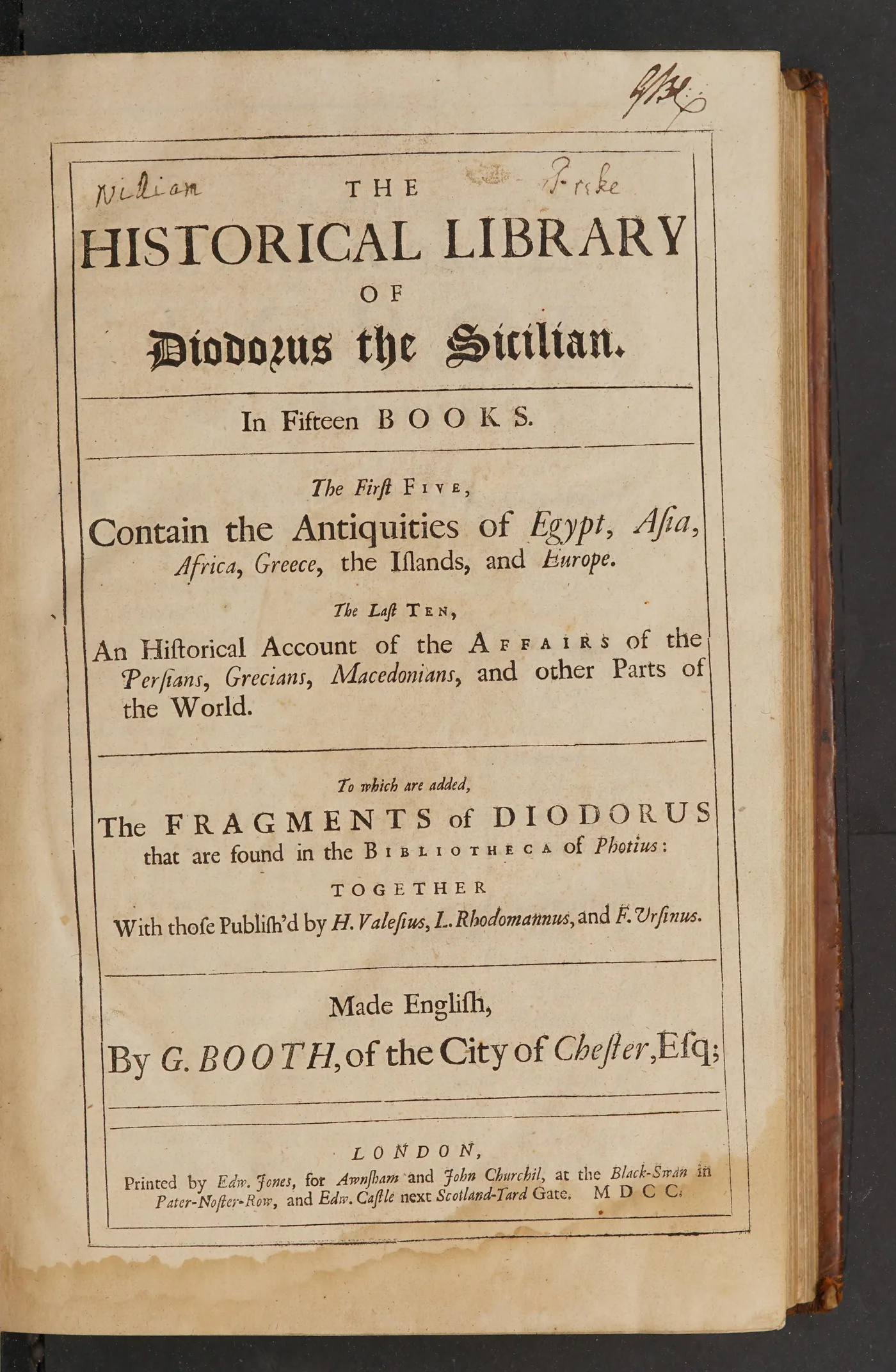
THE Historical Library OF Diodorus the Sicilian. BOOK I.
CHAP. I.
Of the first Generation of Men. How the World first began. Mens first manner of Life, and who were the first Men. First Men in Egypt. Who were the most antient Gods of Egypt. Of their Demy-Gods. Sol, Saturn, Rhea, Jupiter, Juno, Vulcan reign'd in Egypt. Of Osiris and Isis. The Acts of Osiris and Isis. Hermes his Inventions. Osiris prepares for his Expedition through the World, and to that end raises a great Army.
WHAT Notions they had of the Gods who first instituted Divine Worship, and what is fabulously related of every one of the Deities (because the Subject requires much to be said) we shall distinctly set forth: And whatever we conceive to be pertinent to the present History, we shall discourse of severally and distinct, that nothing worth Observation may be omitted And we shall here give an accurate Account (as far as the Antiquity of the matters will admit) of the Generation and Original of Mankind, and of the Affairs and Transactions of all Parts of the Known World, drawing down our History from the most ancient Times.
Of the Origen therefore of Men, there are Two Opinions amongst the most (Of the Opinions of the first Generation of Men.) famous and authentick Naturalists and Historians.
Some of these are of Opinion, that the World had neither* Beginning, nor ever shall have End; and likewise say, that Mankind was from Eternity, and that there never was a Time when he first began to be. Others on the contrary, conceive both the World to be made, and to be corruptible, and that there was a certain Time when Man had first a Being.
Gr. Without Generation or Corruption.
For whereas all things at the first were jumbled together, Heaven and Earth, (Of the Beginning of the World.) were in one Mass, and had one and the same Form: But afterwards (they say) when Corporeal Beings appear'd one after another, the World at length presented it self in the Order we now see; and that the Air was in continual agitation, whose fiery part ascended together to the highest Place, its nature (by reason of its Levity) tending always upwards; for which reason, both the Sun, and that vast number of the Stars, are contain'd within that Orb. That the gross and earthy Matter (clotted together by Moisture) by reason of its Weight sunk down below into one Place, is continually whirling about; the Sea was made of the Humid Parts; and the muddy Earth of the more Solid, as yet very meorish and soft; which by degrees at first was made crusty by the Heat of the Sun; and then after the Face of the Earth was parcht, and as it were firmented, the Moisture afterwards in many Places bubled up, and appear'd as so many Pustles wrapt up in thin and slender Coats and Skins; which may be even seen in standing Ponds, and Marish Places, when after the Earth has been pierc'd with Cold, the Air grows hot on a sudden, without a gradual Alteration. And whereas Moisture generates Creatures from Heat, as from a Seminal Principle, things so generated, by being inwrapt in the dewy Mists of the Night, grew and increas'd, and in the Day solidated, and were made hard by the Heat of the Sun; and when the Births included in those Ventricles had received their due proportion, then those slender Skins being burst asunder by the Heat, the Forms of all sorts of Living Creatures were brought forth into the Light; of which those that had most of Heat mounted aloft†, and were Fowl, and Birds of the Air; but those that were drossy, and had more of Earth, were number'd in the order of Creeping things, and other Creatures altogether us'd to the Earth. Then those Beasts that were naturally watery and moist (call'd Fishes) presently hasten'd to the place connatural to them; and when the Earth afterwards became more dry and solid by the Heat of the Sun, and the drying Winds, it had not power at length to produce any more of the greater living Creatures; but each that had an Animal Life, began to increase their Kind by mutual Copulation. And Euripides the Scholar of Anaxagoras, seems to be of the same Opinion, concerning the first Generation of all things; for in his Monalippe he has these Verses.
Gr. 〈Greek〉.
〈Greek〉
〈Greek〉.
〈Greek〉
〈Greek〉.
A Mass confus'd, Heaven and Earth once were
Of one Form; but after Separation,
Then Men, Trees, Beasts of th' Earth, with Fowls of th' Air
First sprang up in their Generation.
But if this Power of the Earth to produce living Creatures at the first Origen of all things seem credible to any; the Aegyptians do bring Testimonies of this Energy of the Earth, by the same things done there at this day. For they say, that about Thebes in Egypt, after the overflowing of the River Nile, the Earth (Mice bred of Mud in Egypt.) thereby being covered with Mud and Slime, many Places putrify through the heat of the Sun, and thence are bred multitudes of Mice. It is certain therefore, that out of the Earth when it's hardn'd, and the Air chang'd from its due and natural Temperament, Animals are generated. By which means it came to pass, that in the first beginning of all things, various living Creatures proceeded from the Earth. And these are the Opinions touching the Original of Things.
But Men, they say, at first, led a rude and brutish sort of Life, and wandered (Mens first manner of Life.) up and down in the Fields, and fed upon Herbs, and the natural Fruit of the Trees. Their Words were confus'd, without any certain signification; but by degrees they spoke articulately, and making Signs, and giving proper Terms to every thing upon occasion; at length their Discourse became intelligible one to another: But being dispers'd into several parts of the World, they spoke not all the same Language, every one using that Dialect proper to the Place, as his Lot fell: Upon which account there were various and all sorts of Languages in the World; and these Associations of Men, first planted all the Nations of the World.
But forasmuch as what was useful for Mans Life, was not at the beginning found out, this first Race of Mankind liv'd a laborious and troublesom Life, as being as yet naked, not inur'd to Houses, nor acquainted with the use of Fire, and altogether destitute of Delicacies for their Food. For not knowing as yet how to house and lay up their Food, they had no Barns or Granaries where to deposite the Fruits of the Earth; and therefore many through Hunger and Cold perisht in the Winter: But being at length taught by experience, they fled into Caves in the Winter, and laid up such Fruits as were fit to keep; and coming by degrees to the Knowledge of the usefulness of Fire, and of other Conveniences, they began to invent many Arts, and other things beneficial for Man's Life. What shall we say? Necessity was Man's Instructor, which made him skilful in every thing, being an Ingenious Creature, assisted (as with so many Servants) with Hands, Speech, and a Rational Soul, ready to put every thing in execution. But what we have here said concerning the first Generation of Mankind, and his way of living in old time may suffice*, designing to keep within due Bounds.
〈Greek〉.
And now we shall apply our selves to recount those things that have been done in all the known Parts of the World, whereof there is any Memorial handed down to us.
Who were the First Kings, we our selves can neither assert nor agree with (Who were the First Kings.) those Historians who affirm they know; for it's not possible that the Account given of Affairs, should be so ancient as to be contemporary with the first Kings; and if any should admit any such thing, yet it's apparent, that all the Historians extant liv'd long after those Times. For the Greeks themselves are not only in the dark concerning the Antiquity of Nations, but many of the Barbarians also, who call themselves Natural Inhabitants, and boast themselves to be the first of all other Men who have found out things beneficial to Mankind, and to have committed to writing, things done among them many Ages before. And as for us, we determine nothing certainly of the Antiquity of particular Nations, nor which Nation is antienter than another, or how many Years one was before another. But that we may attain the Scope and End we have before design'd, we shall distinctly set forth in these Chapters, what is reported concerning things done in the several Nations, and the Antiquity of them.
We shall first speak of the Barbarians; not that we judge them more ancient than the Grecians (as Ephorus affirms) but that we are willing in the First place to relate many considerable things of them, that when we come afterwards to the History of the Greeks, we may not confound their Antiquity with the other which are of a foreign nature to them. And because the Gods are fabulously reported to be born in Egypt, and the first Observation of the Motion of the Stars is attributed to them, and that there are many remarkable and famous Actions of renown'd Men recorded to be done amongst them, we shall begin with the Affairs of Egypt.
The Egyptians report, that at the beginning of the World, the first Men were (The first Men in Egypt.) created in Egypt, both by reason of the happy Climate of the Country, and the nature of the River Nile. For this River being very Fruitful, and apt to bring forth many Animals, yields of it self likewise Food and Nourishment for the things produc'd. For it yields the Roots of Canes, the Fruit of the* Lote-Tree, the Egyptian Bean, that which they call† Cors•on, and such like Rarities for Man's Food, always ready at hand.
〈Greek〉. A Tree yielding most sweet and delicious Fruit. See Plin. Nat. Hist. lib. 13. c. 17.
Corchorum, Plin. Nat. Hist. lib. 21. c. 〈◊〉.
And that all living Creatures were first produc'd among them, they use this Argument, that even at this day, about Thebes at certain Times, such vast Mice are bred, that it causes admiration to the Beholders; some of which to the Breast and Fore-feet are animated and begin to move, and the rest of the Body (which yet retains the nature of the Soyl) appears without Form. Whence it's manifest, that in the beginning of the World, through the Fertileness of the Soyl the first Men were form'd in Egypt, being that in no other parts of the World any of these Creatures are produc'd; only in Egypt these supernatural Births may be seen.
And that we may sum up all in a word: If in the time of Deucalion's Flood, the greatest part only of all living Creatures were destroy'd, then of such as were so preserv'd, its very probable that those in Egypt, especially, were of the number, whose Inhabitants lye under the South Pole, and the Country for the most part without Rain: Or if all that had Life generally perisht (as some affirm) and that the Earth produc'd Animals anew; yet they say, that notwithstanding this, the chief production of things animated, is to be ascribed to this Country. For they affirm, that if the Showers which fall in any other Places, were warm'd with the same Heat that is in Egypt, the Air would be of that Temperature, as that it would aptly conduce to the Generation of Animals, as at first, in the beginning of the World. For even at this day, such Births may be seen (in the Waters that have lain long) over all the water'd Country of Egypt. For they affirm, that when the River returns into its Channel, and the Sun dries the Mud, living Creatures are generated, some perfect, others half form'd, even cleaving to the Soyl whence they are produc'd. (Osiris, Isis, Ceres, Oceanus and Minerva, the most antient Egyptian Gods.)
The first Generation of Men in Egypt, therefore contemplating the Beauty of the Superior World, and admiring with astonishment the frame and order of the Universe, judg'd there were Two chief Gods that were Eternal, that is to say, The Sun and the Moon, the first of which they call'd Osiris, and the other Isis, both Names having proper Etymologies; for Osiris in the Greek Language, signifies a Thing with many Eyes, which may be very properly apply'd to the Sun darting his Rays into every Corner, and as it were with so many Eyes viewing and surveying the whole Land and Sea, with which agrees the Poet,
〈Greek〉. (〈◊〉 Odys. 〈◊〉 Ver. 〈◊〉.)
The Sun from's lofty Sphear all sees and hears.
Some also of the antient Greek Mythologists call Osiris Dionysus, and sirname him Sirius, amongst whom Eumolphus in his Bacchanal Verses,
〈Greek〉.
Dionysus darts his Fiery Rays.
And Orpheus; 〈Greek〉.
He's call'd Phanetes and Dionysus.
Some likewise set him forth cloath'd with the spotted Skin of a Fawn (call'd Nebris) from the variety of Stars that surround him.
Isis likewise being interpreted, signifies Antient, that Name being ascrib'd to the Moon from Eternal Generations. They add likewise to her, Horns, because her Aspect is such in her Increase and in her Decrease, representing a Sickle; and because an Ox among the Egyptians is offer'd to her in Sacrifice. They hold that these Gods govern the whole World, cherishing and increasing all things; and divide the Year into Three Parts (that is to say, Spring, Summer and Autumn) by an invisible Motion perfecting their constant Course in that time: And though they are in their Natures very differing one from another, yet they compleat the whole Year with a most excellent Harmony and Consent. They say that these Gods in their Natures do contribute much to the Generation of all things, the one being of a hot and active Nature, the other moist and* cold, but both having something of the Air; and that by these, all things are both brought forth and nourish'd: And therefore that every particular Being in the Universe is perfected and compleated by the Sun and Moon, whose Qualities, as before declar'd, are Five; A Spirit or quickning Efficacy, Heat or Fire, Dryness or Earth, Moisture or Water, and Air, of which the World does consist, as a Man made up of Head, Hands, Feet, and other parts. These Five they reputed for Gods, and the People of Egypt who were the first that spoke articulately, gave Names proper to their several Natures, according to the Language they then spake. And therefore they call'd the Spirit Jupiter, which is such by Interpretation, because (Jupiter, Spirit.) a quickning Influence is deriv'd from this into all Living Creatures, as from the original Principle; and upon that account he is esteem'd the common Parent of all things. And to this the most famous Poet of the Greeks gives Testimony, where speaking of this God he says—
〈Greek〉, Cold.
〈Greek〉. (Hom. 〈…〉d. 8. Ver. 54•.)
Of Men and Gods the Father.
Fire they call'd by Interpretation Vulcan, and him they had in Veneration as a Great God, as he that greatly contributed to the Generation and Perfection of (Vulcan, Fire.) all Beings whatsoever.
The Earth, as the Common Womb of all Productions, they call'd Metera, as (Metera, The Earth.) the Greeks in process of time, by a small alteration of one Letter, and an omission of Two Letters, call'd the Earth Demetra, which was antiently call'd Gen Metera, or the Mother Earth, as Orpheus attests in this Verse.
〈Greek〉.
The Mother Earth Demeter also call'd,
Brings forth most richly—
Water or Moisture, the Antients call'd Oceanus; which by Interpretation is a (Oceanus, Water.) nourishing Mother, and so taken by some of the Grecians, of which the Poet says thus,
〈Greek〉. (Hom. Ilia. 14. Ver. 302.)
The Father of the Gods the Ocean is
Tethys the Mother call'd—
But the Egyptians account their Nile to be Oceanus, at which all the Gods were Born. For in Egypt, only among all the Countries in the World, are many Cities built by the ancient Gods, as by Jupiter, Sol, Mercury, Apollo, Pan, Elithia, and many others.
To the Air they gave the Name of Minerva, signifying something proper (Minerva, Air.) to the nature thereof, and call'd her the Daughter of Jupiter, and counted a Virgin, because the Air naturally is not subject to Corruption, and is in the highest part of the Universe; whence rises the Fable, that she was the Issue of Jupiter's Brain: They say she's call'd also Tritogeneia, or Thrice Begotten, because she changes her natural Qualities thrice in the Year, the Spring, Summer and Winter; and that she was call'd Glaucopis, not that she hath Grey Eyes (as some of the Greeks have suppos'd, for that's a weak Conceit) but because the Air seems to be of a Grey Colour, to the view. They report likewise, that these Five Gods travel through the whole World, representing themselves to Men sometimes in the shapes of Sacred living Creatures, and sometimes in the Form of Men, or some other Representation. And this is not a Fable, but very possible, if it be true, that these generate all things; and the* Poet who travell'd into Egypt, in some part of his Works, affirms this Appearance, as he learnt it from their Priests,
Homer.
〈Greek〉
〈Greek〉
〈Greek〉.
The Gods also like Strangers come from far,
In divers Shapes within the Towns appear,
Viewing Mens good and wicked Acts:—
And these are the Stories told by the Egyptians of the Heavenly and Immortal (The Earthly Gods of Egypt.) Gods. And besides these, they say there are others that are Terrestrial, which were begotten of these former Gods, and were Originally Mortal Men, but by reason of their Wisdom and Beneficence to all Mankind, have obtain'd Immortality, of which some have been Kings of Egypt. Some of whom by Interpretation, have had the same Names with the Celestial Gods, others have kept their own proper Names. For they report that Sol, Saturn, Rhea, Jupiter, (surnam'd by some Ammon) Juno, Vulcan, Vesta, and lastly, Mercury, reign'd in Egypt; and that Sol was the first King of Egypt, whose Name was the same with the Celestial Planet call'd Sol.
But there are some of the Priests who affirm Vulcan to be the first of their (Vulcan the first Inventer of Fire.) Kings, and that he was advanc'd to that Dignity upon the account of being the first that sound out the use of Fire, which was so beneficial to all Mankind. For a Tree in the Mountains hapning to be set on Fire by Lightning, the Wood next adjoyning was presently all in a Flame; and Vulcan thereupon coming to the Place, was mightily refresht by the heat of it, being then Winter Season; and when the Fire began to fail, he added more combustible Matter to it, and by that means preserving it, call'd in other Men to enjoy the Benefit of that which he himself was the first Inventer, as he gave out.
Afterwards they say Saturn reign'd, and marry'd his Sister (This Saturn is judg'd upon good grounds to be Naoh. Boccard. Phaleg. lib. 1. c. 1. f. 1. Stilling. Orig. Sacr. lib. 5. c. 5. Sect. 8.) Rhea, and that he begat of her Osiris and Isis; but others say, Jupiter and Juno, who for their great Virtues, rul'd over all the World. That of Jupiter and Juno were born Five Gods, one upon every day of the Five Egyptian intercalary Days. The Names of these Gods are Osiris, Isis, Typhon, Apollo and Venus. That Osiris was interpreted Bacchus, and Isis plainly Ceres. That Osiris marry'd Isis, and after he came to the Kingdom, did much, and perform'd many things for the common (This Osiris was call'd Apis, and was King of Argos, and afterwards of Egypt. Vid. Strab. Plin. about the time of Jacob's leaving Laban, Anno Mund. 2205, before Christ 1744. Hely. Cron. but by Isaacson, Ann. Mund. 2778.) Benefit and Advantage of Mankind. For he was the first that forbad Men eating one another; and at the same time Isis found out the way of making of Bread of Wheat and Barley, which before grew here and there in the Fields amongst other common Herbs and Grass, and the use of it unknown: And Osiris teaching the way and manner of Tillage, and well management of the Fruits of the Earth, this change of Food became grateful; both because it was naturally sweet and delicious, and Men were thereby restrain'd from the mutual Butcheries one of another: For an evidence of this first finding out the use of these Fruits, they alledge an antient Custom amongst them: For even at this day, in the time of Harvest, the Inhabitants offer the first Fruits of the Ears of Corn, howling and wailing about the Handfuls they offer, and invoking this Goddess Isis: And this they do in return of due Honour to her for that Invention at the first. In some Cities also, when they celebrate the Feast of Isis in a Pompous Procession, they carry about Vessels of Wheat and Barley, in memory of the first Invention, by the care and industry of this Goddess. They say likewise, that Isis made many Laws for the good of Human Society, whereby Men were restrain'd from lawless Force and Violence one upon another, out of fear of Punishment. And therefore Ceres was call'd by the ancient Greeks, Themophorus (that is) Lawgiver, being the Princess that first constituted Laws for the better Government of her People.
These were Five Days added to the end of every Year, to make up their former Year to consist of 365 Days. See the Reason, Orig. Sacr. 9•, 91.
Osiris moreover built Thebes in Egypt, with an Hundred Gates, and call'd it (Osiris built Thebes.) after his Mother's Name: But in following Times, it was call'd Diospolis, and Thebes; of whose first Founder not only Historians, but the Priests of Egypt themselves, are much in doubt. For some say that it was not built by Osiris, but many Years after by a King of Egypt, whose History we shall treat of hereafter in its proper place. They report likewise, that he built Two magnificent Temples, and Dedicated them to his Parents, Jupiter and Juno; and likewise Two Golden* Altars, the greater to the great God Jupiter; the other to his Father Jupiter, who had formerly reign'd there, whom they call Ammon. That he also erected Golden Altars to other Gods, and instituted their several Rites of Worship, and appointed Priests to have the Oversight and Care of the Holy things. In the time of Osiris and Isis, Projectors and ingenious Artists were in great Honour and Esteem; and therefore in Thebes there were then Goldsmiths and Braziers, who made Arms and Weapons for the Killing of Wild Beasts, and other Instruments for the husbanding of the Ground, and improvement of Tillage; besides Images of the Gods, and Altars in Gold. They say that Osiris was much given to Husbandry, that he was the Son of Jupiter, brought up in Nisa, a Town of Arabia the Happy, near to Egypt, call'd by the Greeks Dionysus, from his Father, and the Place of his Education*. The Poet in his Hymns makes mention of Nysa, as bordering upon Egypt, where he says,
〈Greek〉. Golden Temples.
Homer.
〈Greek〉
〈Greek〉.
Far off from Phenice stands the Sacred Nyse,
Where Streams of Eygypt's Nile begin to rise,
On Mountain high with pleasant Woods adorn'd.
Here near unto Nyse, (they say) he found out the use of the Vine, and there planting it, was the first that drank Wine; and taught others how to plant it and use it, and to gather in their Vintage, and to keep and preserve it. Above all others, he most honoured† Hermes, one of an admirable Ingenuity, and quick Invention, in finding out what might be useful to Mankind. This Hermes was the first (as they report) that taught how to speak distinctly and articulately, and gave Names to many things that had none before. He found out Letters, and instituted the Worship of the Gods; and was the first that observ'd the Motion of the Stars, and invented Musick; and taught the manner of Wrestling; and invented Arithmetick, and the Art of curious* Graving and Cutting of Statues. He first found out the Harp with Three Strings, in resemblance of the Three Seasons of the Year, causing Three several Sounds, the Treble, Base and Mean. The Treble, to represent the Summer; The Base, the Winter; and the Mean, the Spring. He was the first that taught the Greeks Eloquence; thence he's call'd Hermes, a Speaker or Interpreter. To conclude, he was Osiris's* Sacred Scribe, to whom he communicated all his Secrets, and was chiefly steer'd by his Advice in every thing. He (not Minerva, as the Greeks affirm) found out the use of the Olive-tree, for the making of Oyl. It's moreover reported, that Osiris being a Prince of a publick Spirit, and very ambitious of Glory, rais'd a great Army, with which he resolv'd to go through all parts of the World that were inhabited, and to teach Men how to plant Vines, and to sow Wheat and Barly. For he hop'd that if he could civilize Men, and take them off from their rude and Beast-like Course of Lives, by such a publick good and advantage, he should raise a Foundation amongst all Mankind, for his immortal Praise and Honour, which happen'd accordingly. For not only that Age, but Posterity ever after honour'd those among the chiefest of their Gods, that first found out their proper and ordinary Food. Having therefore settl'd his Affairs in Egypt, and committed the Government of his whole Kingdom to his Wife Isis, he join'd with her Mercury, as her chief Councellor of State, because he far excell'd all others in Wisdom and Prudence. But Hercules his near Kinsman, he left General of all his Forces within his Dominions, a Man admir'd by all for his Valour and Strength of Body. As to those parts which lay near Phaenicia, and upon the Sea-Coasts of them, he made Busiris Lord Lieutenant, and of Ethiopia and Lybia, Anteus.
Mercury, or Hermes his Inventions. This Mercury is supposed to be Joseph, by Bochart. Vid. Crale, Court of the Gent. Part 1. lib. 1. c. 4. p. 45.
Of the exact framing of a Body.
〈Greek〉.
Then marching out of Egypt, he began his Expedition, taking along with him his Brother, whom the Greeks call'd Apollo. This Apollo is reported to have discover'd the Laurel-Tree, which all Dedicate especially to this God. To Osiris they attribute the finding out of the Ivy-Tree, and dedicate it to him, as the Greeks do to Bacchus: And therefore in the Egyptian Tongue, they call Ivy Osiris's Plant, which they prefer before the Vine in all their Sacrifices, because this loses its Leaves, and the other always continues fresh and green: Which Rule the Ancients have observ'd in other Plants, that are always green, dedicating Mirtle to Venus, Laurel to Apollo, and the Olive-Tree to Pallas.
It's said, that Two of his Sons accompany'd their Father Osiris in this Expedition, one call'd Anubis, and the other Macedo, both valiant Men: Both of them wore Coats of Mail, that were extraordinary remarkable, cover'd with the Skins of such Creatures as resembled them in Stoutness and Valour. Anubis was cover'd with a Dog's, and Macedon with the Skin of a Wolf; and for this reason these Beasts are religiously ador'd by the Egyptians. He had likewise for his Companion†, Pan, whom the Egyptians have in great Veneration; for they not only set up Images and Statues up and down in every Temple, but built a City in Thebides after his Name, call'd by the Inhabitants † Chemmin, which by interpretation is (* Cham call'd Pan.) Pan's City. There went along with them likewise those that were skilful in Husbandry, as Maro in the planting of Vines, and Triptolemus in sowing of Corn, and gathering in the Harvest.
The same with Cham.
CHAP. II.
The Continuance of Osiris's Expedition through Ethiopia, all Arabia, India and Europe. Buried by Isis and Mercury. How he was kill'd. His Death reveng'd by Isis and Orus. Two Bulls, Apis and Mnevis, worshipp'd in Egypt. Places discuss'd where Osiris and Isis were Buried. Histories of the Egyptian Priests. Their Tears, Lunar Tears. Giants. Laws about Marriage. Osiris and Isis, their Pillars and Inscriptions. Colonies out of Egypt.
ALL things being now prepar'd, Osiris having vow'd to the Gods to let his Hair grow till he return'd into Egypt, marcht away through Aethiopia; and for that very Reason it's a piece of Religion, and practis'd among the Egyptians at this Day, that those that travel Abroad, suffer their Hair to grow, till they return Home. As he pass'd through Ethiopia, a Company of Satyrs were presented to him, who (as it's reported) were all Hairy down to their Loyns: For Osiris was a Man given to Mirth and Jollity, and took great pleasure in Musick and Dancing; and therefore carry'd along with him a Train of Musicians, of whom Nine were Virgins, most Excellent Singers, and expert in many other things (whom the Greeks call Muses) of whom Apollo was the Captain; and thence call'd the* Leader of the Muses: Upon this account the Satyrs, who are natuturally inclin'd to skipping, dancing and singing, and all other sorts of Mirth, were taken in as part of the Army: For Osiris was not for War, nor came to fight Battels, and to decide Controversies by the Sword, every Country receiving him for his Merits and Virtues, as a God. In Ethiopia having instructed the Inhabitants in Husbandry, and Tillage of the Ground, and built several stately Cities among them, he left there behind him some to be Governors of the Country, and others to be Gatherers of his Tribute.
〈Greek〉.
While they were thus imploy'd 'tis said that the River Nile, about the Dog-days (Inundation of Nile.) (at which time it uses to be the highest) broke down its Banks, and over-flow'd the greatest part of Egypt, and that part especially where Prometheus govern'd, insomuch as almost all the Inhabitants were drown'd; so that Prometheus was near unto Killing of himself for very grief of heart; and from the sudden and violent Eruption of the Waters, the River was call'd† Eagle.
Aetos in Greek, because an Eagle is quick, lively and swift.
Hercules, who was always for high and difficult Enterprizes, and ever of a stout Spirit, presently made up the Breaches, and turn'd the River into its Channel, and kept in within its ancient Banks; and therefore some of the Greek Poets from this fact have forg'd a Fable, That Hercules kill'd the Eagle that fed upon Prometheus his Heart. The most ancient Name of this River was Oceames, which in the Greek pronunciation is Oceanus; afterwards call'd Eagle, upon the violent Eruption. Lastly, it was call'd Egyptus, from the Name of a King that there reign'd; which the Poet attests, who says,
Shot through.
〈Greek〉.
In th' River of Egyptus then I plac'd
The Gallies swift—
For near Thonis (as it's call'd) an ancient Mart Town of Egypt, this River empties it self into the Sea.
The last Name which it still retains, it derives from Nileus, a King of those Parts.
Osiris being come to the Borders of Ethiopia, rais'd high Banks on either side of the River, lest in the time of its Inundation it should overflow the Country more than was convenient, and make it marish and boggy; and made Floodgates to let in the Water by degrees, as far as was necessary. Thence he pass'd through Arabia, bordering upon the Red Sea as far as to India, and the utmost Coasts that were inhabited: He built likewise many Cities in India, one of which he call'd Nysa, willing to have a remembrance of that in Egypt where he was brought up. At this Nysa in India, he planted Ivy, which grows and remains here only of (Nysa in India.) all other Places in India, or the Parts adjacent. He left likewise many other Marks of his being in those Parts, by which the latter Inhabitants are induc'd to believe, and do affirm that this God was born in India.
He likewise addicted himself much to hunting of Elephants; and took care to have Statues of himself in every place, as lasting Monuments of his Expedition. Thence passing to the rest of Asia, he transported his Army through the Hellespont into Europe; and in Thrace he kill'd Lycurgus King of the Barbarians, who oppos'd him in his Designs. Then he order'd Maro (at that time an Old Man) to take care of the Planters in that Country, and to build a City, and call it Maronea, after his own Name. Macedon his Son he made King of Macedonia, so calling it after him. To Triptolemus he appointed the Culture and Tillage of the Land in Attica. To conclude, Osiris having travell'd through the whole World, by finding out Food fit and convenient for Man's Body, was a Benefactor to all Mankind. Where Vines would not grow and be fruitful, he taught the Inhabitants to make Drink of Barley, little interiour in strength and pleasant Flavour to Wine it self. He brought back with him into Egypt the most pretious and richest things (Beer anciently.) that ever place did afford; and for the many Benefits and Advantages that he was the Author of, by the common Consent of all Men, he gain'd the Reward of Immortality and Honour equal to the Heavenly Deities.
After his Death, Isis and Mercury celebrated his Funeral with Sacrifices and other Divine Honours, as to one of the Gods, and instituted many Sacred Rites mystical Ceremonies in Memory of the mighty Works wrought by this Hero, now Deify'd. Antiently the Egyptian Priests kept the manner of the Death of Osiris secret in their own Registers among themselves; but in after-times it fell out, that some that could not hold, blurted it out, and so it came Abroad. For they say that Osiris, while he govern'd in Egypt with all Justice imaginable, was Murder'd by his wicked Brother Typhon; and that (This Osiris was mur•her'd about the time Jacob with his whole Family came into Egypt: As 〈◊〉 H•lvicus Cro. An. Mund. 2239. Vid. Sir Walter Rawl. History, lib. 2. part 1. cap. 2. sect. 5. That this Osiris was Misraim, the Son of Cham.) he mangled his dead Body into Six and Twenty Pieces, and gave to each of his Confederates in the Treason a Piece, by that means to bring them all within the same horrid Guilt, and thereby the more to ingage them to advance him to the Throne, and to defend and preserve him in the Possession.
But Isis, the Sister and Wife likewise of Osiris, with the assistance (In the time of this Orus, Jacob is said to come into Egypt. Sir Walter Rawl. lib. 2. part 1. c. 2. sect. 5. Helvicus says in the time of Osiris, An. Mun. 2239.) of her Son Orus, reveng'd his Death upon Typhon and his Complices, and posses'd her self of the Kingdom of Egypt. It's said the Battel was fought near a River not far off a Town now call'd Antaea in Arabia, so call'd from Anteus, whom Hercules slew in the time of Osiris. She found all the Pieces of his Body, save his Privy Members; and having a desire to conceal her Husband's Burial, yet to have him honour'd as a God by all the Egyptians, she thus contriv'd it. She clos'd all the Pieces together, cementing them with Wax and Aromatick Spices, and so brought it to the shape of a Man of the bigness of Osiris; then she sent for the Priests to her, one by one, and swore them all that they should not discover what she should then intrust them with. Then she told them privately, that they only should have the Burial of the King's Body; and recounting the many good Works he had done, charg'd them to bury the Body in a proper place among themselves, and to pay unto him all Divine Honour, as to a God. That they should Dedicate to him one of the Beasts bred among them, which of them they pleas'd, and that while it was alive, they should pay it the same Veneration as they did before to Osiris himself; and when it was dead, that they should Worship it with the same Adoration and Worship given to Osiris. But being willing to incourage the Priests to these Divine Offices by Profit and Advantage, she gave them the Third part of the Country for the Maintenance of the Service of the Gods and their Attendance at the Altars.
In memory therefore of Osiris's good Deeds, being incited thereunto by the Commands of the Queen, and in expectation of their own Profit and Advantage, the Priests exactly perform'd every thing that Isis injoin'd them; and therefore every Order of the Priests at this Day are of opinion that Osiris is bury'd among them. And they have those Beasts in great Veneration, that were so long since thus consecrated; and renew their Mournings for Osiris over the Graves of those Beasts. There are Two sacred Bulls especially, the one call'd Apis, and the other (Apis and Mnevis.) Mnevis, that are Consecrated to Osiris, and reputed as Gods generally by all the Egyptians. For this Creature of all others was extraordinarily serviceable to the first Inventers of Husbandry, both as to the Sowing Corn, and other Advantages concerning Tillage, of which all reapt the Benefit. Lastly, they say, that after the Death of Osiris, Isis made a Vow never to Marry any other Man, and spent the rest of her Days in an exact Administration of Justice among her Subjects, excelling all other Princes in her Acts of Grace and Bounty towards her own People; and therefore after her Death, she was numbred among the Gods, and as such had Divine Honour and Veneration, and was buri'd at Memphis, where they shew her Sepulchre at this day in the Grove of Vulcan.
Yet there are some that deny that these Gods are Buri'd at Memphis; but near the Mountains of Ethiopia and Egypt, in the Isle of Nile, lying near to a place call'd Philas, and upon that account also nam'd the Holy Field. They confirm this by undoubted Signs and Marks left in this Island, as by a Sepulchre built and erected to Osiris, religiously Reverenc'd by all the Priests of Egypt, wherein are laid up Three Hundred and Threescore* Bowls, which certain Priests appointed for that purpose, fill every Day with Milk, and call upon the Gods by Name, with Mourning and Lamentation. For that cause none go into the Island but Priests. The Inhabitants of* Thebes (which is the most ancient City of Egypt) account it a great Oath, and by no means to be violated, if a Man swear by Osiris that lies bury'd at Philas.
〈Greek〉.
Or of Thebais the higher Egypt.
The several parts therefore of Osiris being found, they report were bury'd in this manner before related; but his Privy-Members (they say) were thrown into the River by Typhon, because none of his Partners would receive them; and yet that they were divinely honour'd by Isis; for she commanded an Image† of this very part to be set up in the Temples, and to be religiously ador'd; and in all their Ceremonies and Sacrifices to this God, she ordered that part to be held in divine Veneration and Honour. And therefore the Grecians, after they had learn'd the Rites and Ceremonies of the Feasts of Bacchus, and the† Orgian Solemnities from the Egyptians in all their Myteries and Sacrifices to this God, they ador'd that Member by the Name of Phallus.
〈Greek〉.
Noise and rude Shoutings at the Feasts of Bacchus.
From* Osiris and Isis, to the Reign of Alexander the Great, who built a City after his own Name, the Egyptian Priests reckon above† Ten Thousand Years, or (as some write) little less than Three and Twenty Thousand Years. They affirm, that those that say this God Osiris was born at Thebes in Boetia of Jupiter and Semele, relate that which is false. For they say that Orpheus, after he came into Egypt, was initiated into the Sacred Mysteries of Bacchus or Dionysus, and being a special Friend to the Thebans in Boetia, and of great esteem among them, to manifest his Gratitude, transferr'd the Birth of Bacchus or Osiris over into Greece.
Mizraim the Son of Cham.
These must be understood Lunary Years of Thirty Days, as the Egyptians us'd to account. Vid. Plut. Numa, Lact. lib. 2. c. 12. p. 118. Orus the Son of Osiris, was Born An. Mund. 1778. Alexander's Conquest of Egypt, An. Mun. 3661. which is 1889 Years after, which makes up 22996 Lunar Years, and 15 Days, which comes near to this Account of Diodorus. Orig. Sacr. c. 5.
And that the Common People, partly out of Ignorance, and partly out of a desire they had that this God should be a Grecian, readily receiv'd these Mysteries and Sacred Rites among them; and that Orpheus took the occasion following to fix the Birth of the God and his Rites and Ceremonies among the Greeks: As thus, Cadmus (they say) was born at Thebes in Egypt, and amongst other Children begat Semele: That she was got with Child by one unknown, and was deliver'd at Seven Months end of a Child very like to Osiris, as the Egyptians describe him. But such Births are not us'd to live, either because it is not the pleasure of the Gods it should be so, or that the Law of Nature will not admit it. The Matter coming to Cadmus his Ear, being before warn'd by the Oracle to protect the Laws of his Country, he wrapt the Infant in Gold, and instituted Sacrifices to be offer'd to him, as if Osiris had appear'd again in this shape; and caus'd it to be spread abroad, that it was begotten of Jupiter, thereby both to honour Osiris, and to cover his Daughter's Shame. And therefore it is a common Report among the Grecians, that Semele, the Daughter of Cadmus, was got with Child by Jupiter, and by him had Osiris.
In After-times, Orpheus, by reason of his excellent Art and Skill in Musick, (Orpheus.) and his Knowledge in Theology, and Institution of Sacred Rites and Sacrifices to the Gods, was greatly esteem'd among the Grecians, and especially was receiv'd and entertain'd by the Thebans, and by them highly honour'd above all others; who being excellently learn'd in the Egyptian Theology, brought down the Birth of the ancient Osiris, to a far later time, and to gratifie the Cadmeans or Thebans, instituted new Rites and Ceremonies, at which he ordered that it should be declared to all that were admitted to those Mysteries, that* Dionysus or Osiris was begotten of Semele by Jupiter. The People therefore partly through Ignorance, and partly by being deceived with the dazling Luster of Orpheus his Reputation, and with their good Opinion of his Truth and Faithfulness in this matter (especially to have this God reputed a Grecian, being a thing that humour'd them) began to use these Rites, as is before declared. And with these Stories the Mythologists and Poets have fill'd all the Theaters, and now it's generally received as a Truth not in the least to be questioned. To conclude, The Priests say, that the Grecians have arrogated to themselves both their Gods and Demy-Gods (or (The Stories of the Heroes and Gods the Grecians deriv'd from the Egyptians.) Heroes,) and say that divers Colonies were transported over to them out of Egypt: For Hercules was an Egyptian, and by his Valour made his way into most parts of the World, and set up a Pillar in Africa; and of this they endeavour to make proof from the Grecians themselves. For whereas it is own'd by all, that Hercules assisted the Gods in the Giants War, it's plain that at that time when the Grecians say Hercules was born, the Earth had not then strength to produce Giants, neither were there any in those Days, that is to say, in the Age next before the Trojan War; but rather (as the Egyptians affirm) at the first Generation and Beginning of Mankind; from which Time the Egyptians account above Ten Thousand Years; but from the Trojan War, not Twelve Hundred: And according to this Computation of the Egyptians, a Club and Lion's Skin may agree well enough with the ancient Hercules; for the use of Arms not being at that time found out, Men fought with Clubs and Staves, and cover'd their Bodies with Beasts Skins. This ancient Hercules they say was the Son of Jupiter, but know not who was his Mother: But he who was the Son of Alemena, they affirm was born above Ten Thousand Years after the other, and was call'd at first Alceus; but afterwards Hercules, not that he had that honourable Surname from* Juno (as Matris says) but assum'd to himself the Name out of emulation, desirous to do as great things as the ancient Hercules, and so to inherit as well his Fame and Glory as his Name.
Osiris was call'd Dionysus or Bacchus.
Juno is called by the Greeks, Heras, and Hercules, Heracles.
Moreover, the Grecians have a very antient Tradition, which agrees with the Egyptians, that Hercules freed the Earth from wild Beasts; which cannot possibly be apply'd to him who flourish'd about the Times of the Trojans, when most Parts of the World were free from such annoyances, by improvement of Lands and Multitudes of Populous Cities. But the reduction of the World to a more civil course of Living, agrees best with the ancient Hercules, when Men were as yet vext and plagu'd with wild Beasts; and especially in Egypt, whose upper part is a Wilderness, and full of Wild Beasts at this very Day. And 'tis but very reasonable to think that Hercules should mind the Prosperity and Welfare of Egypt, his own Country, and free the Land from Beasts, and so deliver it into the Hands of the Husbandman, to be improv'd by Tillage; and that upon this account he was Honour'd as a God.
They report likewise, that Perseus was born in Egypt, and that the Grecians have transferr'd from thence the Birth of Isis into Argos, inventing a Story that she was the same with Io, who was metamorphosed into a Bull. And indeed there are great Differences and Disputes concerning these Gods: For some call the same Goddess Isis, others call her Ceres; some† Thesmophorus, others Luna, others Juno, and some by all these Names.
A Lawgiver.
They term Osiris sometimes Serapis, sometimes Dionysus, and sometimes Pluto; then again Ammon; sometimes Jupiter, and often Pan. There are some likewise that say, Serapis is the same, whom the Grecians call Pluto.
The Egyptians report that Isis found out many Medicines for the Recovery of Mens Health, being very expert in the Art of Physick, and contriv'd many Remedies for that purpose; and therefore even now when she is advanc'd to an immortal State, she takes pleasure in curing Mens Bodies, and to those that desire her assistance, in their sleep she clearly manifests her presence, and affords ready and effectual Relief to them that stand in need of it.
For clear proof of all this, they say, they have not only the usual Fables of the Greeks, but the undoubted Evidence of the fact to confirm it; and that almost the whole World bears Testimony to this, by the Respect and Honour they pay to this Goddess upon the account of her great Fame in curing of Diseases: For in Sleep she's present with Persons, and applies Remedies to the Sick, and wonderfully cures those that are her Votaries. That many that have been given off by the Physitians as incurable, have been restor'd by her; and that many that have been blind and lame, who have sought to her for help, have been perfectly restor'd to their former Sight, and Soundness of Body.
They say she found out a Medicine that would raise the Dead to Life, with (Orus the last of the Gods, King of Egypt.) which she not only rais'd her Son Orus, that was kill'd by the Titans, and found dead in the Water, but by that Application made him Immortal. This Orus was the last of the Gods that reign'd in, Egypt, after the* Translation of Osiris his Father. This Orus, they say, by interpretation is Apollo, who being taught by his Mother Isis, the Art of Physick and Divination, was very beneficial to Mankind in these respects.
〈Greek〉.
The Egyptian Priests in their Computation of Time do reckon above Three and Twenty Thousand Years from the Reign of Sol, to the passage of Alexander the Great into Asia.
In their fabulous Stories they say, that the most ancient of their God's reign'd Twelve Hundred Years, and the latter no less than Three Hundred Years apiece. Whereas this great number of Years seems incredible, some have not stuck to affirm that the motion of the Sun not being then known, the Year was reckon'd according to the Course of the Moon; and therefore the Solar Year, consisting (Lunary Years, 30 Days a Month.) then but of Three Hundred Days, some of them were sure to live Twelve Hundred Lunary Years; and even at this Day now that there are Twelve Months in the Year, many live a Hundred Solar Years.
The like they say of them that reign'd Three Hundred Years: For in their Time (they say) the Year was made up of† Four Months, every Four applicable to each of the Three* Seasons of the Solar Year, that is to say, Spring, Summer and Winter; which is the reason that some of the Grecians call Years, Horas, Seasons; and Historical Annals, Horography.
So that there was Three Years in one Solar Year.
〈Greek〉, Times or Seasons.
The Egyptians moreover among their Fables report, that in the Time of Isis, there were Men of vast Bodies, whom the Grecians call Giants, and whom they place in their Temples in prodigious Shapes, who are whipt and scourg'd by them that Sacrifice to Osiris. Some idly give forth, that they sprang from the Earth, when at first it gave Being to Living Creatures. Others report, that from many extraordinary things done by Men of strong Bodies, the Fables and Stories of Giants arose. But in this most agree, that for the War they rais'd against the Gods, Jupiter and Osiris, they were all destroy'd.
It was a Law likewise (they say) in Egypt, against the Custom of all other Nations, that Brothers and Sisters might Marry one with another, which accordingly was prosperous and successful in the Marriage of Isis, who marry'd her Brother Osiris, and after his Death made a Vow never to marry any other Man; and after she had reveng'd her Husbands Death upon his Murderers, she govern'd the Kingdom, and reign'd justly all her Days; and did good universally to all sorts of People, obliging them with many and extraordinary Benefits and Advantages. And for her sake it is a Custom among them, that they honour a Queen, and allow her more Power and Authority than a King: And in their Contracts of Marriage Authority is given to the Wife over her Husband, at which time the Husbands promise to be obedient to their Wives in all things. (Obedience to Wives in Egypt.)
Isis was Buri'd at Memphis, where at this day her Shrine is to be seen in the Grove of Vulcan: Although some affirm, that these Gods lie Bury'd in the Isle of Nile, at Philas, as is before said. Neither am I ignorant that some Writers say, their Sepulchers are at Arabia; whence Dionysus is call'd Nysaeus; there they say is a Pillar erected to each of the Deities with Inscriptions of Sacred Letters upon them; in one of which, that belonging to Isis, are these Words— I am Isis, Queen of all this Country, the Scholar of Mercury: What Laws I have made, none ought to disannul. I am the Eldest Daughter of the Youngest God, Saturn. I am the Wife and Sister of King Osiris. I am she that first found out Corn for Man's use. I am the Mother of King Orus. I am she that arises in the Dog-Star. The City Bubastus was built in memory of me. Farewel, rejoyce O Egypt that was my Nurse, that brought me up.
Upon Osiris's Pillar are these that follow. My Father was Saturn, the Youngest of all the God's. I am Osiris, that led an Army through all the Nations, as far as to the Deserts of India, and in the Countries lying to the North, as far as to the Head Springs of the River Ister; and to other Parts, as far as to the Ocean. I am the Eldest Son of Saturn, a Branch of a famous noble Stock, Cosin German to the Day. There's not a Place in the World where I have not been; and what I have discover'd, I have imparted to all.
So much of the Inscriptions on the Pillars (they say) may be read, the rest is defac'd and worn out through length of Time. Thus therefore many disagree concerning the Sepulchres of these Gods, because the Priests, who were secretly instructed in the perfect Knowledge of these matters, would not suffer them to be spread abroad, out of fear of those Punishments that such were liable unto, who reveal'd the Secrets of the Gods.
They report, that afterwards many Colonies out of Egypt were dispers'd over (Colonies out of Egypt.) all parts of the World: That Belus (who was taken to be the Son of Neptune and Lybra) led a Colony into the Province of Babylon, and fixing his Seat at the River Euphrates, Consecrated Priests, and according to the custom of the Egyptians, freed (Babylonians.) them from all publick Taxes and Impositions. These Priests the Babylonians call Caldeans, who observe the Motions of the Stars, in imitation of the Priests, Naturalists and Astrologers of Egypt. That Danaus likewise took from thence another Colony, and planted them in Argos, the most ancient City almost of all Greece. And that the People of Cholchos, in Pontus, and the* Jews lying between Arabia and Syria, were Colonies out of Egypt; and that therefore it is an ancient Custom among these Nations, to Circumcise all their Male Children after the Rites and Customs receiv'd from the Egyptians. That the Athenians likewise are a Colony of the† Saits, which came out of Egypt, and are their Kindred, they endeavour to prove by these Arguments; (That is to say) That they only of all the Greeks call the City Astu, from Astu a City among those People of the Saits: And that for the better Government of the Commonwealth, they divide their People into the same Ranks and Degrees as they in Egypt do, to wit, into Three Orders; the first of which are call'd* Eupatride, imploy'd for the most part in studying the Liberal Arts and Sciences, and are advanc'd to the highest Offices and Places of Preferment in the State, as the Priests of Egypt are. The Second Order of Men are the Rustick and Country People, who are to be Souldiers, and take up Arms upon all occasions for the Defence of their Country, like to those who are call'd† Husbandmen in Egypt, who furnish out Soldiers there. In the Third Rank are reckon'd Tradesmen and Artificers, who commonly bore all the necessary and publick Offices, which agrees exactly with the Orders and Usage among the Egyptians.
Cholchians, Jews. 〈Greek〉. Circumcision.
Athenians, The Saits of the City Sais near one of the Mouths of Nile in Delta, in the lower Egypt.
The Nobility.
Tillers of the Ground.
They say likewise, that there were some of the Athenian Generals that came (Captains out of Egypt. Vid. Plutarch Theseus.) out of Egypt. For they affirm, that Peteos the Father of Menestheus, who was a Captain in the Trojan War, was an Egyptian, and afterwards was King of Athens. That the Athenians had not Wit enough to find out the true reason why Two Natures were ascrib'd to him; for every Man knows that he was call'd Half a Beast, that is, half a Man, and half a Beast; and the true ground was, because he was a Member of Two several Commonwealths, a Grecian and a Barbarian. Erechtheus likewise, one of the Kings of Athens, they say was an Egyptian, which they prove by these Arguments, viz. That whereas there was a great Drought (as all confess) almost over all the World†, except Egypt only (because of the peculiar property of the Place) which destroy'd both Men and the Fruits of the Earth together, Erechtheus transported a great quantity of Corn to Athens out of Egypt, because they and the Egyptians were of the same Kindred; with which Kindness the Citizens were so affected, that they advanc'd him to the Kingdom. After which, he instituted the Festivals, and taught the Egyptian Rites and Mysteries of Ceres in Eleusina.
The Fourth King of Athens, time of the Exodus of the Children of Israel.
This seems to be the Seven Years Famine. Scarcity all over the World but in Egypt.
They say moreover, that it's reported upon good ground, that the Goddess her self came into Attica at that time when Corn and other goodly Fruit in her Name were transported thither; and that therefore it seem'd as if she had again renew'd the Invention of Seed, as she did at the beginning. Likewise that the Athenians themselves confess, that in the Reign of Erichtheus, when the Drought had burnt up all the Fruits of the Earth, Ceres came thither and gave them Corn. And that the Rites and Mysteries of this Goddess, were then begun in Eleusina, and that the Sacrifices and ancient Ceremonies, both of the Athenians and Egyptians, are one and the same: And that they took the original of their* Eumolphide from the Egyptian Priests, and their Heralds from their† Pastophori. Further, that only the Grecians swear by the Name of Isis, and that in all their Manners and Customs, they are altogether like the Egyptians. These and many other such like Arguments they bring to maintain this Colony, more (I think) out of Ambition, because of the Glory and Renown of that City, than any ground of Truth they have for their Assertion. To conclude, the Egyptians say, that many Parts of the World were planted by their Ancestors, by Colonies sent from thence, by means of the State and Grandure of their Kings, and the vast number of their People. Which Reports not being supported with sufficient Arguments, nor attested by credible Authors, we think 'em not worthy of any further Account. But thus much we thought fit to say of the Egyptian Theology.
Priests or Magistrates of Athens.
Pastaphori, Egyptian Priests, who carry'd the Coat of Venus, whose Name was Pastos.
CHAP. III.
The Description of Egypt. Of the Lake of Serbon. The Nature of the River Nile. The Cataracts; the Mouths of Nile. The Fruits of Egypt. The Beasts, Crocodile, &c. Several Opinions concerning the Inundation of Nile.
AND now we shall endeavour to treat distinctly of the Country it self, and the River Nile, and other things worthy of Remark. The Land of Egypt almost all lies wholly to the South, and is naturally fortify'd, and the most pleasant Country of any of the Kingdoms round about it. For on the West it's defended by the Desarts of Libya, full of Wild Beasts, running out a vast way in Length; where the Passage is both difficult, and extreamly hazardous, through want of Water, and other Provision. On the South it's inviron'd with the Cataracts of Nile, and the Mountains adjoyning. For from the Country of the Troglodites, and the higher Parts of Ethiopia, for the space of Five Thousand and Five Hundred Furlongs, there's no passing either by Land or Water, without such a measure of Provision as a King himself could only be furnish'd with. Those Parts towards the East, are partly secur'd by the River, and partly surrounded by the Deserts and by the Marishes call'd the† Barathra. For there's a Lake between Coelo-Syria and Egypt, very narrow, but exceeding deep, even to a Wonder, two Hundred Furlongs in length, call'd Serbon: If any through Ignorance approach it, they are lost irrecoverably; for the Channel being very narrow, like a Swadling-band, and compass'd round with vast heaps of Sand, great quantities of it are cast into the Lake, by the continu'd Southern Winds, which so cover the Surface of the Water, and make it to the view so like unto Dry Land, that it cannot possibly be distinguish'd; and therefore many unacquainted with the nature of the Place, by missing their way, have been there swallow'd up, together with whole Armies. For the Sand being trod upon, sinks down and gives way by degrees, and like a malicious Cheat, deludes and decoys them that come upon it, till too late when they see the mischief they are likely to fall into, they begin to support and help one another, but without any possibility either of returning back, or escaping certain Ruin; for sinking into the Gulf, they are neither able to swim (the Mud preventing all motion of the Body) nor in a capacity to wade out, having nothing firm to support them for that purpose; for Sand and Water being mixt together, the Nature of both is thereby so chang'd, that there's neither fording, nor passing over it by Boat. Being brought therefore to this pass, without the least possibility of help to be afforded 'em, they go together with the Sand to the Bottom of the Gulf, at the very Brink of the Bog; and so the Place agreeable to its nature is call'd* Barathrum.
Lake of Serbon, Plin. Na. Hist. lib. 5. c. 1•. In his time but a small Lake, said to be once (80.5 kilometers) in compass.
Barathrum, a deep Gulf.
Having spoken of the Three Boundaries of Egypt, by which it is distinguish'd from the rest of the Continent, we now proceed to the next.
The Fourth side is near surrounded with a† vast Sea, without any Harbours, being a very long and tedious Voyage, and very difficult to find any place of Landing. For from Parcetonium in Africa, to Joppa in Coelo-Syria, for the space almost of* Five Thousand Furlongs, there's not one safe Harbour to be found, except Pharus. Then again all along the Coasts of Egypt, the Sea is full of Rocks and Sands, not discernible by Mariners unacquainted with the Places; so that when they look upon themselves as safe, and to have escaped the danger of the Seas, and make with great joy to Land (wanting skill to steer aright) they are on a sudden and unexpectedly shipwrackt. Others inconsiderately, because they cannot see the Land, in regard it lies so low, are carried either into the Bogs, or to the Deserts. And in this manner is Egypt naturally guarded on every side. It's of a long Form or Shape; that part that lies along to the Sea-Coast stretches forth it self in length† Two Thousand Furlongs; but to the South it runs almost* Six Thousand Furlongs. It was anciently the most Populous Country in the World, and at this day not inferior to any. It was formerly full of Famous Towns, and had in it above Eighteen Thousand Cities, as is to be seen registred in their Sacred Records: And in the time of Ptolemy Lagus, there were reckon'd above Three Thousand, which remain still to this day. Once they say in a General Account taken of all the Inhabitants, they amounted to Seven Millions; and at this time are no less than Three Millions of People. And therefore they say that their Kings by the help of such a Multitude, left behind them in their great and wonderful Works, eternal Monuments of their state and grandure; which we shall by and by distinctly treat of: But at present we shall speak of the nature of Nile, and of the property of the Soyl.
The Medeterranean.
Five Thousand Furlongs. Eight Hundred Miles.
(515 kilometers).
(1,545 kilometers).
Nile runs from the South towards the North from Spring-heads hitherto unknown, (The nature of Nile.) for they are in the utmost Borders of Ethiopia, where by reason of the vast Deserts, and Extremity of Heat, there's no coming. It's the greatest of all other Rivers, and runs through many Countries, and therefore has many large Turnings and Windings, sometimes making its Way to the East and Arabia, and then again to the West and Lybia. For it runs down from the Mountains of Ethiopia, till it empties it self into the Sea, at least† Twelve Thousand Furlongs, accounting the several Windings it makes in the way. In its Course it makes many Islands; amongst many others in Ethiopia, one remarkable for its Greatness, call'd Meroes, Two and Twenty Furlongs broad. But in the lower Places its swelling Waves grow narrower, and the Current divides it self into Two Channels towards the Continents that lye on either side the Island. One of the Currents bends towards Africa, and is at length swallow'd up in a Bed of Sand of an incredible Depth: The other makes its Course towards Arabia, on the other side, and falls into deep Guts and vast Bogs, inhabited round by divers Nations; entring at last into Egypt, it keeps no direct Course, but turns and winds here and there in some Places Ten Furlongs in breadth, in others less, sometimes running towards the East, then to the West, and sometimes back again to the South. For Mountains stand on both sides the River, and take up a large Tract of Ground; and the River forcing it self with great violence against strait and narrow Precipices, the Water is driven back, and flows over the Neighbouring Fields; and after it has run a considerable way towards the South, it returns at length to its natural Course. And though this River is thus remarkable above all others, yet this is especially observable in it, that its Stream runs calm and smooth, without any violent Surges, or tempestuous Waves, except at the Cataracts; a Place of (Cataracts.) Ten Furlongs being so call'd, running down in a Precipice, in a straight and narrow Passage amongst steep Rocks; the whole is a rugged shelvy Gulf, where there lye many great Stones, like huge Rocks. The Water dashing violently against these Rocks, is beaten back, and rebounds the contrary way, by which are made wonderful Whirlpools, and by the repeated Influx, the whole Place is cover'd with Froth and Foam, to the no small amazement of the Beholders: For the River there runs down with as quick and violent a Current, as an Arrow out of a Bow. Sometimes it happens that (these Rocks, and the whole Gulf being cover'd with the vast quantity of Waters of the Nile) some Ships driven with contrary Winds are hurried down the Cataract, but there's no possibility of Sailing up against it, the force of the Stream baffling all the Art of Man. There are many Cataracts of this kind, but the greatest is that in the Confines of Ethiopia and Egypt.
(3,090 kilometers).
About (4.83 kilometers).
How the River Nile makes several Islands near Ethiopia (amongst which Meroe (Meroe.) is the chief) is before declar'd. In this Island is a Famous City of the same Name, which Cambyses built, and call'd it after the Name of his Mother Meroe. This Island is said to be of the shape of a Shield, and for Greatness exceeding all the rest of the Islands in those Parts, being† Three Thousand Furlongs in Length, and a* Thousand in Breadth, having in it many Cities, of which Meroe is the Noblest. The Island is surrounded towards the Coasts of Lybia with vast Heaps of Sand, all along close to the River, and towards Arabia run along steep rocky Mountains. It's said there are in it Mines of Gold, Silver, Iron and Brass, a great number of Ebony Trees, and all sorts of precious Stones. To conclude, there are so many Islands made by this River, that it's scarce credible. For besides those Islands in that part of Egypt call'd Delta, there are (they say) Seven Hundred, some of which the Ethiopians inhabit, and sow with Millet; others are so pester'd with Serpents†, Baboons, and all Kinds of hurtful Beasts, that it's dangerous to come into them.
3000 Furlongs is about (579 kilometers).
Note, Above he says it was but 22 Furlongs broad; now 1000, which is about (193 kilometers).
〈Greek〉, Cynocephales, Monkies that have Heads like Dogs, are fierce and cruel, Plin. Nat. Hist. lib. 8. c. 54.
The River Nile parting it self into several Channels in Egypt, makes that part call'd Delta, so call'd from the shape resembling that* Greek Letter. The Two Sides of this Delta are fashion'd by the Two extream Branches of the River; the Foot of this Letter is the Sea, where the Seven Mouths of Nile disgorge themselves. (The Mouths of Nile.) For there are Seven Places call'd Mouths, through which it empties itself into the Ocean. The first lying to the most Eastward Channel, is at Pelusium, call'd† Pelusaicum; the Second Taniticum; the Third Mendesium; the Fourth Phatniticum; the Fifth Sebenyticum; the Sixth Bolbitinum, and the last Canopicum or Herculeum, as some call it. There are some other Mouths made by Art, of which it's not material to write. At every of the Mouths is a City built on either side of the River, defended with strong Guards and Bridges on each Bank. From Pelusaicum as far as to the Arabian Gulf, and the Red Sea, is a Canal cut out. Necos the Son of Psameticus, was the First that began this Work, (Attempt to cut through the Isthmus to the Red Sea.) and after him Darius the Persian carry'd it on, but left it unfinish'd, being told by some that if he cut it through the Isthmus, all Egypt would be drown'd, for that the Red Sea lay higher than Egypt. The last Attempt was made by Ptolemy the Second, who cut a Sluce cross over the Isthmus in a more convenient Place, which (Ptolemy's River.) he open'd when he had a mind to Sail down that way, and then presently after shut up again; which Contrivance prov'd very useful and serviceable. The River which runs through this Cut is call'd Ptolemy, after the Name of the Maker. Where it falls into the† Sea, there's a City built call'd* Arsinoe. Delta is of the shape of Sicily: Both sides are Seven Hundred and Fifty Furlongs in length, and the Foot which lies along the Sea-Coast, is Thirteen Hundred Furlongs.
δ.
Now Damiata. 1. Pelusian. 2. Tanitian. 3. Mendesian. 4. Pathmetian, or Fatnian, by Strabo. 5. Sebinnitian, 6. Bolbinitian. 7. Canopian.
The Red Sea.
Asinoe, now Azirus.
This Island has in it many Dikes and Sluces cut by Art, and is the most sweet and pleasantest part of Egypt; for being inricht and water'd by the River, it produces all sorts of Grain and other Fruits; and by the Yearly overflowing of the River, the Face of the Ground is still continually renew'd, and the Inhabitants have an easie way to water it by means of a certain Engin, invented by Archimedes the Syracusian, which from its Form is call'd† Choclia. And whereas the Nile flows gently over it, it brings along with it much Soyl, which resting in low and hollow Grounds, makes very rich Marishes. For in these Places grow Roots of several Tasts and Savours, and Fruits and Herbs of a singular nature and quality, which are very useful both to the Poor, and those that are Sick; for they do not only afford plentifully in every Place things for Food, but all other things necessary and useful for the Life of Man. There grows in great Plenty Lotus, of (Lotus, Vid. Plin. Nat. Hist. lib. 13. c. 17. Ciborium.) which the Egyptians make Bread for the nourishment of Man's Body. Here's likewise produc'd in plenty Ciborium, call'd the Egyptian Bean. Here are divers sorts of Trees, amongst which those call'd* Persica, whose Fruit is of wonderful sweetness: This Plant was brought out of Ethiopia by the Persians, when Cambyses conquer'd these Places. The Sycamore (or Egyptian Fig-tree) some of them bear Mulberries, others a Fruit like unto Figs, and bear all the Year long; so that a Man may satisfie his Hunger at any time. After the falling of the Waters of the River, they gather the Fruits call'd Bates, which for their sweet and delightful Taste are at Entertainments served up at last Course as delicious Deserts.
A Snail's Shell.
Persica, Plin. Nat. Hist. lib. 13. c. 9. Sycamore, Plin. Nat. Hist. lib. 13. c. 7. Bates.
The Egyptians make a Drink of Barley, call'd Zythus, for smell and sweetness (Zythus.) of Taste not much inferior to Wine. They make a Liquor like Oyl for the feeding of their Lamps, of the Juice of a Plant which they call Cici. There are (Cici.) many other Plants which grow in Egypt of admirable use, which would be too tedious here to enumerate.
The River Nile breeds many Creatures of several Forms and Shapes, amongst (The Beasts of Nile. Crocodile, Vid. Plin. lib. 8. c. 25.) which, Two are especially remarkable, the Crocodile and the Horse as it's call'd: Amongst these the Crocodile of the least Creature becomes the greatest; for it lays an Egg much of the bigness of that of a Goose, and after the young is hatcht, it grows to the length of Sixteen Cubits, and lives to the Age of a Man: It wants a Tongue, but has a Body naturally arm'd in a wonderful manner. For its Skin is cover'd all over with Scales of an extraordinary hardness; many sharp Teeth are rang'd on both sides its Jaws, and Two of them are much bigger than the rest. This Monster does not only devour Men, but other Creatures that come near the River. His Bites are sharp and destructive, and with his Claws he tears his Prey cruelly in Pieces, and what Wounds he makes, no Medicine or Application can heal. The Egyptians formerly catcht these Monsters with Hooks, baited with raw Flesh; but of later times, they have us'd to take 'em with strong Nets like Fishes; sometimes they strike them on the Head with Forks of Iron, and so kill them. There's an infinite Multitude of these Creatures in the River and the Neighbouring Pools, in regard they are great Breeders, and are seldom kill'd. For the Crocodile is ador'd as a God by some of the Inhabitants; and for Strangers to hunt and destroy them is to no purpose, for their Flesh is not eatable. But Nature has provided relief against the increase of this destructive Monster; for the Ichneumon, as it's call'd (of the Bigness of a little Dog) running up and down (Ichneumon;) near the Water-side, breaks all the Eggs laid by this Beast, whereever he finds them; and that which is most to be admir'd, is, that he does this not for Food or any other Advantage, but out of a natural Instinct for the meer Benefit of Mankind.
The Beast call'd the† River Horse, is Five Cubits long, Four Footed, and cloven Hoof'd like to an Ox. He has Three Teeth or Tushes on either side his Jaw, appearing outwards larger than those of a Wild-Boar; as to his Ears, Tayl and his Neighing, he's like to a Horse. The whole Bulk of his Body is not much unlike an Elephant; his Skin is firmer and thicker almost than any other Beast. He lives both on Land and Water; in the Day time he lies at the Bottom of the River, and in the Night time comes forth to Land, and feeds upon the Grass and Corn. If this Beast were so fruitful as to bring forth Young every Year, he would undo the Husbandman, and destroy a great part of the Corn of Egypt. He's likewise by the help of many Hands often caught, being struck with Instruments of Iron; for when he is found, they hem him round with their Boats, and those on Board wound him with forked Instruments of Iron, cast at him as so many Darts; and having strong Ropes to the Irons, they fix in him, they let him go till he loses his Blood, and so dies: His Flesh is extraordinary hard, and of ill digestion. There's nothing in his inner Parts that can be eaten, neither his Bowels, nor any other of his Intrails.
Hippopotamus, or Sea-Horse, Vid. Plin. Nat. Hist. lib. 8. c. 25.
Besides these before mention'd, Nile abounds with multitudes of all sorts of (Abundance of Fish in Nile.) Fish; not only such as are fresh taken to supply the Inhabitants at hand, but an innumerable Number likewise which they salt up to send Abroad. To conclude, no River in the World is more Beneficial and Serviceable to Mankind, than Nile.
Its Inundation begins at the Summer* Solstice, and increases till the† Equinoctial in Autumn; during which time he brings in along with him new Soyl, and waters as well the Till'd and Improv'd Ground, as that which lies waste and untill'd, as long as it pleases the Husbandman; for the Water flowing gently and by degrees, they easily divert its Course, by casting up small Banks of Earth; and then by opening a Passage for it, as easily turn it over their Land again, if they see it needful. It's so very advantageous to the Inhabitants, and done with so little pains, that most of the Country People turn in their Cattel into the sow'd Ground to eat, and tread down the Corn, and Four or Five Months after they reap it. Some lightly run over the Surface of the Earth with a Plow, after the Water is fallen, and gain a mighty Crop without any great Cost or Pains: But Husbandry amongst all other Nations, is very laborious and chargable, only the Egyptians gather their Fruits with little Cost or Labour. That part of the Country likewise where Vines are planted after this watering by the Nile, yields a most plentiful Vintage. The Fields that after the Inundation are pastur'd by their Flocks, yield them this advantage, that the Sheep Yean twice in a Year, and are shorn as often. This Increase of the Nile is wonderful to Beholders, and altogether incredible to them that only hear the Report; for when other Rivers about the Solstice fall and grow lower all Summer long, this begins to increase, and continues to rise every day, till it comes to that height that it overflows almost all Egypt; and on the contrary in the same manner in the Winter Solstice, it falls by degrees till it wholly return into its proper Channel. And in regard the Land of Egypt lies low and Champain, the Towns, Cities and Country Villages that are built upon rising-ground (cast up by Art) look like the Islands of the Cyclades: Many of the Cattel sometimes are by the River intercepted, and so are drown'd; but those that fly to the higher Grounds are preserv'd. During the time of the Inundation, the Cattel are kept in the Country Towns and small Cottages, where they have Food and Fodder before laid up and prepar'd for them. But the common People now at liberty from all Imployments in the Field, indulge themselves in Idleness, feasting every day, and giving themselves up to all sorts of Sports and Pleasures. Yet out of fear of the Inundation, a Watch Tower is built in* Memphis, by the Kings of Egypt, where those that are imploy'd to take care of this concern, observing to what height the River rises, send Letters from one City to another, acquainting them how many Cubits and Fingers the River rises, and when it begins to decrease; and so the People coming to understand the Fall of the Waters, are freed from their fears, and all presently have a foresight what plenty of Corn they are like to have; and this Observation has been Registred from time to time by the Egyptians for many Generations.
June 10th.
Sept. 10th.
Now Grand Cairo.
There are great Controversies concerning the Reasons of the overflowing of (Controversies about the overflowing of Nile.) Nile, and many both Philosophers and Historians have endeavour'd to declare the Causes of it, which we shall distinctly relate, neither making too long a Digression, nor omitting that which is so much banded and controverted. Of the Increase and Spring-heads of Nile, and of its emptying of it self at length into the Sea, and other properties peculiar to this River above all others, though it be the greatest in the World, yet some Authors have not dar'd to say the least thing: Some who have attempted to give their Reasons, have been very wide from the Mark. For as for Hellanicus, Cadmus, Hecataeus, and such like ancient Authors, they have told little but frothy Stories, and meer Fables. Herodotus above all other Writers very industrious, and well acquainted with General History, made it his Business to find out the Causes of these things, but what he says, is notwithstanding very doubtful, and some things seem to be repugnant and contradictory one to another. Thucydides and Xenophon, who have the reputation of faithful Historians, never so much as touch upon the Description of any Place in Egypt. But Ephorus and Theopompus, though they are very earnest in this matter, yet they have not in the least discover'd the Truth.
But it was through Ignorance of the Places, and not through Negligence, that they were all led into Error. For anciently none of the Grecians, till the time of Ptolemy Philadelphus, ever went into Ethiopia, or so much as to the utmost Bounds of Egypt. For those Places were never frequented by Travellers, they were so hazardous, till that King marcht with a Grecian Army into those Parts, and so made a more perfect Discovery of the Country.
No Writer hitherto has pretended that he himself ever saw or heard of any one else that affirm'd he had seen the Spring-heads of Nile: All therefore amounting to no more but Opinion and Conjecture, the Priests of Egypt affirm that it comes from the Ocean, which flows round the whole Earth: But nothing that they say is upon any solid grounds, and they resolve Doubts by things that are more doubtful; and to prove what they say, they bring Arguments that have need to be proved themselves.
But the Troglodites (otherways call'd Molgii) whom the scorching Heat forc'd († Bolgii.) to remove from the higher Parts into those lower Places, say, that there are some Signs whence a Man may rationally conclude, that the River Nile rises from Streams which run from many Fountains or Spring-heads, and meet at last in one Channel, and therefore to be the most fruitful and richest River of any that is known in the World.
The Inhabitants of the Isle of Meroe (who are most to be credited upon this account) are far from inventing so much as any probable Arguments; and though they live near to the Place in controversy, are so far from giving any certain account of this matter, that they call Nile, Astapus, which in the Greek Language, signifies Water that issues out of a Place of Darkness; so that they give a Name to the River to denote their Ignorance of the Place whence it springs: But that seems the truest Reason to me, that looks to be furthest from Fiction and study'd Contrivance. Yet I am not ignorant, that Herodotus who bounds Lybia both on the East and West with this River, does ascribe the exact Knowledge of it to the Africans, call'd Nasamones, and says, that Nile rises from a certain Lake, and runs through a large Tract of Ground down all along through Ethiopia: But neither are the Sayings of the Africans in this behalf (as not altogether agreeable to Truth,) nor the affirmation of the Writer (who proves not what he says) to be of absolute credit. But enough concerning the Spring-heads and Course of Nile, let us now venture to treat of the Causes of the Risings of this River.
Thales, who is reckon'd one of the Seven Wise Men of Greece, is of Opinion that the Etesean Winds that beat fiercely upon the Mouth of the River, give a (Yearly Winds.) check and stop to the Current, and so hinder it from falling into the Sea, upon which the River swelling, and its Channel fill'd with Water, at length overflows the Country of Egypt, which lies flat and low. Though this seem a plausible Reason, yet it may be easily disprov'd. For if it were true what he says, then all the Rivers which run into the Sea against the Etesean Winds would overflow in like manner; which being never known in any other part of the World, some other Reason and more agreeable to Truth must of necessity be sought for. Anaxagoras the Philosopher ascribes the Cause to the melting of the Snow in Ethiopia, whom the Poet Euripides (who was his Scholar) follows, saying thus—
〈Greek〉
〈Greek〉
〈Greek〉
The pleasant Streams of th'River Nile forsakes,
Which flowing from the Negro's parched Land,
Swells big when th' melting Snow to th'River takes,
Comes furling down and overflows the Strand.
Neither is it any hard Task to confute this Opinion, since it's apparent to all, that by reason of the parching Heats, there's no Snow in Ethiopia at that time of the Year. For in these Countries there's not the least Sign either of Frost, Cold or any other effects of Winter, especially at the time of the overflowing of Nile. And suppose there be abundance of Snow in the higher Parts of Ethiopia, yet what is affirm'd is certainly false: For every River that is swell'd with Snow, fumes up in cold Fogs, and thickens the Air; but about Nile, only above all other Rivers, neither Mists gather, nor are there any cold Breezes, nor is the Air gross and thick. Herodotus says, that Nile is such in its own nature, as it seems to be in the time of its Increase; for that in* Winter, when the Sun moves to the South, and runs its daily Course directly over Africa, it exhales so much Water out of Nile, that it decreases against Nature; and in Summer when the Sun returns to the North, the Rivers of Greece, and the Rivers of all other Northern Countries fall and decrease; and therefore that it is not so strange for Nile about Summer time to increase, and in Winter to fall and grow lower. But to this it may be answer'd, that if the Sun exhale so much moisture out of Nile in Winter time, it would do the like in other Rivers in Africa, and so they must fall as well as Nile, which no where happens throughout all Africa, and therefore this Author's Reason is frivolous; for the Rivers of Greece rise not in the Winter, by reason of the remoteness of the Sun, but by reason of the great Rains that fall at that time.
Our Winter.
Democritus the Abderite says, that the Northern Countries, and not those towards (Democritus.) the South (as Anaxagoras and Euripides say) are subject to Snow; for that it's clear and evident to every Body, that in the Northern Parts, Drifts and Heaps of Snow lye congeal'd at the time of the Winter Solstice; but in Summer, the Ice being melted by the heat of the Sun, the Land becomes very wet, which causes many thick Mists to appear upon the Hills from the Vapours rising from the Earth. These Vapours, he says, are driven about by the Etesean Winds, till they fall upon the highest Mountains, which are (as he affirms in Ethiopia) and by the violent impression they make upon the Tops of these Mountains, great Storms and Showers of Rain are occasion'd, which about the time of the Etesean Winds cause the River to rise. But if any will diligently observe the time and season of the Year when this falls out, he may easily answer this Argument; for Nile begins to swell at the time of the Summer Solstice, when there are no Etesean Winds; and after the Autumnal Equinox, when those Winds are past, it falls again. Inasmuch therefore as certain Experience to the contrary, answers all Arguments be they never so probable, the Mans diligence and ingenuity is to be commended, but his Affirmations and Opinions by no means to be rely'd upon: And I wave this, that it's evident that the Etesean Winds come as often from the West, as from the North. For not only the North-East Winds call'd Aparctie, but those of the North-West (Plin. Nat. His. lib. 2. c. 47.) call'd Argeste, go under the name of the Etesean Winds. And whereas he affirms that the greatest Mountains are in Ethiopia, as it wants proof, so likewise all grounds for credit and belief, as is evident from the thing itself.
Ephorus, who gives the last account of the thing, endeavours to ascertain the (Ephorus.) Reason, but seems not to find out the Truth.
The whole Land of Egypt (says he) is cast up from the River, and the Soyl is of a loose and spungy nature, and has in it many large Clifts and hollow Places, wherein are abundance of Water, which in the Winter-time is frozen up, and in the Summer issues out on every side, like Sweat from the Pores, which occasions the River Nile to rise. This Writer does not only betray his own Ignorance of the nature of Places in Egypt, that he never saw them himself, but likewise that he never was rightly inform'd by any that was acquainted with them. For if the overflowing of Nile should proceed from Egypt it self, it could not flow above the Land of Egypt, where it passes through Rocks and Mountainous Places. For as it takes its Course through Ethiopia for above the space of Six Thousand Furlongs, it is at its full height before ever it reach Egypt, and therefore if the River Nile lye lower than the Caverns of congested Earth, those Clefts and hollow Places must be above, towards the Superficies of the Earth, in which it is impossible so much Water should be contain'd. And if the River lye higher than those spongy Caverns, it is not possible that from hollow Places, much lower than the River, the Water should rise higher than the River. Lastly, who can imagin that Waters issuing out of Holes and hollow Parts of the Earth, should raise the River to such a height, as to overflow almost all the Land of Egypt? But I let pass this vain Imagination of Casting up the Soyl, and lodging of Waters in the Bowels of the Earth, being so easily to be confuted. The River Meander hath cast up a great Tract of Land in Asia, whereas at the time of the Rising of Nile, nothing of that kind in the least can be seen.
In the same manner the River Archelous in Arcadia, and Cephesus in Beotia, which runs down from Phocea, have cast up great quantities of Earth, by both which the Writer is convicted of falsity: And indeed no Man is to expect any certainty from Ephorus, who may be palpably discern'd not to make it his business in many things to declare the Truth. The Philosophers indeed in Memphis have urg'd strong Reasons of the Increase of Nile, which are hard to be confuted; and though they are improbable, yet many agree to them. For they divide the Earth into Three Parts, one of which is that wherein we inhabit; another quite contrary to these Places in the Seasons of the Year; the Third lying between these Two, which they say is uninhabitable by reason of the scorching heat of the Sun; and therefore if Nile should overflow in the Winter-time, it would be clear and evident, that its Source would arise out of our Zone, because then we have the most Rain: But on the contrary being that it rises in Summer, it's very probable that in the Country opposite to us it's Winter-time, where then there's much Rain, and that those Floods of Water are brought down thence to us: And therefore that none can ever find out the Head-Springs of Nile, because the River has its Course through the opposite Zone; which is uninhabited. And the exceeding sweetness of the Water, they say, is the Confirmation of this Opinion; for passing through the Torrid Zone, the Water is boil'd, and therefore this River is sweeter than any other in the World; for Heat does naturally dulcorate Water. But this Reason is easily refuted; for its plainly impossible that the River should rise to that height, and come down to us from the opposite Zone; especially if it be granted that the Earth is round. But if any yet shall be so obstinate as to affirm it is so as the Philosophers have said, I must in short say it's against and contrary to the Laws of Nature.
For being they hold Opinions that in the nature of the things can hardly be disprov'd, and place an inhabitable part of the World between us and them that are opposite to us; they conclude, that by this device, they have made it impossible, and out of the reach of the Wit of Man to confute them. But it is but just and equal, that those who affirm any thing positively, should prove what they say, either by good Authority or strength of Reason. How comes it about that only the River Nile should come down to us from the other opposite Zone? Have we not other Rivers that this may be as well apply'd to? As to the Causes alledg'd for the sweetness of the Water, they are absur'd: For if the Water be boyl'd with the parching Heat, and thereupon becomes sweet, it would have no productive quality, either of Fish or other Kinds of Creatures and Beasts; for all Water whose Nature is chang'd by Fire, is altogether incapable to breed any living thing, and therefore being that the Nature of Nile contradicts this decoction and boyling of the Water, we conclude that the Causes alledg'd of its increase are false.
The Opinion of Oenopides of Chios is this: The Waters (say he) that are under the Earth in Summer-time, are cold, and warm in the Winter, as we see by experience in deep Wells; for in a sharp Winter they are the least cold, but in Summer they are the coldest of any other time; and therefore, saith he, there's good reason that Nile in the Winter should grow low and contracted, because the Heat in the Bowels of the Earth exhales much of the Water, which cannot be supply'd, in regard no Rains fall in Egypt. But in Summer-time, when the Waters that lye deep in the Earth are no longer exhal'd, then the Channel of the River, according to the order of Nature, fills without any obstruction. But to this it may be answer'd, that many Rivers in Africa, whose Mouths lye parallel with this River, and run the like Course, yet overflow not like Nile. For on the contrary they rise in Winter, and fall in Summer, which clearly evinces his Falsity, who endeavours with a shew of Reason to oppose the Truth. But to the true cause*, Agartharchides of Cnidus comes nearest. For he says, that in the Mountainous parts of Ethiopia, there are Yearly continual Rains† from the Summer Solstice to the Equinox in Autumn, and therefore there's just cause for Nile to be low in the Winter, which then flows only from its own natural Spring-heads, and to overflow in Summer through the abundance of Rains. And though none hitherto have been able to give a Reason of these Inundations, yet he says his Opinion is not altogether to be rejected; for there are many things that are contrary to the Rules of Nature, for which none are able to give any substantial Reason. That which happens in some parts of Asia, he says, gives some confirmation to his Opinion. For in the Confines of Scythia, near Mount Caucasus, after the Winter is over, he affirms, that abundance of Snow falls every Year for many Days together: And that in the Northern Parts of India, at certain Times, there falls abundance of Hail, and of an incredible Bigness: And that near the River Hydaspis; in Summer-time, it rains continually; and the same happens in Ethiopia for many Days together; and that this disorder of the Air whirling about, occasions many Storms of Rain in Places near adjoyning; and that therefore it's no wonder if the Mountainous Parts of Ethiopia, which lies much higher than Egypt, are soakt with continual Rains, wherewith the River being fill'd, overflows; especially since the natural Inhabitants of the Place affirm, that thus it is in their Country. And though these things now related, are in their nature contrary to those in our own Climates, yet we are not for that Reason to disbelieve them. For with us the South Wind is cloudy and boysterous, whereas in Ethiopia it's calm and clear; and that the North Winds in Europe are fierce and violent, but in those Regions low and almost insensible.
This is now found to be the true Reason at this day.
From the 10th of June to the 10th of September.
But however (after all) though we could heap up variety of Arguments against all these Authors concerning the Inundation of Nile, yet those which we have before alledg'd shall suffice, lest we should transgress those Bounds of Brevity which at the first we propos'd to our selves. Having therefore divided this Book, because of the Largeness of it, into Two Parts (having before determin'd to keep within moderate Bounds) we shall now end the first part of this Treatise, and continue in the other, those things that are further remarkable in Egypt coherent with those before, beginning with the Actions of the Kings of Egypt, and the antient way of Living among the Egyptians.
Book contents. Previous: Diodorus, To the reader, contents and preface. Next: Diodorus, Book I, part 2.

