Table of Contents
- The garden and the golden apples
- A garden in the far west
- The Hesperides as Atlantis
- Arundell: the Garden of the Hesperides as a memory of Eden
- Spence on the Hesperides
- Diodorus on Hesperus, son of Atlas
- The vanishing of Hesperus
- Bailly on a fertile garden in a land of ice
- A country where one sees only ices
- Related pages
The Hesperides were the nymphs of the evening who guarded the golden apples in a garden at the western edge of the world. Because that garden lay in the far west, in the Atlantic, it keeps coming back in my research as one of the names under which Atlantis may have been remembered. These are the pages where I wrote about it.
The garden and the golden apples
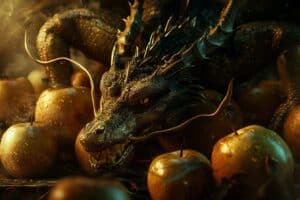
On The forbidden fruit I describe the Hesperides as the “Daughters of the Evening” or nymphs of the west, to whom Hera entrusted the golden apples, together with the hundred-headed dragon Ladon. Nymphs lists them among the other Greek nymphs. On Herculus I retell the labour in which Hercules had to fetch the apples: he either killed the dragon or tricked Atlas into getting them for him.
Bashar, channeled by Darryl Anka, reads the dragon Ladon and the golden apples as symbols. Asked about Heracles and the dragon, he says the apples stand for knowledge that humanity was kept from, and he ties them to the tree of knowledge (at 25:35). His view of the dragon itself is on Dragons.
It ties directly into your ancient story of the fruit of the tree of knowledge of good and evil.
Bashar

A garden in the far west
The ancient writers placed the garden beyond the known world. The island of Erytheia was guarded by Orthrus, a two-headed dog, and the cattle were herded by the giant Eurytion describes Erytheia as one of the Hesperides, the islands at the westernmost edge of the known world. Canary Islands: The Gaunches had light skin, fair hair, and blue eyes notes that ancient writers sometimes put the garden in or near the Canary Islands. On Ancient sources on Atlantis I list the geographer Statius Sebosus, who placed Atlantis forty days’ sail from the Gorgades islands to the Hesperides, in the middle of the Atlantic.
On War Against the Atlantioi: Led by Queen Myrina, the Amazones invaded the Atlantioi I show how Diodorus Siculus combined the tales of the Hesperides, the Libyan Amazones of Lake Tritonis and the Atlantioi into one history.
The Hesperides as Atlantis
Ignatius Donnelly saw the garden as one more memory of Atlantis. On The Irish Colonies from Atlantis, after quoting an Irish poem about Tir-na-n’oge, the land of eternal youth that rises out of the western sea, he concludes:
This is the Greek story of Elysion; these are the Elysian Fields of the Egyptians; these are the Gardens of the Hesperides; this is the region in the West to which the peasant of Brittany looks from the shores of Cape Raz; this is Atlantis.
Ignatius Donnelly, Atlantis: The Antediluvian World

On The antiquity of some of our great inventions he adds that the Greek traditions of the golden apples of the Hesperides and the golden fleece point to Atlantis. On The Pyramid, the cross and the Garden of Eden he quotes an older writer who placed the gardens on an island of the ocean, or on the islands off the north or west coast of Africa. And Atlantis: a name recorded by hundreds of cultures includes the Hesperides in its list of names for Atlantis.
Arundell: the Garden of the Hesperides as a memory of Eden
Lord Arundell of Wardour answered Ignatius Donnelly in The Secret of Plato’s Atlantis (1885). In his account Plato built Atlantis mainly from the voyage of the Carthaginian Hanno along the coast of Africa and from old traditions of the Deluge. Donnelly sees support for his theory in the placing of the Garden of the Hesperides in the islands of the west.
His confirmation of the theory, however, again disappears when we remember that the Garden of the Hesperides was only one of the reminiscences of Eden.
Lord Arundell of Wardour, The Secret of Plato's Atlantis (1885), chapter I, p. 11
Spence on the Hesperides
In 1943 Lewis Spence published The Occult Sciences in Atlantis. In his account primitive Greek poetry places the abode of the pious dead on an island in the Atlantic, far beyond the Pillars of Hercules. The quotations are short excerpts for review and study.
Primitive Greek poetry and myth situate the abode of the pious dead far beyond the Pillars of Hercules, in an island in the midst of the Atlantic.
Lewis Spence, The Occult Sciences in Atlantis (1943), chapter II, p. 25
Diodorus on Hesperus, son of Atlas
In Book III of G. Booth’s 1814 translation of The Historical Library of Diodorus the Sicilian, Diodorus tells the Atlantides’ story of Hesperus, a son of Atlas. In that account he vanished in a tempest from the top of Mount Atlas, and the brightest star was called after him.
The vanishing of Hesperus
Being upon the top of Mount Atlas, to observe the motion of the stars, he suddenly vanished in a tempest. The people hereupon, much lamenting the loss of him, that they might for ever honour him, called the brightest star in the heavens after his name.
Diodorus Siculus, The Historical Library of Diodorus the Sicilian, trans. G. Booth, printed by W. M'Dowall for J. Davis, London, 1814, vol. I, Book III, p. 201
Bailly on a fertile garden in a land of ice
In Letter XXI of Lettres sur l’Atlantide de Platon et sur l’ancienne histoire de l’Asie (London and Paris, 1779), Jean-Sylvain Bailly places the garden of the Hesperides near the pole. After that claim he turns to the golden apples, and to the difficulty of picturing such fertility in a country now covered in ice.
A country where one sees only ices
This fertility disturbs a little the idea that we form for ourselves of a country where one no longer sees anything but ices.
Jean-Sylvain Bailly, Lettres sur l'Atlantide de Platon et sur l'ancienne histoire de l'Asie (London and Paris, 1779), Letter XXI, p. 308, translated from the French
Related pages
- The forbidden fruit
- Herculus
- Nymphs
- The island of Erytheia was guarded by Orthrus, a two-headed dog, and the cattle were herded by the giant Eurytion
- Ancient sources on Atlantis
- The Irish Colonies from Atlantis
- The Pyramid, the cross and the Garden of Eden
- Atlantis: a name recorded by hundreds of cultures
For every page I tagged with Hesperides, see the Hesperides tag archive.