
Table of Contents
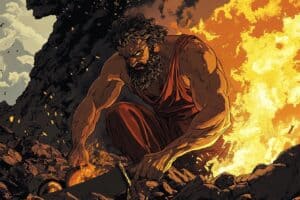
Hephaestus, the Greek smith god of fire and metalworking, keeps turning up in my research where myth touches craft: in volcanoes, in Egyptian temples and in the golden objects that pass from hand to hand through the old genealogies. These are the pages where I wrote about him.
The forge under the mountain
On Mines I list the mines of Hephaestus: the divine blacksmith was believed to keep his forge under Mount Etna, and Homer’s Iliad, Book 18, has him working beneath the earth. On Mount Etna I go further into the myth of the mountain as the forge of Hephaestus, Vulcan to the Romans, where he crafted weapons and armour for the gods.
Hephaestus in Egypt
The Greeks matched Hephaestus with the Egyptian creator god Ptah, as I note on Ptah. That is why Herodotus calls Sethos a priest of Hephaestus who rose to become king of Egypt, on Account of Sethos. On Ancient Egypt – 11,800 BCE I quote Herodotus counting 341 generations from Menes to this priest of Hephaestus, and on Account of Menes Menes is credited with building the temple of Hephaestus, that is Ptah, at Memphis. On The semi-mythical aspect of Manetho’s king list Ptah, equated with Hephaestus, stands first among the god kings, with a span of 9,000 years.
In H. C. Hamilton and W. Falconer’s 1856 wording of the same Geography, volume II, Strabo reports what Herodotus said about temples of Vulcan, the Roman name for Hephaestus, at Memphis.
Herodotus mentions, that there were at Memphis temples of the Cabeiri as well as of Vulcan, which were destroyed by Cambyses.
Strabo, The Geography of Strabo, trans. H. C. Hamilton and W. Falconer, Henry G. Bohn, London, 1856, vol. II, p. 190
The golden basket
On Who Was Telephassa? I follow Moschus, who traces Europa’s golden basket back to the smith god:
Now Europa’s basket was of gold, an admirable thing, a great marvel and a great work of Hephaestus, given of him unto Libya the day the Earth-Shaker took her to his bed, and given of Libya unto the fair beauteous Telephassa because she was one of her own blood; and so the virgin Europa came to possess the renownèd gift, being Telephassa was her mother.
Moschus, Europa, translated by Edmonds
Other craftsmen gods
On Colonization I compare the artisans among the Anunnaki with Kothar-wa-Khasis, a Canaanite god of craftsmanship who resembles Hephaestus.
Daniel Wilson on the smith gods
In The Lost Atlantis and Other Ethnographic Studies (1892) Daniel Wilson places Hephaestus among the legendary first metalworkers.
Variations of the first worker
Wilson sets Hephaestus beside Tubal-cain, Vulcan, Wayland and the Aztec Quetzalcoatl.
The history of the grand achievement is embodied in the earliest myths both of the Old and the New World. Tubal-cain, Dædalus, Hephæstus, Vulcan, Vœlund, Galant, the Luno or the Celtic Fingal, and Wayland, the Saxon smith-god, are but legendary variations of the first worker by whom the gift of metallurgy was communicated to man; and so too the New World has its Quetzalcoatl, or Vœlund of the Aztecs, the divine instructor of their ancestors in the use of the metals.
Daniel Wilson, The Lost Atlantis and Other Ethnographic Studies (1892), chapter IV, p. 182
Proclus on Hephaestus
Proclus writes about Hephaestus, called Vulcan in Thomas Taylor’s 1820 translation, in The Commentaries of Proclus on the Timaeus of Plato.
Lame and hurled from Olympus
Proclus reads the lameness and fall of the god as symbols. In his account Hephaestus makes bodies, the last things in the order of being.
But he is lame in both his feet, as being the fabricator of things that are last in the progressions of being; for such are bodies; and also as being no longer able to proceed into another order. Likewise, because he is the maker of the universe, which, as Timæus says, is without legs. And he was hurled from on high to earth, as extending his fabrication through the whole of a sensible essence.
Proclus, The Commentaries of Proclus on the Timaeus of Plato, trans. Thomas Taylor (1820), vol. 1, book I, p. 120
The seed of the Athenians
Proclus repeats the fable that the Athenians sprang from the seed of Hephaestus. In his account the god is always in love with Athena, called Minerva here.
And on this account it is said that the seed of Vulcan, together with earth, gave subsistence to the generation of the Athenians. For according to the fable also, Vulcan being in love with Minerva, emitted his seed on the earth, and from thence the race of the Athenians blossomed forth. In short, therefore, Vulcan is always in love with Minerva, imitating her intellectual nature, in the fabrication of sensibles.
Proclus, The Commentaries of Proclus on the Timaeus of Plato, trans. Thomas Taylor (1820), vol. 1, book I, p. 121
Plato on Hephaestus and Athene
In the Timaeus and Critias, in Benjamin Jowett’s translation, Critias says that Hephaestus and Athene received Attica as their common portion and planted there a people of the soil.
A common portion of the land
Brother and sister, and united in the love of philosophy and art, they are said to have given that land its first order of government. Their names were kept, but their actions were lost through destruction and the lapse of ages.
Now different gods had their allotments in different places which they set in order. Hephaestus and Athene, who were brother and sister, and sprang from the same father, having a common nature, and being united also in the love of philosophy and art, both obtained as their common portion this land, which was naturally adapted for wisdom and virtue; and there they implanted brave children of the soil, and put into their minds the order of government; their names are preserved, but their actions have disappeared by reason of the destruction of those who received the tradition, and the lapse of ages.
Plato, Critias, 109c-d (Jowett)
Related pages
- Mines
- Mount Etna
- Ptah
- Account of Sethos
- Ancient Egypt – 11,800 BCE
- Account of Menes
- Who Was Telephassa?
- Colonization
For every page I tagged with Hephaestus, see the Hephaestus tag archive.

