
Table of Contents
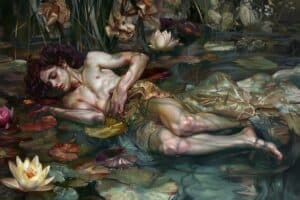
Hermaphroditus was a figure in Greek mythology, known as the son of Hermes, the messenger god, and Aphrodite, the goddess of love and beauty.
He was originally a handsome young man who attracted the love of a water nymph named Salmacis.
The story goes that Salmacis was deeply enamored with Hermaphroditus and attempted to seduce him. When he resisted her advances, she prayed to the gods to be united with him forever.
The gods granted her wish, and their bodies were fused together, creating a being that possessed both male and female physical characteristics.
This fusion resulted in Hermaphroditus being depicted as having both male and female genitalia, and from this myth, the term “hermaphrodite” (meaning a person or animal having both male and female sex organs) is derived.
Hermaphroditus is often depicted in classical art as a figure with a beautiful, androgynous form, embodying the attributes of both sexes.
His story is a symbol of the blending of male and female characteristics and has been interpreted in various ways through history, reflecting ancient views on gender and sexuality.
Characteristics or stories similar to Hermaphroditus
| Culture | Name | Description | Similarity to Hermaphroditus |
|---|---|---|---|
| Hindu | Ardhanarishvara | A composite form of the god Shiva and his consort Parvati, depicted as half male and half female. | Embodies both male and female aspects, similar to Hermaphroditus' androgyny. |
| Norse | Loki | Although not typically androgynous, Loki gave birth to Sleipnir after transforming into a mare. | Shows fluidity in gender roles and transformation. |
| Mesopotamian | Ishtar | A goddess associated with love, beauty, sex, and war, sometimes depicted with dual characteristics. | Represents a combination of traits typically associated with both genders. |
| Egyptian | Hapi | The god of the Nile's inundation, often depicted with both male and female attributes, such as breasts and a beard. | Depicted with both male and female characteristics. |
| Native American (Zuni) | Ahsonnutli | A creator deity, often considered both male and female. | Combines male and female elements, similar to Hermaphroditus. |
| African (Yoruba) | Obatala | A god associated with creation and purity, sometimes depicted as having both male and female traits. | Contains aspects of both genders, akin to Hermaphroditus' androgynous nature. |
| Polynesian | Tāne Mahuta | A god of forests and birds who, in some stories, is considered to have dual gender characteristics. | Depicted with dual gender traits in certain narratives. |
Adam as both man and woman
Jewish and Christian commentators read Genesis 1:27 as saying that the first human was male and female in one body. Baring-Gould records the idea in Legends of Old Testament Characters (1871).
The notion of the first man having been of both sexes till the separation, was very common. He was said to have been male on the right side and female on the left, and that one half of him was removed to constitute Eve, but that the complete man consists of both sexes.
Sabine Baring-Gould, Legends of Old Testament Characters (1871), chapter 3, p. 17
The androgyne in Theosophy
In The Lost Lemuria (1904) William Scott-Elliot sets out Haeckel’s account of reproduction, from budding to two-sexed and separate sexes. He then says the Third Race on Lemuria went through similar stages.
Now, the interesting fact in connection with the evolution of Third Race man on Lemuria, is that his mode of reproduction ran through phases which were closely analogous with some of the processes above described. Sweat-born, egg-born and Androgyne are the terms used in the Secret Doctrine.
William Scott-Elliot, The Lost Lemuria (1904), p. 27

