
Table of Contents
In the Book of Saphah, Oahspe (1882) gives Dan’ha as a word of the Panic language for “The etherea, the highest place in ethereal worlds.” The same entry describes the sun as a serpent and counts the cycles of time back from Kosmon.
The sun as the great serpent
The sun I made as the head of a serpent, and his phalanx made I as the body of a serpent; thus made I the great corporeal serpent.
Oahspe, 1882, Book of Saphah, Interpretation 58, p. 802
In Oahspe the body of the serpent is the sun’s phalanx, the group of worlds that travels with it, rather than its orbit. Jehovih gives the sun a circuit and numbers “his time a thousand tuos and seven aka and four bi’jus, for the sun coil.” Along that circuit he places A’ji, which Oahspe glosses as “semi-dark,” and Ji’ay, “Semi-light,” in many places. Dan’ha he places “only in one thousand six hundred places.”
How long a cycle lasts
A cycle of time is about three thousand years, sometimes more, sometimes less.
Oahspe, 1882, Book of Saphah, Interpretation 58, p. 802
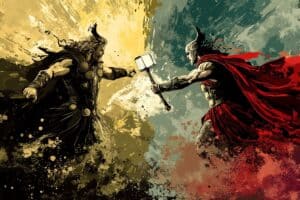
Oahspe then counts the cycles back from Kosmon, “the present time.” It gives 3,400 years back to Moses and Capilya, “alias Capella,” and 2,400 years from them to Brahma and Abraham. From there it is 3,100 years to Zarathustra, and 3,300 years from Zarathustra to Osiris the first. The count continues with 3,200 years from Osiris to Thor, 2,800 years from Thor to Apollo, 3,200 years from Apollo to Sue, and 3,600 years from Sue to Aph.
| Event | Year (BCE) |
|---|---|
| Kosmon Era (Present) | 1880 (CE) |
| Moses and Capilya | 1,520 BCE |
| Brahma and Abraham | 3,920 BCE |
| Zarathustra | 7,020 BCE |
| Osiris the First | 10,320 BCE |
| Thor | 13,520 BCE |
| Apollo | 16,320 BCE |
| Sue | 19,520 BCE |
| Aph | 23,120 BCE |
The table assumes 1880 as the present year; Oahspe does not name a base year. Oahspe dates the day the angels of heaven were made known to mortals, the start of Kosmon, to March 31, 1848. See also the Synopsis of Sixteen Cycles and the Book of Saphah.
Proclus on endless periods
Proclus reads Plato’s Laws as teaching that time has no beginning. In The Commentaries of Proclus on the Timaeus of Plato (Thomas Taylor’s translation, 1820) he says mankind has passed through countless barren and fertile periods.
For Plato in the Laws clearly says, that time is infinite according to the past, and that in this infinity there have been myriads on myriads of barren and fertile periods of men.
Proclus, The Commentaries of Proclus on the Timaeus of Plato, trans. Thomas Taylor (1820), vol. 1, book II, p. 242
Endless development in The Secret Doctrine
In The Secret Doctrine (1888), Blavatsky presents development itself as without a beginning or an end that the mind can reach:
The Secret Doctrine teaches the progressive development of everything, worlds as well as atoms ; and this stupendous development has neither conceivable beginning nor imaginable end.
H. P. Blavatsky, The Secret Doctrine (1888), Vol. I, p. 43


