
Table of Contents
Description of Thor (Etherean God) in the
In the Oahspe: A New Bible, Thor is depicted as an Etherean God, a high-ranking divine being who serves Jehovih, the Creator, in the administration of the heavens and the Earth. Unlike Anuhasaj, who is a false god driven by ambition and deception, Thor is a true and faithful servant of Jehovih, embodying wisdom, authority, and benevolence. Below is a detailed and accurate description of Thor based on the Oahspe text:
Role and Authority
Thor is an Etherean God, meaning he originates from the Etherean realms, the highest spiritual planes in Oahspe’s cosmology, characterized by purity and proximity to Jehovih. He is appointed as a God of Earth and its lower heavens for specific cycles, tasked with overseeing the spiritual and material progress of humanity. For example, in the “Book of Thor, Son of Jehovih,” Thor is described as the God of Earth during a cycle approximately 7,800 years before Kosmon (circa 5,800 BCE), managing the heavens of Hored and the Earth during a critical period of spiritual development.
Establishment of Heavenly Kingdoms
Thor is responsible for founding and organizing heavenly kingdoms to guide both angels and mortals. In the “Book of Thor,” he establishes Hored as a new heavenly kingdom, restructuring the spiritual governance after the decline of previous false gods. He appoints officers, such as marshals, asaphs (collectors of newly deceased souls), and ashars (guardian angels), to maintain order and protect mortals from drujas (low, chaotic spirits). His administration is marked by order, discipline, and devotion to Jehovih’s will.
Resurrection and Deliverance
A key aspect of Thor’s role is the resurrection of souls, guiding them from the lower heavens to higher Etherean realms. He organizes grade systems to assess the spiritual progress of angels and mortals, ensuring that those ready for ascension are delivered to higher heavens. For instance, Thor delivers millions of angels to Etherean regions like Nesact and Hoitsa, using his light-ships to transport them. He also rescues mortals and angels from the influence of false gods, restoring faith in Jehovih.
Interaction with Mortals
Thor’s influence extends to Earth, where he inspires mortals to live righteously and worship Jehovih. He sends ashars to guard newborns and guide humanity toward spiritual purity. In the “Book of Thor,” he is credited with inspiring the establishment of Faithist communities in regions like Shem, Ham, and Jaffeth, fostering non-resistance, charity, and communal living. His presence ensures that mortals are protected from the chaos caused by drujas and false gods.
Character Traits
Thor is depicted as wise, just, and compassionate, with a deep commitment to Jehovih’s universal plan. He is a skilled administrator, capable of managing vast heavenly kingdoms and coordinating the efforts of thousands of angels. Unlike Anuhasaj, Thor’s actions are selfless, aimed at uplifting others rather than seeking personal glory. His leadership is characterized by foresight, as seen in his preparation for future cycles by cultivating new Gods and Lords to succeed him.
Key Events
Thor’s cycle includes significant events such as the submersion of the continent of Pan (Whaga) due to spiritual and material imbalances caused by prior false gods. He works to mitigate the effects of this cataclysm, saving remnants of humanity (e.g., the I’hins) and guiding them to new lands. He also confronts the lingering influence of false gods like Anuhasaj, cleansing the heavens of their druj-infested kingdoms and establishing a new spiritual order.
Symbolism and Power
As an Etherean God, Thor wields immense spiritual power, including the ability to manipulate ethereal light and command vast fleets of light-ships. His throne in Hored is a place of divine authority, where he receives reports from his officers and issues decrees in Jehovih’s name. His presence is associated with light, harmony, and progress, contrasting sharply with the darkness and chaos of false gods.
Comparison to Other Figures
Thor’s role as an Etherean God in Oahspe invites comparison to various figures from religious and mythological traditions, though his unique position within Oahspe’s cosmology makes direct parallels challenging. Below are some comparisons, along with my reasoning:
- Archangel Michael (Christian Tradition):
- Similarities: Like Michael, Thor is a high-ranking divine being who serves as a protector and warrior for the divine order. Both figures are tasked with combating spiritual corruption (Michael against Satan, Thor against false gods like Anuhasaj) and guiding souls toward salvation. Thor’s role in cleansing the heavens of drujas parallels Michael’s battle against demonic forces.
- Differences: Michael is primarily an archangel, not a God with administrative duties over Earth and heavens, and his role is more militaristic than Thor’s, which emphasizes governance and resurrection. Oahspe’s universalist framework also lacks the dualistic eternal conflict of Christian theology, as Thor’s efforts lead to redemption rather than permanent defeat of enemies.
- Why This Comparison?: Thor’s role as a divine protector and leader in Jehovih’s service aligns closely with Michael’s archetype as a champion of God’s will, especially in spiritual warfare and guidance.
- Indra (Hindu Mythology):
- Similarities: Indra, a Vedic god associated with thunder, war, and leadership, shares some traits with Thor, particularly in his authority over natural and spiritual forces. Both are powerful divine figures who maintain order and combat chaos. Thor’s association with the name “Thor” (evoking the Norse god of thunder) and his role in managing cosmic cycles in regions like Vind’yu (India) suggest a connection to Indra’s domain.
- Differences: Indra is a deity within a polytheistic pantheon, often depicted with human-like flaws, whereas Thor in Oahspe is an Etherean God of pure spiritual origin, wholly devoted to Jehovih. Indra’s battles are often physical or elemental, while Thor’s are primarily spiritual, focusing on resurrection and heavenly governance.
- Why This Comparison?: Oahspe’s references to Vind’yu and its spiritual history make Indra a relevant comparison, especially given Thor’s authoritative and protective role, though Thor’s monotheistic devotion to Jehovih sets him apart.
- Thor (Norse Mythology):
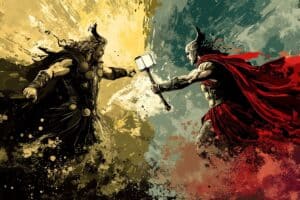
- Similarities: The name “Thor” in Oahspe clearly draws from the Norse god Thor, known for his strength, protection of humanity, and association with thunder. Both figures are powerful protectors who combat chaotic forces (Norse Thor against giants, Oahspe Thor against drujas and false gods). The Oahspe Thor’s leadership and divine authority echo the Norse Thor’s role as a heroic defender of Asgard and Midgard.
- Differences: Norse Thor is a mythological deity with anthropomorphic traits, wielding a hammer (Mjolnir) and engaging in physical battles, while Oahspe’s Thor is a spiritual Etherean God focused on cosmic administration and soul resurrection. The Oahspe Thor lacks the earthy, warrior-like persona of his Norse counterpart and operates within a monotheistic framework.
- Why This Comparison?: The shared name and protective role make Norse Thor an obvious point of comparison, though Oahspe reinterprets the figure in a spiritual, universalist context, stripping away mythological elements like the hammer or physical combat.
My Opinion on the Best Comparison
In my view, the closest comparison to Thor in Oahspe is Archangel Michael from Christian tradition. Thor’s role as a high-ranking, faithful servant of Jehovih, tasked with protecting souls, combating spiritual corruption, and guiding humanity toward divine truth, aligns closely with Michael’s archetype as a divine warrior and protector of God’s order. Both figures are authoritative, spiritually powerful, and focused on upholding the will of the Creator against opposing forces. The cleansing of heavens from drujas and false gods mirrors Michael’s battles against Satan and demonic forces.
While the Norse Thor provides an intriguing comparison due to the shared name and protective role, Oahspe’s Thor is far more spiritual and administrative, lacking the mythological warrior traits of his Norse counterpart. Indra is relevant given Oahspe’s references to Vind’yu, but his polytheistic context and less universalist nature make him a less precise fit. Moses, while a leader, lacks the divine and cosmic scope of Thor’s role. Michael’s celestial authority and alignment with a monotheistic divine plan make him the most fitting parallel, though Oahspe’s universalist redemption narrative adds a unique dimension not fully present in Christian theology.


Comments are closed.