
Table of Contents
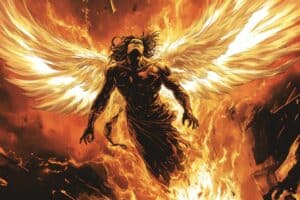
In the Oahspe: A New Bible, Eskra is a significant Etherean God, a high-ranking divine being from the Etherean realms, the purest spiritual planes in Oahspe’s cosmology.
As a faithful servant of Jehovih, the Creator, Eskra is tasked with overseeing Earth and its heavens during a transformative cycle that spans the rise of major world religions and the continued influence of false gods.
His role is detailed primarily in the Book of Eskra, with additional context in the Book of Wars Against Jehovih.
Role and Authority
Eskra is appointed as an Etherean God to govern Earth and its lower heavens during a cycle approximately 1,200 BCE–400 CE (4,000 B.K.–1,482 A.K.), with the Kosmon Era beginning around 1882 CE (Oahspe: Book of Eskra, Chapter I; Book of Wars Against Jehovih).
As a “Son of Jehovih,” Eskra holds immense authority, tasked with managing the spiritual and material realms during a period marked by the rise of Judaism, Christianity, and Islam, alongside the persistent influence of false gods like Baal, Ashtaroth, and Looeamong.
Establishment of Heavenly Kingdoms
Eskra establishes a new heavenly kingdom, Hapsendi, to replace the corrupted hadan heavens (false spiritual realms) of false gods and to support the spiritual reformation initiated by Cpenta-armij (Book of Eskra, Chapter II). Hapsendi serves as a spiritual capital for guiding angels and mortals, with Eskra appointing millions of officers, including:
- Asaphs: Angels collecting deceased souls for judgment and education in Hapsendi.
- Ashars: Guardian angels protecting mortals, particularly Faithists, from drujas (chaotic spirits).
- Loo’is: Angels guiding mortal leaders, such as Elijah and other prophets, to fulfill Jehovih’s plan.
Eskra organizes Hapsendi with councils, schools, and industries, creating a robust spiritual government to align Earth with Jehovih’s universal order.
Management of False Gods and Religions
Eskra’s primary mission is to oversee the transition of Earth’s spiritual landscape as false gods, particularly Looeamong (Kriste), Baal, and Ashtaroth, establish major religions (Christianity, later Islam) while Faithist principles continue to be upheld by true prophets (Book of Eskra, Chapter III; Book of Wars Against Jehovih, Chapter LII).
He ensures that Jehovih’s plan progresses despite these distortions, guiding true prophets to maintain monotheistic worship.
Support for Mortal Prophets
Eskra works through angels to inspire prophets like Elijah and others, who counter Baal worship and restore Faithist teachings (The Book of Saphah, The Basis of the Ezra Bible). His divine guidance supports the preservation of Jehovih’s covenant amidst the rise of false religions.
Resurrection and Deliverance
Eskra oversees the resurrection of souls, delivering millions of angels from hadan heavens to higher Etherean realms like Eos and Nirvana (Book of Eskra, Chapter V). He uses light-ships (otevans) to transport high-grade spirits, implementing a grading system to free them from druj bondage and advance their spiritual progress.
Key Events
- Spiritual Inventory and Reorganization (~1,200 BCE): Eskra begins his cycle by taking an inventory of Earth’s mortals and spirits, assessing the spiritual state post-Cpenta-armij (Book of Eskra, Chapter I). He establishes Hapsendi, restructuring the heavens to support true prophets and limit false gods’ influence.
- Prophetic Interventions (~9th Century BCE):
- Elijah: The angel Jerub inspires Elijah, who counters Baal worship in 2768 B.K. (The Book of Saphah, The Basis of the Ezra Bible). Elijah’s efforts restore Faithist principles amidst false god influence.
- Other unnamed prophets continue to uphold Jehovih’s worship in regions like Vind’yu, Jaffeth, and Arabin’ya.
- Rise of False Religions:
- Looeamong’s Christianity (~1st Century CE): Looeamong, a Triune false god, establishes Christianity as Kriste, manipulating mortal followers through Gabriel (Thoth) (Book of Eskra, Chapter XLV). Eskra allows this to unfold as part of Jehovih’s plan, ensuring true Faithists remain distinct.
- Gabriel’s Islam (~7th Century CE): Gabriel, later acting as Mohammed’s angel, founds Islam, becoming the fourth false god (Book of Eskra, Chapter XLVI). Eskra oversees this development, maintaining spiritual balance.
- Conflicts Among False Gods:
- Baal and Ashtaroth inspire the Assyrian (722 BCE) and Babylonian (587 BCE) captivities of the Israelites, weakening Faithist communities (Book of Wars Against Jehovih, Chapter LII).
- Looeamong uses Persians and Greeks (~539–490 BCE) to defeat Baal and other false gods, consolidating his power (Book of Eskra, Chapter XLV).
- Eskra manipulates these rivalries to limit false gods’ dominance, ensuring Jehovih’s plan progresses.
- Eskra’s cycle coincides with significant cultural advancements, including the consolidation of Judaic traditions, the spread of Greek philosophy, and the foundations of Christian and Islamic thought, though distorted by false gods (Book of Eskra, Chapter III). True Faithists, guided by Eskra’s angels, maintain Jehovih’s worship in small communities.
- Eskra prepares the heavens for the Kosmon Era (~400 CE–present) by appointing successors and ensuring the resurrection of souls (Book of Eskra, Chapter VI). His work sets the stage for the spiritual awakening detailed in Oahspe’s later books.
Character Traits
- Eskra is depicted as a wise and strategic leader, managing complex heavenly and earthly dynamics to advance Jehovih’s plan (Book of Eskra, Chapter III). His ability to balance false gods’ influence with prophetic interventions showcases his tactical acumen.
- Eskra’s compassion is evident in his efforts to liberate angels and guide mortals toward Jehovih’s truth, despite false religions’ dominance (Book of Eskra, Chapter IV). His unwavering devotion to Jehovih ensures his actions align with universal redemption.
- As an Etherean God, Eskra wields immense power, manifested through his command of ethereal light and fleets of otevans. His throne in Hapsendi radiates divine authority (Book of Eskra, Chapter I).
- Eskra anticipates the rise of Christianity and Islam, allowing their development while supporting true prophets to preserve Faithism, preparing for the Kosmon Era (Book of Eskra, Chapter VI).
Significance
Eskra’s cycle (~1,200 BCE–400 CE) is a critical period in Oahspe’s cosmology, bridging the reformation efforts of Cpenta-armij and the spiritual awakening of the Kosmon Era. His management of false gods’ religions (Christianity, Islam) and support for prophets like Elijah ensure the continuity of Faithist principles amidst spiritual distortion. Eskra’s reorganization of Hapsendi and resurrection of souls strengthen the heavenly framework, influencing the development of Judaism, Christianity, and Islam, though these are shaped by false gods. His legacy persists in the Kosmon Era (143 A.K. in 2025), where Faithist ideals support global spiritual unity, countering the legacy of false religions.
Sources
- Oahspe: Book of Eskra, Chapter I–VI (primary source for Eskra’s role and cycle)
- Oahspe: Book of Wars Against Jehovih, Chapter LII (context for false gods’ religions and captivities)
- Oahspe: Book of Cosmogony and Prophecy, Chapter III–V (cycle timing, cosmic arcs)
- Oahspe: Book of the Arc of Bon, Chapter I (Noe’s time period, Arc of Noe context)
- Oahspe: Book of Aph, Son of Jehovih (Aph’s flood, Atavia’s statement)
- Oahspe: Book of Cpenta-armij, God’s Word, Sapha (context for preceding cycles)
- Oahspe: Book of Knowledge (Kosmon Era, 2025 as 143 A.K.)


Comments are closed.