
Table of Contents
Book contents. Next: Introductory remarks and notes.
This is the first of four companion volumes, in which I have attempted to translate the works attributed to Xenophon. The three remaining volumes will, it is hoped, be published in succession within a reasonable time.
The text, which, as a rule, I have followed throughout, is the editio stereotypa of Gustav Sauppe, the occasional variations from which are noted at the bottom of the page.
The task, which I set myself some years ago, was to produce a version which should be true at once to the sense and spirit of the original and at the same time readable as an English book. I desired, in other words, to follow in the footsteps of the Master of Balliol, non passibus aequis ; and in the case of so popular and plain a writer as Xenophon I thought I might satisfy my ambition.
I did not, as it now appears to me, sufficiently allow for personal deficiencies ; nor until I came to study the problem of translation more closely did I realise how impossible it was to represent in English the essential quality of a writer so peculiar.
After trying many spirits in vain, I thought I might
discover some helpful analogy to the speech of Xenophon within the field of English literature. Before long I hit upon Goldsmith. I think I owed this suggestion to my friend Professor Lewis Campbell. I believe there is a real resemblance between Goldsmith and Xenophon.
But Goldsmith, in spite of his versatility, plain, simple, and human-hearted as he is, corresponds only to a side of Xenophon, whose idiom, not to speak of other differences, is at once more modern and more acchaic.
Goldsmith indeed, had he chanced to translate the Hellenica or any other portion of Xenophon, would doubtless have produced a masterpiece of English “written in a soft and Xenophontine manner” {molli et Xenophonteo sermonis genere conscriptum). Or, to take a more modem instance, could Mr. Ruskin, cujus sermo est ille quidem melle dulcior^ have carried out a projected work of his on education (see his Introduction to Deucalion), he might have illustrated his life of Xenophon by translations or comments in a style as sweet as the original.
Of my own attempt it would be out of place to speak further ; but I seem to have discovered as the reward of endeavour some true obstacles to success. These I will briefly summarise.
The difficulty of fairly translating Xenophon into readable English depends partly on the fundamental differences between Greek and English, and partly on the peculiarities of. Xenophon’s own style. Of the first I nee^ not speak. The latter may be named as
(i) A mannerism in the use of particles (76 firjVy aXK^ fifjv … 76 and the rest), felt not disagreeably, but like some trick of gesture or intonation on the part of a friend.
These particles if rendered literally, “But indeed,” ” howsoever,” etc., would appear un-English. They must therefore be given up, or their suggestion otherwise conveyed.
(2) A certain unevenness (^avcofiaXla), very marked at times (even where there is no reason to suspect a later editorial hand), and curiously contrasting with a style so plain, as a rule, and unaffected. I can best illustrate this by pointing out that many passages of Xenophon, so simple and inartificial is he, might be turned quite literally and without impropriety into the English of the Gospels. However it may chance, such is the true ring of many of his sentences. But then again, and without forgetfulness, for any length of time, of his dominant quality, this same simple writer is detected striving after some effect of fashionable literary form. He is by no means devoid of figures of language or of thought, as the old critics have it ; — he delights in word jingles and double compounds and sonorous polysyllables : he is Isocratic for the nonce : and his style, so far from reminding us of the English of the Gospels, has the afflatus rather of the muse of modern journalism. Great discrimination is needed on the part of the translator, so as neither to ignore nor yet to exaggerate the effect of such ” anomalousness.”
(3) The last difficulty I shall speak of is connected less with diction than vocabulary. Xenophon, as an excellent modern critic has said, is not in the strict sense of the word an Attic writer. ” With Attic for jts basis (his speech) allows of words from all the dialects, and is wanting in that quality which has justly been termed purity” (see The New Phrynichus^ p. 160). Yet purity {KadapoTq^;), it so happens, is a quality which one of the best ancient critics attributes
to him. This is an interesting question. But for the present I wish merely to draw attention to the fact that, while in -Xenophon’s vocabulary the Attic words, that is to say, words represented by good vernacular classical English, predominate, his gamut is wide enough to admit a host of non-Attic words, and in two directions. At one end of his scale he has a number of words Ionic or old Attic (the Doric are so few that I need not speak of them) which arouse an archaic or poetic suggestion in the reader’s brain ; and at the other a very large admixture of quite modern vocables common to himself and to the writers of the next generation, that is to say, of the common dialect These produce a very opposite sense on the reader’s mind. They have the ring about them of the modern — or possibly even the degenerate.
To represent the quality here spoken of — this extraordinary width of gamut — one may perhaps find an analogy of a sort in the history of our own tongue. If the correct Victorian English, as it is sometimes named, of our own land to-day may be allowed to stand for the newer Attic of Isocrates’ time, Xenophon is not unlike an able American of the moment, bringing forth from the treasure-house of language vocables new and old. At one time, and quite naturally, he will use words bearing the stamp of Elizabethan or of Puritai times; at another he employs some specimen of the latest vernacular, which has hardly as yet received the^ consecration of literary usage.
The combined dignity and freshness of a style composite, employed by a writer of tact and delicacy such as Xenophon, might perhaps be represented by any one who could write as gracefully and freely as the author of My Study Windows,
It remains for me to express my obligations to many friends for much help directly or indirectly given to me in the course of this work.
I am especially indebted to three of my old friends : to Mr. J. R. Mozfey, who has been at pains to read through and criticise nearly all the proof-sheets of this volume ; to Mr. Arthur Sidgwick, with whom I revised the earlier half of the translation ; and to Mr. J. A. Symonds, whose ready sympathy has been at all times of the utmost help to me. I am indebted for similar aid in revision and otherwise to another old friend, Dr. Evelyn Abbott ; as also to Professor Hastings Crossley of Belfast ; and to Mr. S. T. Irwin, one of my colleagues in Clifton College.
The books which have been of the greatest service to me in this volume are : the three Histories of Greece by Grote, Thirl wall, and Curtius ; Grote’s Plato ; J ebb’s Attic Orators ; the three Histories of Greek Literature by Miiller and Donaldson, Mure, and Mahaffy ; the Dissertatio de Vita Xenophontis by Adalbert Roquette ; and the Geschichte des Griechischen Kriegswesens by Riistow and Kochly.
I have already named the edition of Xenophon by Gustav Sauppe, which has been my companion for many years. But I am equally indebted to those other great Xenophontine editors, Ludwig Dindorf, C’ G. Cobet, and Arnold Hug. I have further derived occasional help from the following editions : Hellenica^ I. and II., H. Hailstone, and HeUenicay I. and H., G. E. Underbill ; the Griechische Geschichte of Dr. B. Büchsenschütz; the Anabasis of F. Vollbrecht, the Anabasis of A. Pretor; and Anabasis, Books I.-IV., W. W. Goodwin and J. W. White. I hope I have always remembered to express my special obligations to authors here unnamed, at the proper place. It is impossible in a work of this kind not to build largely, and sometimes unconsciously, on the labour of others.
Finally, my best thanks are due to my friend Mr. George Macmillan for all sorts of help ; and to Mr. John Bolton for the pains which he and the rest of Mr. Stanford’s staff have taken to make the maps a useful addition to the work.
In conclusion, I would ask the indulgence of any scholar who may care to glance at these pages, for much which to him will appear superfluous ; and of the public at large for anything that in spite of my intention may serve to misrepresent my author.
Clifton, November 1889.
NOTE EXPLANATORY OF MAPS
Attica and Boeotia. [To face p. xli.]
This map is from the 1:300,000 map of Greece, issued by the Military Geographical Institute of Vienna in 1885. The ancient roads are printed in red. Ancient sites compared with Dr. William Smith’s Ancient Atlas; Map of Central Greece, by Dr. Müller; and Dr. H. Kiepert’s Atlas and Map of Greece. A few heights in English feet above sea level have been engraved.
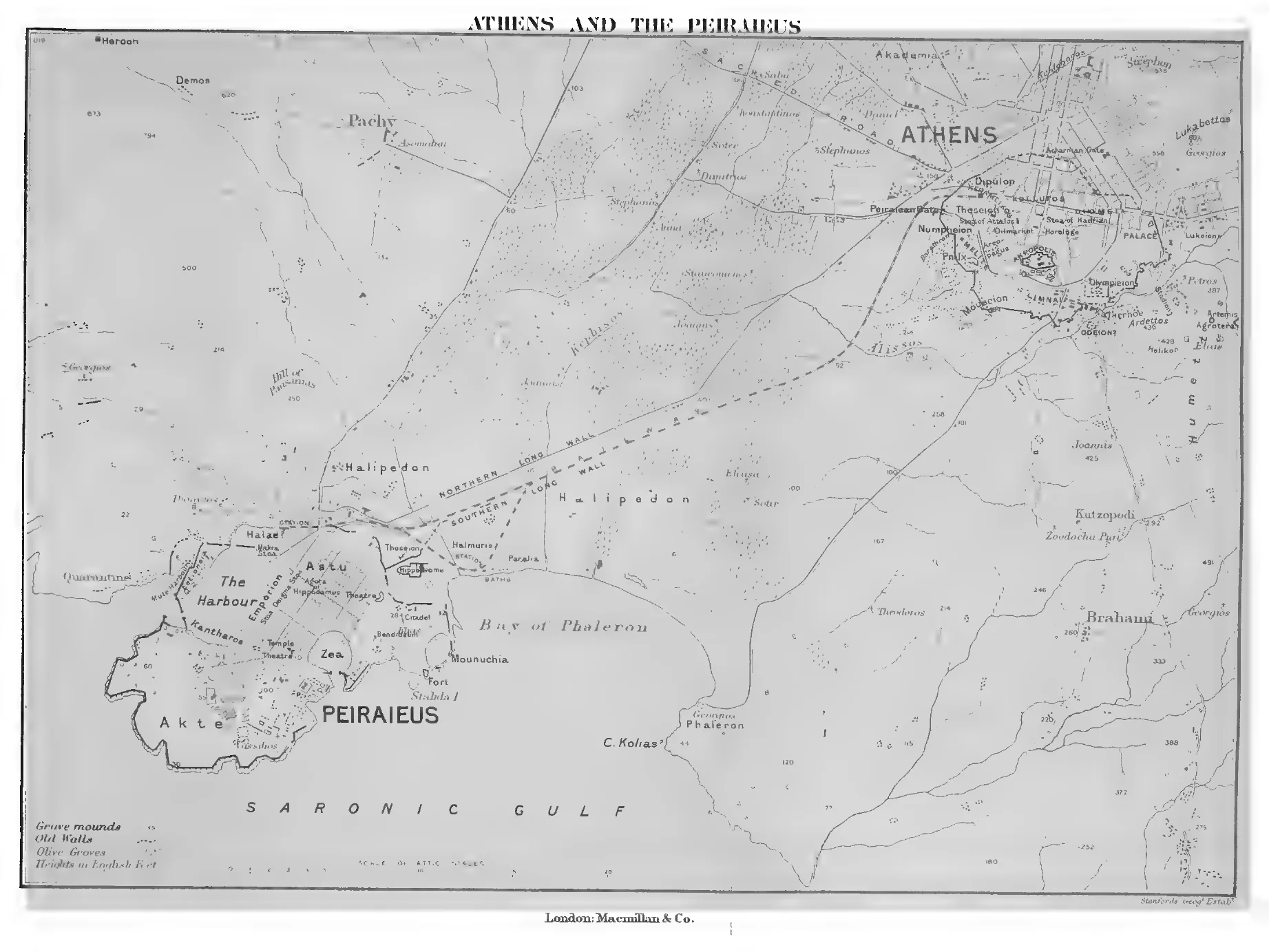
Athens and Piraeus. [To face p. 76.]
This map is reduced from the survey executed by officers of the Royal Prussian General Staff at the instance of the Imperial German Archaeological Institute. The modern topographical features are printed in gray ink, and the ancient sites and existing ruins in red. Doubtful identifications have a note of interrogation after the names. The heights of numerous points in English feet above mean sea level in the harbour of Piraeus are shown by small gray figures. Contour lines, or lines of equal altitude, are drawn at intervals of (65.6 feet) vertical. The olive groves (a conspicuous feature in the landscape) are engraved in the usual conventional manner. The scale of this map is given in Attic stades. There are 8½ Attic stades in one English statute mile.
Part of Babylonia. [To face p. 116.]
This is taken from Edward Stanford’s map, based on surveys of ancient Babylonia, etc., made, by order of the Government of India in 1860 to 1865, by Commander W. Beaumont Selby, Lieutenant W. Collingwood, and Lieutenant J. B. Bewsher; with others made by Felix Jones, I.N., compiled by order of H.M. Secretary of State for India in Council by Trelawney Saunders, F.R.G.S., Geographical Assistant, India Office, 1885.
The Country around Scillus. [To face p. 218.]
This map is drawn chiefly from that accompanying the account of excavations at Olympia by Kaupert and Dörpfeld, supplemented from the 1:300,000 map of Greece issued by the Military Geographical Institute of Vienna. Ancient sites and roads are shown in red. Heights, of which but few are obtainable, are expressed in English feet above the level of the sea.
Route of the Ten Thousand. [To face p. 318.]
Chiefly from Dr. H. Kiepert’s map of the Asiatic Provinces of the Ottoman Empire, published in 1884, and the route maps of Dr. Sterrett, published in 1886. The route has been carefully laid down in accordance with present topographical knowledge of the country, and where it differs from the route, as drawn on Dr. Kiepert’s latest wall map of the Persian Empire, that route is shown by broken red lines. Better surveys are required before we can satisfactorily lay down the tracks between the Pylae Syriae and Thapsacus, and between the Phasis and Gymnias.
ERRATA
P. 14, line 7, for “Hegesandridas” read “Agesandridas.”
P. 48, in headline, for “B.C. 405” read “B.C. 405-404.”
P. 81, line 26, for “two” read “officers.”
P. 92, line 25, for “Myriandrus” read “Myriandus.”
P. 105, line 5 of note, for “justificatives” read “Justificatives.”
P. 117, line 8, for “Demaratus” read “Damaratus.”
P. 131, line 5, for “now” read “had.”
P. 151, in headline, for “Oct. 22” read “Oct. 22—Night.”
P. 193, line 28, for “dashed” read “clashed.”
P. 197, footnote should read “Probably a tributary of the Araxes = modern Pasin-Su.”
P. 202, line 10, for “Spartan” read “Laconian.”
P. 204, line 19, for “three stages of ten parasangs” read “three stages—ten parasangs.”
P. 251, line 15, for “Maryandynians” read “Mariandynians.”
P. 285, line 2, for “Selymbria” read “Selybria.”

