
Table of Contents
Santorini, the ancient Thera, is the volcanic island in the Aegean whose Bronze Age eruption is the most popular Mediterranean answer to Plato’s Atlantis. I keep coming back to it, so these are the pages where it appears and the reasons some authors accept it and others set it aside.
The Minoan reading
On Minoan Civilization: Colony of Atlantis I keep an excerpt in which Jim Marrs follows Gavin Menzies, who reads the legend as a garbled memory of the Minoan sea empire of Crete:
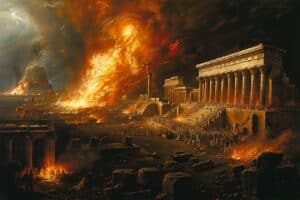
Their empire ended about 1500 BC with the gigantic eruption of the volcano on the island of Santorini, which sent millions of tons of volcanic ash into the atmosphere, produced intense atmospheric shockwaves, and generated disastrous tsunamis.
Jim Marrs, Our Occulted History, on Gavin Menzies
On The Phaeacians and Phoenicians I place the eruption around 1600 BCE and count the Minoans among the strongest candidates for a historical base of the story. On 3000 BC: Notes and References a tree ring note from Baillie puts an Aegean eruption of Santorini in 1628 BC. On Atlantis: One Name, Many Locations Santorini and Minoan Crete are one of the candidate locations.
The objections
Andrew Tomas, in Atlantis: From Legend to Discovery (1972), sets Santorini aside. Galanopoulos lands the disaster on 1460 B.C., but Tomas allows the island only 75 square miles and asks how ten provinces could have stood on it. He keeps the date of the priests:
According to Solon, Atlantis perished 9,000 years before his trip to Egypt, or in 9560 B.C.
Andrew Tomas. Atlantis: From Legend to Discovery (Sphere, 1973), p. 19
The video The 5th Kind on whether Plato’s Atlantis was real makes the same point in one line:
Santorini's timeline does not match the dates that Plato claimed for Atlantis
The 5th Kind, The 5th Kind on Plato's Atlantis
The Maritime History Podcast in Akrotiri, the Thera eruption, and Atlantis sets the ship fresco of Akrotiri and the Thera tsunami beside Plato and finds the fit incomplete. In What historians still cannot settle about the Minoans the eruption is not treated as the direct end of Minoan Crete, and daily life on the island goes on after the palaces.
Thera in other theories
In Jürgen Spanuth’s Atlantis: The Mystery Unravelled (1956) I note that Spanuth, in later books, linked the disaster to the eruption of Thera, which is now dated around 1600 BC. Stewart Pearce, on Atlantis: One Name, Many Locations, goes the other way: for him the Azores, Santorini and Crete were all high peaks of one mountain range of a far larger Atlantis.
In the video Myth or Lost Alien Civilization Giorgio A. Tsoukalos walks through Akrotiri, where no human remains were found, and asks whether the Telekhines on the frescoes were the real builders of Atlantis.
Related pages
- Minoan Civilization: Colony of Atlantis
- Atlantis: From Legend to Discovery (1972)
- Atlantis: One Name, Many Locations
- The Phaeacians and Phoenicians
- 3000 BC: Notes and References
- Jürgen Spanuth’s Atlantis: The Mystery Unravelled (1956)
- Akrotiri, the Thera eruption, and Atlantis
- The 5th Kind on whether Plato’s Atlantis was real
- What historians still cannot settle about the Minoans
For every page I tagged with Santorini, see the Santorini tag archive.

