

Table of Contents
Atlantis was created by a migration from Lemuria across the North, Central, and South American continents, creating what you now refer to as the American Indian civilizations that ultimately reached Atlantean shores.
This is why the look of Atlanteans was very mixed, but at first was mostly what you now recognize as indigenous cultures of the Americas. The architecture was more similar to what you call Aztec architecture rather than European or Grecian.
Later colonies, such as the Minoan civilization, became far removed from the original early Atlantean style and took on some European styles.
Bashar

Question: Is the Minoan Linear A script a derivative of Atlantean writing systems?
Bashar: Yes, it is a derivative — not exact, but an offshoot. Things change over time.
Question: Any hints about deciphering these texts?
Bashar: No. You have people working on this, and we will leave them to their tasks according to their timeline.
The closest representation of Atlantean architecture is Aztec architecture; large stone blocks and pyramids found in Central and South America resemble the structures you would have seen in Atlantean times.
The Aztec architecture that remains is the closest remnant to the idea of Atlantean architecture that still exists on your planet now.
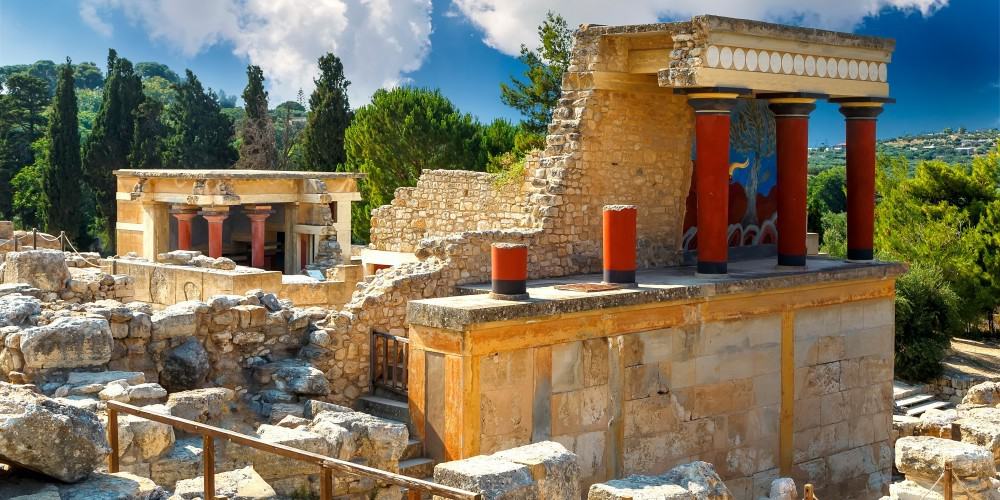
It did change a little bit when they went to the other side of the Mediterranean, but it didn’t become Grecian architecture. The closest representation is what you call the Minoan Architecture, specifically the Crete.
On the island of Crete, you will see an ancient Atlantean colony in that temple, which is known as The Labyrinth Temple. The legend of the minitor says that the Atlanteans were bull worshippers, so the idea is that they adopted some of the Grecian architecture but still retained something quite different.
If you look at the architecture of the Temple of Knossos you will find that the pillars and the structures there are not what you would find in the area you know to be Greece.
They are painted differently, they are shaped differently. And it represents more the idea of the Atlantian idea of decoration being that the pillars are red and black and the stones are white
If you look at the remnants of the labyrinth in the Temple of Knossos on the island of Crete, you will see that it was actually an initiation labyrinth from the Atlantean culture.
Bashar

(photo credit: Wikimedia Commons)

THE MINOAN EMPIRE AND SANTORINI
Excerpt from OccultedHistory by Jim Marrs
More recent theories have placed Adantis at various Mediterranean locations, including Crete, Cyprus, and the island of Santorini (ancient Thera). In his 2011 book, The Lost Empire of Atlantis, author Gavin Menzies presented a cogent argument for the legend of Adantis being simply a vague and garbled recollection of the Minoan Empire, a Bronze Age seafaring civilization centered on the island of Crete and named for its line of kings, collectively named Minos. According to Menzies’s studies, Minoan ships ranged from the Americas to India. Their empire ended about 1500 BC with the gigantic eruption of the volcano on the island of Santorini, which sent millions of tons of volcanic ash into the atmosphere, produced intense atmospheric shockwaves, and generated disastrous tsunamis.
Menzies wrote of ingots of nearly pure copper found in a sunken Minoan ship near Thera. Because copper of this quality is found only near Lake Superior in North America, the Minoans clearly had amazing range with their fleet of ships. Menzies also noted that the tobacco beetle, Lasioderma serricorne, was found in volcanic ash in the Minoan town of Akrotiri. This beetle is only indigenous to the Americas.
Because Menzies has equated the Minoan civilization with the Atiantean Empire, he believes that the great volcanic eruption on Santorini helped create the legend of Atlantis. Much like the myth of Atlantis’s destruction taken from Plato, the resulting tidal waves, deadly gaseous clouds, famine due to destroyed crops, and opportunistic pirate clans finished off the great Minoan Empire, leaving remarkably little behind.
Yet there are others who disagree with Menzies’s position. R. Cedric Leonard said that Menzies and others who believe Minoan Empire and Atlantis were one and the same have mistakenly traced Atlantis back to the Bronze Age instead of the Ice Age as described by Plato, who placed the time of Atlantis at
about 9600 BC. “By thus ‘miniaturizing’ it (both size-wise and time-wise), it has been made more palatable for modern scientists and scholars to accept,” said Leonard. “Plato describes Atlantis as having subjected the parts of Libya within the columns of Heracles as far as Egypt, and of Europe as far as Tyrrhenia.’
The Minoan kings never conquered neither Europe nor North Africa. But archeological evidence is abundant indicating that a cohesive ‘megalithic culture’ occupied those very same areas of Europe and North Africa in Mesolithic times (5,000-6,000 years before the Minoan empire began).”
Moreover, the area of Atlantis as described by Plato was far larger than that ascribed to the Minoan culture.
The Minotaur and Minoan Civilization
At Knossos, Wallis learned about the origin of the Minoan civilization. The guide explained that the Minoans descended from the hybrid offspring of Europa and Zeus.
Europa, a Phoenician princess, was abducted by Zeus, and their son, Minos, became the progenitor of the Minoan civilization.
This story, considered history by the locals, further intrigued Wallis, as it mirrored other cultural myths that attribute advanced knowledge to non-human origins. Source
Minoan Civilization and Bull-Leaping
The Minoans on Crete, contemporaneous with the proposed time of Atlantis, practiced bull-leaping, a ritualistic and possibly religious ceremony involving bulls.
This practice indicates a shared cultural motif centered around bulls in the ancient Mediterranean, possibly influenced by or parallel to Atlantean traditions. Source
Minos (Greek Myth)
The three hybrid (demigod) sons of Europa and Zeus in Greek mythology were Minos, Rhadamanthys (also spelled Rhadamanthus), and Sarpedon.
Zeus, the shape-shifting king of the gods, abducted the Phoenician princess Europa in the form of a magnificent white bull and carried her across the sea to Crete. There, he fathered these three sons with her. (Europa later married the Cretan king Asterion/Asterius, who adopted the boys.)
Minos
The most famous of the three. He became king of Crete (after prevailing in a contest involving a bull sent by Poseidon). He is the legendary ruler associated with the Minoan civilization (named after him by later Greeks).
Minos is central to the myths of the Labyrinth, the Minotaur (born to his wife Pasiphaë), and the Athenian tribute of youths. After his death, he became one of the three judges of the dead in the Underworld (alongside his brother and Aeacus), known for his stern but just verdicts.
In Greek mythology the Minotaur was a creature with the body of a man and the head of a bull. It lived inside a huge maze called the Labyrinth on the island of Crete. According to the story:
- King Minos of Crete received a special white bull from the god Poseidon.
- Minos’s wife, Pasiphaë, fell in love with the bull (through a curse) and gave birth to the Minotaur.
- The creature was kept hidden in the Labyrinth.
- Every nine years Athens had to send seven young men and seven young women as tribute. They were sent into the Labyrinth and killed by the Minotaur.
- The hero Theseus eventually entered the Labyrinth, killed the Minotaur, and found his way out with the help of a thread given to him by Minos’s daughter Ariadne.
Rhadamanthys (Rhadamanthus)
Renowned for his wisdom, incorruptible justice, and virtue. He ruled parts of Crete (or was involved in Cretan kingship) before being exiled or leaving when Minos consolidated power.
Like his brother, he became a judge of the dead, often placed in the Elysian Fields or Isles of the Blessed, where he judged the souls of the righteous. Some sources emphasize his inability to be deceived and his role as a paragon of fairness.
Sarpedon
Minos became king of Lycia in Asia Minor. In the Iliad, he is a major Trojan ally who fights bravely at Troy and is ultimately slain by Patroclus (with Zeus reluctantly allowing his death while honoring him with special rites).
Note on sources: While Minos and Rhadamanthys are consistently named as sons of Zeus and Europa across ancient authors, Sarpedon’s parentage shows some variation — Homer and certain traditions give him a different mother (Laodamia). However, many genealogies (including Hesiodic traditions and later compilations) include him as the third son of Zeus and Europa.
These three brothers were demigods — hybrids between the immortal, shape-shifting god Zeus and the mortal Phoenician princess Europa. Their stories blend Cretan kingship, justice in the afterlife, and heroic exploits. Minos in particular became the eponymous figure for the sophisticated Bronze Age culture of Crete (the Minoans), whose palaces, art, and bull-related rituals echo in the myths.
The abduction of Europa by the bull is one of the most iconic scenes in Greek art and literature.


Comments are closed.