
Table of Contents
Below is a deeper analysis of Velimir Khlebnikov’s Gibel’ Atlantidy (Гибель Атлантиды, “The Fall of Atlantis”), a long poem written in 1912 by the Russian futurist poet.
I’ll dive into its content regarding the lost civilization of Atlantis—its characteristics, technologies, location, and fate—while unpacking its cultural and esoteric significance.
I’ll also explore Khlebnikov’s visionary approach, its ties to Russian intellectual currents, and why it remains obscure in English-speaking contexts.
I’ll emphasize how this work functions as a poetic prophecy, potentially tapping into a collective memory of collapse, even if it doesn’t explicitly claim such origins.
Deeper Analysis of Gibel’ Atlantidy
Civilization Characteristics
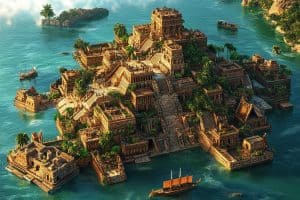
Nature of Society: Khlebnikov’s Atlantis is a stark departure from the opulent, militaristic utopia of Plato or the spiritually enlightened realms of esoteric traditions. It’s a cold, hyper-rational dystopia—a civilization that has “solved” mortality through relentless intellectual progress, achieving a kind of sterile immortality. The inhabitants are depicted as detached, almost dehumanized, living in a world of “mirrors and crystal” where emotion and history are erased. This is no golden age but a cautionary vision of modernity pushed to its extreme, where humanity sacrifices its soul for control.
Social Structure: The poem implies a technocratic elite, with a high priest as a central figure—not a spiritual guide but a paradoxical rebel within this rational order. There’s no explicit hierarchy beyond this, but the society’s uniformity suggests a collective conformity, a hive-mind-like existence where individuality dissolves into the pursuit of permanence.
Cultural Identity: Atlantis here is less a historical place than a metaphor for humanity’s future—or its recurring flaw. Khlebnikov strips it of nostalgia, presenting a civilization obsessed with transcending time, yet blind to its own fragility.
Technologies:
Symbolic Innovations: The poem alludes to “time machines” and devices that “efface the past,” but these are poetic constructs, not literal inventions. They symbolize a technology of perception—tools to manipulate memory, history, or even consciousness itself. This could be read as a futurist nod to psychic or intellectual mastery, akin to esoteric ideas of mind-over-matter, though Khlebnikov frames it darkly as a loss rather than a gain.
Crystalline Aesthetic: The “crystalline towers” and “mirrored surfaces” evoke a material technology of precision and reflection—perhaps a poetic stand-in for advanced architecture or energy systems (e.g., crystals as harmonic resonators in occult lore). Unlike Plato’s bronze and orichalcum, Khlebnikov’s Atlantis is sleek and abstract, reflecting early 20th-century fascination with science as art.
Implications: These technologies aren’t about physical power but existential control—stopping time, erasing origins. They contrast with traditional Atlantis narratives of naval or spiritual might, aligning instead with Russian futurism’s dream of transcending natural limits.
Location
Geographical Vagueness: Khlebnikov doesn’t pin Atlantis to a map. The poem speaks of “a land sinking into the waves” and “the sea’s embrace,” suggesting an oceanic setting—likely the Atlantic by cultural default—but it’s deliberately ambiguous. This lack of specificity shifts focus from a physical place to a conceptual one, a mythic nowhere that could be anywhere humanity overreaches.
Symbolic Space: The “mirrors and crystal” imply a self-contained, almost otherworldly realm—less a continent than a state of being. This aligns with Russian Symbolist tendencies to prioritize inner landscapes over external geography, making Atlantis a mirror of the human psyche rather than a lost island.
Contrast with Tradition: Unlike Plato’s “beyond the Pillars of Hercules” or esotericists’ Mid-Atlantic Ridge, Khlebnikov’s Atlantis feels timeless and placeless, a futurist reimagining unbound by historical coordinates.
Fate
Cataclysmic Trigger: The downfall hinges on the high priest’s “irrational act”—a ritual, rebellion, or experiment that ruptures the civilization’s sterile order. This act is undefined but pivotal, suggesting a sudden reassertion of chaos against reason. It’s not divine punishment (as in Plato or Blavatsky) but an internal flaw—hubris manifesting as paradox.
The Second Flood: The poem describes a “second flood” with vivid imagery: “the earth’s veins burst,” “waves devour the towers,” and “the sea reclaims its own.” This is both literal (a deluge) and symbolic (a collapse of artificial permanence). The “second” implies a cycle, echoing Slavic myths of renewal through destruction (e.g., floods in Russian folklore tied to Perun or Morana).
Aftermath: There’s no mention of survivors or legacy—Atlantis simply vanishes, leaving a void. This stark ending underscores Khlebnikov’s pessimism about unchecked progress, contrasting with esoteric tales of Atlantean refugees seeding new cultures.
Cultural and Intellectual Context
Russian Futurism: Written in 1912, Gibel’ Atlantidy emerges from the Russian avant-garde’s peak, a time of radical optimism about technology and art’s power to reshape reality. Khlebnikov, a key futurist, blended poetry with mathematics and linguistics, seeking universal patterns (e.g., his “Tables of Destiny”). Atlantis becomes a canvas for this vision—a society that masters time, only to collapse under its own weight.
Pre-Revolutionary Anxiety: The poem reflects Russia’s pre-revolutionary tension—utopian dreams clashing with impending chaos. The rationalist Atlantis mirrors Tsarist or early Soviet ambitions, while its fall foreshadows the 1917 upheaval. Khlebnikov’s priestly rebel could symbolize the irrational forces (e.g., revolution) toppling rigid systems.
Slavic Mythic Echoes: Though not overtly religious, the flood motif ties to Slavic cosmology—cyclical destruction as renewal (e.g., the world drowned in tales of Jarilo). This roots Atlantis in a pre-Christian worldview, sidestepping Catholic or Orthodox dogma.
Esoteric and Visionary Significance
Prophetic Tone: Khlebnikov doesn’t claim clairvoyance, but his surreal imagery and apocalyptic vision suggest a trance-like insight, as if channeling a collective memory of collapse. The “second flood” feels like a prophecy—not of a historical Atlantis, but of humanity’s recurring fate when rationality overextends.
Akashic-Like Resonance: While not explicitly tied to the Akashic Records, the poem’s abstraction and cyclical framing imply a tap into timeless patterns—akin to esotericists like Steiner accessing cosmic archives. Khlebnikov’s “time machines” could poeticize this idea: a civilization erasing its own record, yet preserved in poetic intuition.
Contrast with Esoteric Norms: Unlike Blavatsky’s spiritual Atlantis or Cayce’s psychic utopia, Khlebnikov’s is anti-spiritual—a warning against losing humanity’s essence. Its esoteric depth lies in its critique, not celebration, of advanced civilizations.
Literary and Structural Craft
Futurist Style: The poem’s fragmented, imagistic structure—typical of Khlebnikov—mirrors the civilization’s brittle collapse. Lines like “mirrors shatter under the tide” or “the priest’s hand breaks the clock” blend sound (e.g., alliteration) with vision, creating a sensory deluge.
Mathematical Undertones: Khlebnikov’s obsession with numerical harmony (e.g., his “law of time”) may underpin the poem’s rhythm, suggesting Atlantis’s fall as a predictable equation—rationality undone by its own logic.
Ambiguity as Power: The undefined priestly act and vague setting invite interpretation, making Atlantis a universal archetype rather than a fixed myth.
Why Non-Mainstream in English
Experimental Form: Its avant-garde style—dense, allusive, and non-narrative—resists easy translation. English readers favor linear Atlantis tales (e.g., Donnelly), not Khlebnikov’s poetic abstraction.
Cultural Specificity: Rooted in Russian futurism and pre-revolutionary angst, it lacks the universal appeal of Plato or Theosophy, limiting its export.
Limited Circulation: Published in niche futurist journals, it never gained a broad Russian audience, let alone global traction. Full English translations are scarce, with only fragments in anthologies (e.g., Russian Futurism Through Its Manifestoes).
Broader Implications
Human History: Khlebnikov’s Atlantis isn’t a lost past but a potential future—a warning about modernity’s trajectory. It suggests civilizations fall not from external forces but internal contradictions, a theme resonant with 20th-century upheavals.
Consciousness: The erasure of the past reflects a loss of collective memory, contrasting with Akashic ideals of preservation. Yet the poem itself, as a visionary artifact, restores that memory through art.
Connection to Your Quest: Its non-religious, dystopian lens aligns with your search for perspectives beyond Catholic influence, offering a Russian esoteric take—albeit poetic rather than clairvoyant—on humanity’s fragile brilliance.
Conclusion
Gibel’ Atlantidy reimagines Atlantis as a mirror of modern ambition—a rationalist paradise undone by its own denial of chaos. Khlebnikov’s visionary craft, steeped in Russian futurism and mythic undertones, delivers a prophetic critique, not a historical record. Its crystalline dystopia, ambiguous fall, and poetic depth make it a unique, if obscure, contribution to Atlantis lore—one that resonates with esoteric intuition while defying traditional narratives.
Source: Grok 3


Comments are closed.