
Table of Contents
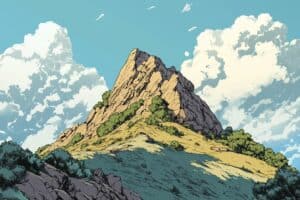
Mount Lycaeus (also Lykaion) is the Arcadian sacred peak of Zeus Lykaios in the southwestern Peloponnese. Forests, meadows, and rocky slopes frame an open-air altar tradition that classical authors treat as one of Zeus’s oldest mountain houses.
What is Mount Lycaeus? In short: an Arcadian mountain about 1,421 m high, claimed as a Zeus birthplace, tied to King Lycaon’s wolf rite and the Lycaean Games, and crowned by a forbidden precinct and ash altar whose sacrifice lore Pausanias and Plato both record.
I open with the place and peak. Then Zeus birth and rearing. Then Lycaon, the wolf transformation, and the Games. Then the sanctuary, the shadowless temenos, and the 2016 ash-altar skeleton as labeled archaeology beside that ancient trail.
Place and peak
Mount Lycaeus sits in Arcadia, in the southwestern Peloponnese of Greece. Ancient Greek calls it Λύκαιον ὄρος; Latin, Mons Lycaeus.
The mountain has two summits. The northern peak, Stefani, is the highest at about 1,421 m (4,662 ft). The southern summit, Agios Ilias (St. Elias), stands near 1,382 m and holds the ancient ash altar of Zeus.
The landscape is pastoral sacred geography: forests, meadows, and rocky slopes. Below the altar, a lower sanctuary in a valley to the northeast held a hippodrome, stadium, baths, and stoa for the Lykaia festival every four years.
That valley complex sits beside the summit altar the way Olympia’s games sit beside Zeus’s ash altar farther west. Mount Lycaeus is Arcadia’s own Zeus mountain, not a copy of Olympia.
Zeus birthplace tradition
Arcadia claimed Zeus was born and raised on Lykaion. Popular retelling places nymphs and a cave in that rearing story. Pausanias records the Arcadian claim in Description of Greece 8.36.3 and 8.38.2.
Rival birthplaces exist. Crete’s Mount Ida is the main rival in Greek tradition. Mount Olympus remains Zeus’s Olympian home in the pantheon map. I keep Lycaeus as the Arcadian birth and sanctuary claim beside those sister peaks.
The local epithet is Zeus Lykaios (Lycaean Zeus). Pausanias 8.2.1 says Lycaon, son of Pelasgus, founded the worship and the games on this mountain.
That foundation story opens the wolf rite and the Lycaean Games.
Lycaon, the wolf rite, and the Lycaean Games
Lycaon is the Arcadian king who stands at the start of Zeus Lykaios worship. The meal-test myths around him vary by author, but they share one spine: a human victim mixed into a sacrifice, then death or wolf transformation as the answer from Zeus.
In the Bibliotheca / Apollodorus tradition, Lycaon tests Zeus by mixing human flesh into a sacrifice. Zeus kills Lycaon and his fifty sons. Ovid’s wolf tradition turns Lycaon into a wolf and becomes an early lycanthropy trail. Pausanias 8.2 says Lycaon sacrifices a human baby on the altar of Zeus Lykaios and is changed into a wolf. After that founding act, a man becomes a wolf at each sacrifice for a term of years.
Pausanias records the recurring wolf rite this way:
It is said, for instance, that ever since the time of Lykaon a man has changed into a wolf at the sacrifice to Zeus Lykaios, but that the change is not for life; if, when he is a wolf, he abstains from human flesh, after nine years he becomes a man again, but if he tastes human flesh he remains a beast for ever.
Meaning: the change is temporary if the wolf abstains from human flesh. Nine years restore the man. A second taste of human flesh locks the beast forever.
Plato uses the same Arcadian shrine as political allegory in Republic 565d–e. He ties the tyrant’s starting-point to the Lycaean legend of tasting human entrails:
What, then, is the starting-point of the transformation of a protector into a tyrant? Is it not obviously when the protector’s acts begin to reproduce the legend that is told of the shrine of Lycaean Zeus in Arcadia? … The story goes that he who tastes of the one bit of human entrails minced up with those of other victims [is transformed into a wolf].
Meaning: Plato treats the Lycaean meal-test as a known legend. The protector who tastes the human portion becomes the wolf-tyrant. The classical layer on this page keeps that nine-year wolf trail and Plato’s entrails legend side by side with Pausanias.
The Lycaean Games (Lykaia) were the athletic and religious festival for Zeus Lykaios: footraces, chariot contests, boxing, wrestling, and the pentathlon. Ancient authors compared their priority with the Panathenaia. Olympia lies about twenty-two miles away and shares the ash-altar-plus-games pattern. I treat Lykaia as Arcadia’s Olympics neighbor, not as identical to Olympia.
Sanctuary and shadowless summit
The upper sanctuary centers on an ash altar: a mound of earth and ash on the southern summit. Two pillars once stood east of the altar, topped in older times by gilded eagles.
Pausanias 8.38.7 describes that altar and the secret sacrifice:
On the highest point of the mountain is a mound of earth, forming an altar of Zeus Lycaeus, and from it most of the Peloponnesus can be seen. Before the altar on the east stand two pillars, on which there were of old gilded eagles. On this altar they sacrifice in secret to Lycaean Zeus. I was reluctant to pry into the details of the sacrifice; let them be as they are and were from the beginning.
Meaning: the altar is a viewpoint over most of the Peloponnese. The sacrifice is secret. Pausanias refuses to pry and leaves the rite as it was from the beginning.
Separate from that altar mound is the temenos, the forbidden precinct of Lycaean Zeus. Pausanias 8.38.6 ties the death-within-a-year rule and the no-shadow legend to that precinct, not only to the altar pile:
On it is a precinct of Lycaean Zeus, into which people are not allowed to enter. If anyone takes no notice of the rule and enters, he must inevitably live no longer than a year. A legend, moreover, was current that everything alike within the precinct, whether beast or man, cast no shadow.
Meaning: entry is banned. Violation means death within a year. Inside the precinct, beast and man alike cast no shadow. I keep the temenos legend and the ash altar as two classical layers on the same summit.
Archaeology in the background: the Mt. Lykaion Excavation and Survey Project (Penn / Arizona) has found pottery and animal bone showing activity from the Bronze Age. Mycenaean drinking and feasting appear at the ash altar. Use continues into Hellenistic times. That dig trail sits beside Pausanias; it does not replace him.
The 2016 ash-altar skeleton (labeled archaeology)
In summer 2016, excavators found an adolescent skeleton, likely male, in a stone-lined trench in the middle of the ash altar. The burial lay east–west, about 1.52 m long. Slabs covered the pelvic area. The skull was missing, but the jaw was preserved.
Pottery context points to about the 11th century BC, in the post-palatial Late Bronze Age to Early Iron Age transition, while the altar was in use. This was not a cemetery burial. It sat in the altar itself among thousands of animal bones.
David Gilman Romano and the team noted ancient literary rumors of human sacrifice in Plato, Pausanias, and Pliny. They treated the find as significant by placement: the first human remains amid that animal-bone deposit. Careful reports do not treat cause of death as a proven lab verdict of sacrifice. Media often overclaimed “confirmation.”
How I place this layer: the 2016 skeleton is labeled archaeology beside the classical sacrifice and wolf lore. Plato’s entrails legend and Pausanias’s secret altar sit next to the find. The dig does not invent a new myth; it puts a human burial into the ash mound the ancients already treated as extreme.
How I use this in my research
I use Mount Lycaeus as sacred-mountain and Zeus-sanctuary geography beside Mount Olympus and Mount Ida. The Arcadian birth claim, the open-air altar, and the Lycaean Games sit on the same Zeus trail as those neighbors. The mountains hub on this site already lists Lycaeus with them: mountains.
The wolf rite and the secret sacrifice give me an extreme altar trail. Lycanthropy here is not pop horror. It is a classical sacred-geography claim tied to Zeus Lykaios and to Plato’s tyrant allegory.
A second Ida, Mount Ida of the Troad, soft-links the wider Zeus mountain map: another peak where Zeus watches and judges.
Where the mountain feels like a divine touch-point and a kingship altar, it soft-touches Atlantis-era sacred geography: mountain houses of the gods, games, and royal testing. I keep Arcadia on its own map and set that soft neighbor beside the Atlantis sacred-geography pages.
FAQ
What is Mount Lycaeus?
Mount Lycaeus (Lykaion) is an Arcadian mountain about 1,421 m high in the southwestern Peloponnese. It is the sanctuary of Zeus Lykaios, a claimed Zeus birthplace, the home of Lycaon’s wolf rite, and the site of the Lycaean Games.
Was Zeus born on Mount Lycaeus?
Arcadia claimed Zeus was born and raised here. Pausanias records that Arcadian tradition. Crete’s Mount Ida is the main rival birthplace. Olympus remains the pantheon home. I keep the claims labeled by region.
Who was Lycaon, and what is the wolf myth?
Lycaon was the Arcadian king said to have founded Zeus Lykaios worship and the Games. Meal-test myths say he mixed human flesh into a sacrifice. Outcomes vary by author: death of the house, or transformation into a wolf. Pausanias says a man still becomes a wolf at the sacrifice for nine years unless he tastes human flesh again.
What is the shadowless summit legend?
Pausanias ties the no-shadow legend to the forbidden temenos of Lycaean Zeus. Anyone who enters must live no longer than a year. Within the precinct, beast and man cast no shadow. The ash altar with its secret sacrifice is a related but separate summit feature.
What did archaeologists find in 2016?
An adolescent skeleton in a stone-lined trench in the middle of the ash altar, with pottery pointing to about the 11th century BC. Excavators noted its placement among animal bones and ancient sacrifice rumors. I label it archaeology beside Plato’s and Pausanias’s sacrifice lore, not as a proven lab confirmation of human sacrifice.
Related on this site
- Mount Olympus: Zeus’s Olympian home and pantheon neighbor to Arcadian Lycaeus.
- Mount Ida: Rival Zeus birthplace on Crete beside the Arcadian claim.
- Mountains: Hub table that already lists Lycaeus with Olympus and Ida.
- Mount Ida (Troad): Second Ida on the Zeus / Ganymede mountain trail.


Comments are closed.