

Table of Contents
- A city in the delta
- The statue of Athena at Sais
- The vestibule of the temple of Athena
- The priests and Solon
- Solon and Sonchis at Sais
- What the priests remembered
- Proclus on Sais
- Pateneit, Ochlapi and Ethimon
- Fathers or a colony
- Later echoes
- Arundell: Sais and the voyage around Africa
- The voyage under Necho
- Related pages
- Churchward on the Nile Colony at Sais
- Thoth at Sais
- Bailly on the priests of Saïs
- A tradition from Solon
- Memoirs kept at Saïs
- Monuments at Memphis and Saïs
Every Atlantis story on this site passes through one city. Plato says the account came to Solon from the priests of Sais, a temple city in the Nile delta, and almost every writer I collected repeats that chain before adding their own view. I wanted to see what the site actually says about Sais itself, so I gathered it here.
A city in the delta
The German book Atlantis, die Urheimat der Arier quotes the opening of the story in Plato’s Timaeus, where Critias, one of the speakers, places the city:
There is in Egypt, began Critias, in the Delta, at the tip of which the Nile splits, a district; one calls its inhabitants the Saitic, and the greatest city of this district is Sais, the birthplace of King Amasis.
Plato, Timaeus
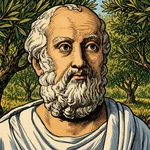
The same passage says the people of Sais honored a founding goddess the Greeks called Athena, and so counted themselves friends and kin of the Athenians. The Phaeacians and Phoenicians identifies the site as modern Sa el-Hagar. 7 Rivers of the Nile points to the Durham University Expedition to Saïs for work on how the Nile branches around the city changed over time.
The statue of Athena at Sais
In Frank Cole Babbitt’s 1936 Loeb translation of Isis and Osiris, Plutarch records an inscription from the statue of Athena at Saïs, whom the Egyptians, in his account, believed to be Isis.
In Saïs the statue of Athena, whom they believe to be Isis, bore the inscription : “ I am all that has been, and is, and shall be, and my robe no mortal has yet uncovered.”
Plutarch, Isis and Osiris, trans. Frank Cole Babbitt, Loeb Classical Library, 1936, p. 25
The vestibule of the temple of Athena
In the same translation, Plutarch describes carvings in the vestibule of that temple at Saïs.
At Saïs in the vestibule of the temple of Athena was carved a babe and an aged man, and after this a hawk, and next a fish, and finally an hippopotamus.
Plutarch, Isis and Osiris, trans. Frank Cole Babbitt, Loeb Classical Library, 1936, p. 79
The priests and Solon
Jürgen Spanuth’s Atlantis dates Solon’s visit to around 560 BC and notes the priest’s claim that Sais was founded 8,000 years before Solon and Athens 9,000 years before (Timaeus 23e). Timaeus and Critias gives the priests names from Plutarch: Psenophis of Heliopolis and Sonchis of Sais. James Churchward treats the story as too well known to repeat, on What Was the Lost Continent of Mu?:
The description of that land given to Solon by Sonchis, priest at Sais; its destruction by earthquakes, and submergence, recorded by Plato in his Timaeus, have been told and retold so many times that it is useless to encumber these pages with a repetition of it.
James Churchward
Ignatius Donnelly quotes the priest’s rebuke to the Greeks on The Kings of Atlantis become the Gods of the Greeks:
You Greeks are novices in knowledge of antiquity. You are ignorant of what passed either here or among yourselves in days of old.
A priest of Sais to Solon, quoted by Ignatius Donnelly

Proclus on the Timaeus keeps the same numbers, nine thousand years for Athens and eight thousand for Sais.
Solon and Sonchis at Sais
Lewis Spence, in The History of Atlantis (1926), treats Solon’s visit as a fact, and he reports what Plutarch says of the priest Sonchis at Sais.
The fact of Solon’s visit to Egypt also appears as indubitable. Plutarch in his Life of Solon (ch. 26) and his De Iside et Osiride (ch. 10) states that Solon visited Egypt and spoke with the priest Sonchis at Sais.
Lewis Spence, The History of Atlantis (1926), p. 40
Lewis Spence cites the chapter. Babbitt’s wording names the teachers Plutarch assigns to Eudoxus, Solon, and Pythagoras.
Eudoxus, they say, received instruction from Chonuphis of Memphis, Solon from Sonchis of Saïs, and Pythagoras from Oenuphis of Heliopolis.
Plutarch, Isis and Osiris, trans. Frank Cole Babbitt, Loeb Classical Library, 1936, p. 25
What the priests remembered
The priests did not only speak of Atlantis. Donnelly notes on The Destruction of Atlantis described in the deluge legends that the priest of Sais told Solon of a noble race in Athens before “the great deluge of all”, which resisted Atlantis before the destruction came. On The Indentity of the Civilizations of the Old World and the New the same priest explains the myth of Phaëthon as a memory of “a declination of the bodies moving round the earth and in the heavens”, which Donnelly reads as comets. Paschal Beverly Randolph, on Estimates of human origins, links a “Mysterious Event” in early Chinese annals with the catastrophe the priests of Sais described to Solon.
In the video Solon 11,600 Catastrophe, Randall Carlson works through the same dialogue. He takes the priest’s 9,000 years before Solon as a date around 11,600 years ago, at the end of the Younger Dryas, and the 8,000 years for Egypt as a founding after a thousand years of recovery.
Proclus on Sais
Proclus, head of the Platonic school at Athens in the fifth century AD, comments on the Sais passage in The Commentaries of Proclus on the Timaeus of Plato. Thomas Taylor translated it into English in 1820.
Pateneit, Ochlapi and Ethimon
Proclus gives names for the priests Solon met in three Egyptian cities. He says the names come from the histories of the Egyptians.
Solon, however, met at Saïs with a priest called Pateneit; but at Heliopolis, with a priest called Ochlapi; and at Sebennytus, with one whose name was Ethimon, as we learn from the histories of the Egyptians.
Proclus, The Commentaries of Proclus on the Timaeus of Plato, trans. Thomas Taylor (1820), vol. 1, book I, p. 85
Fathers or a colony
Proclus also records an old dispute over how Athens and Sais were related. In his account the Greek historians took opposite sides, and Atticus blamed Theopompus for the version that made Athens the colony.
Callisthenes, however, and Phanodemus relate, that the Athenians were the fathers of the Saïtæ. But Theopompus, on the contrary, says, that they were a colony of them. The Platonic Atticus says, that Theopompus altered the history through envy.
Proclus, The Commentaries of Proclus on the Timaeus of Plato, trans. Thomas Taylor (1820), vol. 1, book I, p. 82
Later echoes
The Adam and Eve Story counts the archives of Sais, with those of Alexandria and Heliopolis, among the lost writings Moses may have known. Jerusalem notes that Sais was later called the City of Hagar, the same name Galatians 4:25 gives Jerusalem. And in the letter Paul Schliemann published on How I found the lost Atlantis, his grandfather’s last note points straight back to the city:
Investigate the east of the ruins of the temple of Sais and the cemetery in Chacuna Valley.
Paul Schliemann, How I found the lost Atlantis
Arundell: Sais and the voyage around Africa
Lord Arundell of Wardour answered Ignatius Donnelly in The Secret of Plato’s Atlantis (1885). In his account Plato built Atlantis mainly from the voyage of the Carthaginian Hanno along the coast of Africa and from old traditions of the Deluge. He suggests how the story could have reached Solon and the priests of Sais.
The voyage under Necho
In Arundell’s account Atlantis began in flood tradition. The voyage around Africa under the pharaoh Necho could have brought it to the attention of Solon or the priests of Sais, as Hanno’s voyage did for Plato.
The conception of Atlantis probably originated in some development of the diluvian tradition. It is curious, however, that it might have been brought prominently to the notice and speculation of Solon or the priests of Sais under circumstances very similar to those of which we have evidence—in the case of Plato as regards Hanno, viz. through the circumnavigation of Africa during the reign of Necho or Nako (B.C. 611). No record, however, of this exploration has survived.
Lord Arundell of Wardour, The Secret of Plato's Atlantis (1885), chapter V, p. 80
Related pages
- Timaeus and Critias
- Proclus on the Timaeus
- Jürgen Spanuth’s Atlantis
- The Phaeacians and Phoenicians
- Jerusalem
- How I found the lost Atlantis
- The Destruction of Atlantis described in the deluge legends
- Plato
For every page I tagged with Sais, see the Sais tag archive.
Churchward on the Nile Colony at Sais
James Churchward, in The Children of Mu (1931), gives his own account of how Lower Egypt began. He says the Nile Colony started at Sais, on the Nile Delta, when Mayas came from Atlantis under Thoth about 16,000 years ago. The quotations are short excerpts for review and study.
Thoth at Sais
The Nile Colony was the original name of Lower Egypt. It was started at Sais on the Nile Delta by Mayas, coming from Atlantis under the leadership of Thoth about 16,000 years ago.
James Churchward, The Children of Mu (1931), chapter IX, p. 155
Bailly on the priests of Saïs
In Lettres sur l’Atlantide de Platon et sur l’ancienne histoire de l’Asie (London and Paris, 1779), Jean-Sylvain Bailly follows the chain of memory that, in his account, brought the story of Atlantis from the priests of Egypt to Plato.
A tradition from Solon
Bailly places Solon, the legislator of Athens, in that chain, as the teacher of Critias’s youth, and he treats the line of transmission as a source worthy of trust.
Critias in his youth had likewise been instructed by Solon, a friend of his father Dropidas, Solon, the legislator of Athens, and one of the seven sages of Greece. One cannot therefore point to a more venerable source, a tradition better followed and more worthy of confidence.
Jean-Sylvain Bailly, Lettres sur l'Atlantide de Platon et sur l'ancienne histoire de l'Asie (London and Paris, 1779), Letter XII, p. 25, translated from the French
Memoirs kept at Saïs
He then turns to the Egyptian priest who, in Plato, speaks to Solon. In Bailly’s account the priest is drawing on memoirs kept at Saïs, and he begins with the island of Atlantis even when the years are given as if they belonged to Egypt itself.
The Egyptian priest declares that he speaks from memoirs preserved at Saïs in Lower Egypt: these facts of 8 to 9000 years are given as the facts of the country itself; and yet he begins his narrative with the history of the island of Atlantis, which surely was not in Egypt.
Jean-Sylvain Bailly, Lettres sur l'Atlantide de Platon et sur l'ancienne histoire de l'Asie (London and Paris, 1779), Letter XII, pp. 29-30, translated from the French
Monuments at Memphis and Saïs
In a later letter, still searching for traces of the Atlantes, Bailly comes down the coast to the Nile. He says Memphis and Saïs in the Delta were full of their monuments and of their memory.
After having followed the whole coast, after having made this long journey, without having heard a word of the Atlantes, we arrive at last at the mouths of the Nile and at Memphis; this city, as well as that of Saïs in the Delta, were full of their monuments and of their memory.
Jean-Sylvain Bailly, Lettres sur l'Atlantide de Platon et sur l'ancienne histoire de l'Asie (London and Paris, 1779), Letter XIV, p. 93, translated from the French

