
Table of Contents
Quetzalcoatl, the feathered serpent of Mexico, is the figure most often brought forward as a bearded civiliser from across the ocean. These are the pages where he appears.
The bearded man from the east
On The Story of Atlantis – focus on the occult investigation of Atlantis and its sub-races W. Scott-Elliot lists him among the traditions pointing east:
Quetzalcoatl, the Mexican Deity, is said to have come from "the distant east." He is described as a white man with a flowing beard.
W. Scott-Elliot, The Story of Atlantis

On Atlantis: From Legend to Discovery (1972) Andrew Tomas places Aztlan in the east in the Mexican tradition he uses, with Quetzalcoatl coming from there. In Atlantis – a widespread distribution of land Manly P. Hall tells the story of Quetzalcoatl as one of the cultural heroes who brought civilisation, disappeared and promised to return.
Fruits and flowers
On The Indentity of the Civilizations of the Old World and the New Ignatius Donnelly writes that Quetzalcoatl, the founder of the Aztecs, condemned all sacrifice but that of fruits and flowers, which he sets beside Plato’s account of the Atlantean religion. On American Evidences of Intercourse with Europe Or Atlantis Donnelly calls Quetzalcoatl the leader and civiliser of the Nahua family.
Myth and worship
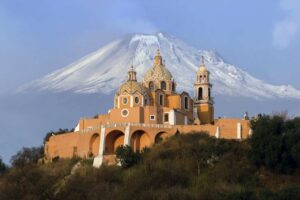
In the Aztec story of the 5 Suns the second sun is governed by Quetzalcoatl, the feathered serpent god associated with wind, air and learning. On Temple of Cholula I note that the temple was dedicated to him. On The Occult Sciences in Atlantis Lewis Spence tells how Quetzalcoatl periodically visited the Place of Shining Sand and returned as a boy after a magic draught.
Quetzalcoatl as Atlas and Poseidon
In The Problem of Atlantis Lewis Spence lists the points where a Mexican account of the world ages agrees with Plato. The first is the god himself, carved in many places as a figure holding up the sky. Herbert Spinden called these figures Atlantean.
In the first place, the god Quetzalcoatl, although he had many guises, can be equated with Atlas and Poseidon. He is, like the Greek god, represented in architecture in caryatid form, as, for example, in a statuette found in the Calle de Escalerillas in Mexico City in 1900, and at Chichen Itza in Yucatan, and many other centres in Mexico and Central America, and it is noteworthy that in many of these he is represented as having a beard. These figures Dr Herbert J. Spinden, a foremost authority on Mexican and Central American archæology, calls “Atlantean,” because of their likeness to the Greek caryatids of Atlas.
Lewis Spence, The Problem of Atlantis (1925), chapter 8, p. 99
Related pages
- The Story of Atlantis – focus on the occult investigation of Atlantis and its sub-races
- Atlantis: From Legend to Discovery (1972)
- Atlantis – a widespread distribution of land
- The Indentity of the Civilizations of the Old World and the New
- American Evidences of Intercourse with Europe Or Atlantis
- Temple of Cholula
- The Occult Sciences in Atlantis
For every page I tagged with Quetzalcoatl, see the Quetzalcoatl tag archive.

