
Table of Contents
W. Scott-Elliot published The Story of Atlantis: A Geographical, Historical, and Ethnological Sketch in 1896. This Theosophical work describes Atlantis as a real lost continent. It draws from occult sources, clairvoyance, and ancient records. A.P. Sinnett wrote the preface.
The book presents Atlantis as the home of the Fourth Root Race in Theosophical teaching. This race existed for millions of years. It faced four major catastrophes that reduced the land over time. The final island, Poseidonis, sank in 9,564 B.C.
Preface by A.P. Sinnett
Sinnett explains the use of astral clairvoyance to access past events. He states that memory exists on a non-physical plane. Trained occultists can read these records. Scott-Elliot’s book comes from such sources, including preserved Atlantean maps. Sinnett contrasts this method with materialist history based on fossils and monuments. He argues that psychic abilities advance human knowledge. He mentions examples like Keely’s inventions and European mesmerism.
Introduction and Evidence for Atlantis
Scott-Elliot focuses on the Fifth (Aryan) Root Race, with its sub-races like Hindus, Chaldeans, Persians, Kelts, and Teutons. He contrasts their recorded history with the unrecorded past of earlier races.
For Atlantis (Fourth Root Race), he lists evidence:
- Ocean floor soundings show a mid-Atlantic ridge from 50° N to near South America and Africa. Peaks include the Azores and Ascension Island. Volcanic activity near the Azores supports recent changes.
- Similar fossils and plants across continents (camels, horses, Miocene flora, seedless bananas) suggest ancient land connections.
- Language links (Basque with American tongues, Phoenician-Maya alphabets, Hebrew-Chiapenec words).
- Ethnological diversity: red, yellow, white, and black races in Atlantis. Negro types in Central America and varied American Indian complexions.
- Shared religious elements: cross worship, sun and serpent cults, similar terms for God, baptism, and confession across Old and New Worlds.
- Ancient texts and legends: Plato’s accounts, Theopompus, Diodorus Siculus, flood myths in many cultures (Popul Vuh, Troano MS.), and migrations from the east (Quetzalcoatl, Zamna).
Atlantean Sub-Races and Geographical Changes
The book includes four maps showing land changes over time:
- Map 1 (about 1 million years ago): Large Atlantis from Iceland to Brazil, including parts of North America, Europe, and Africa. Lemuria and Hyperborea remnants exist.
- Map 2 (after 800,000 years ago catastrophe): Northern parts lost. America separates. Britain connects to Scandinavia and France.
- Map 3 (after 200,000 years ago): Atlantis splits into Ruta and Daitya. Scandinavia joins Europe.
- Map 4 (75,000 years ago): Daitya almost gone. Poseidonis remains as the last island until 9,564 B.C. British Isles connect to Europe. Sahara was an ocean.
The seven sub-races evolved from the Third (Lemurian) Root Race:
- Rmoahal: Black giants (10-12 feet (3.66 meters) tall), from Lemuria’s edge, migrated to southern Atlantis and Iceland.
- Tlavatli: Red-brown, mountain people, spread to Greenland and America.
- Toltec: Copper-skinned, tall, advanced rulers of Atlantis, Mexico, Peru, and early Egypt.
- Turanian: Yellow-skinned, colonized eastward.
- Original Semite: White, from northeast Atlantis (Scotland-Ireland area).
- Akkadian: White, seafaring, ruled later Atlantis.
- Mongolian: Yellow, from Asian plains, never reached Atlantis.
Political Systems and Society
Governance varied by sub-race: from Manu rule in early groups to hereditary empires (Toltec), feudal systems (Turanian), patriarchal (Semite), oligarchic (Akkadian), and nomadic priest-rulers (Mongolian).
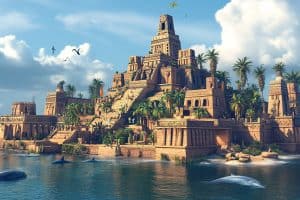
The Toltec empire peaked with Adept emperors in the “City of the Golden Gates.” Later decay led to sorcery.
Emigrations and Legacy
Sub-races migrated widely:
- Toltecs to America (Red Indians, Incas) and Egypt (pyramids).
- Akkadians to Levant, Phoenicia, Carthage, Basques.
- Others to Europe, Asia, and Africa.
Modern groups trace back to these migrations.
Arts, Sciences, and Culture
Toltecs built massive cities, used air-ships, explosives, and advanced agriculture. Education was state-supported, from basic to psychic training. Society included polygamy, equality for women, and metal books. Religion shifted from ancestor worship to sun cults and sacrifices.
Conclusion
Scott-Elliot sees Atlantis as the midpoint of the current cycle. Spirit descended into matter there, with psychic gifts mixed with base passions. The Fifth Race develops mind fully, leading to future spiritual advance.
This Theosophical account relies on occult clairvoyance, not mainstream archaeology. It influenced later esoteric views on Atlantis and root races.


Comments are closed.