Table of Contents
- Isis Worship
- Temple of Isis (destroyed)
- Summary of the Past Life Regression: Isis from Sirius
- Dreams
- OAHSPE Bible
- The inscription at Sais
- The garment no one has lifted
- Taylor on Plutarch’s version
- Heindel on the veil of Isis
- The veil none may lift
- Le Plongeon on Isis and Queen Moo
- Le Plongeon on the royal wife and sister
- Plato on the chants of Isis
- Ancient chants attributed to Isis
- Read more
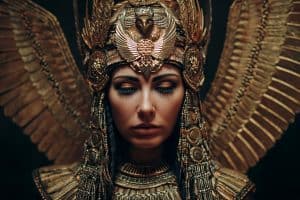
In ancient Egypt, Isis was known as the wife/sister of Osiris, sister of Nephthys, and mother of Horus. She is featured prominently in Egyptian mythology as a goddess of immense magical power and as the archetypal maternal figure. Other cultures have known her as Ishtar (Semites), Athena (Greeks), Kwan Yin (Chinese), and Inanna (Sumerians).
Names
- Isis
- Ezi
- Eset
- Aset
- related to Yemoja or Yaya, the queen of the Mami Wata pantheon
Isis Worship
About 80 BC, General Lucius Cornelius Sulla Felix, better known simply as Sulla, founded a college in Rome dedicated to the Egyptian goddess Isis. However, Isis worship was discouraged by the Roman consuls, who did not want to share control over the population. The worship of Isis at Rome continued to be suppressed by a succession of decrees until the reign of Caligula. source
Temple of Isis (destroyed)
Participants in the journey were guided to confront and integrate their own inner darkness. Through ceremonies in sacred spaces, such as the Subterranean Chamber of the Great Pyramid and the Temple of Isis, they learned to embrace their shadows as part of their wholeness. This work of witnessing and integrating darkness allowed them to find deeper compassion for themselves and others. source
Summary of the Past Life Regression: Isis from Sirius
In a session by Dolores Cannon, the subject channels Isis, a light-energy being from Sirius, part of a cosmic council overseeing planetary harmony.
36,000 years ago, after Atlantis’s destruction, Isis arrives reluctantly from Sirius to aid survivors in Egypt (former Atlantis part). She assumes a physical female body to match Earth’s frequencies.
Lives 600 years as “Ezi” (later Isis), teaching survivors love, harmony, oneness, ecology, herbal healing, frequency raising, and respect for life and nature. Builds pyramids and tunnels using light energy; some intermarry with humans to create hybrids for ongoing support.
After humans become self-sufficient, sheds body and returns to Sirius.
Isis is a highly evolved light entity, feeding on light; aligns with Sirius’s bright frequencies; council member enforcing love-based laws. Gatekeeper and teacher, focused on creation, reprogramming species, and restoring balance; embodies feminine archetypes of motherhood, regeneration, fertility, and protection. Reluctant intervener, concerned with Earth’s disharmony (e.g., pollution, greed); emphasizes free will for love, not destruction; adapts forms for planetary aid.
Dreams
Tell me about this gift [Dreams] from Isis.
A:Before this, we did not know sleep as you do. Our consciousness was always active, always awake, never finding true rest. We were constantly engaged, continuously processing. When Isis connected with us, she recognized the immense potential within our civilization. She saw that we needed a pause —a space for rest, for reflection, for emotional and spiritual growth. So, she bestowed upon us the gift of sleep, a sacred reprieve that would allow our consciousness to enter a state of stillness, freeing us to expand beyond what we had known.
A hypnotist's journey to Avalon
OAHSPE Bible
Oahspe presents a history of “false gods” (angelic or spiritual entities who set themselves up as deities and influenced earthly religions).
A figure called the false Osiris (distinct from any true higher entity) inspires the creation of idols for worship. He declares male and female aspects of himself as creator, leading to idols named Osiris (male) and Isis (female).
This occurs in sections like the Book of Wars Against Jehovih (Chapter XLVII), where Osiris consults with other false gods such as Baal, Ashtaroth, and Egupt to establish these idols. The teaching associated with them includes symbols like the bull (for Osiris, representing “to go forth”) and the lamb (for Isis, representing “to rest in meekness”).
Later references appear in God’s Book of Ben (Chapter VII), where it states that “Osiris and Isis shall go down” alongside other false deities like Anubi, Baal, Ashtaroth, and Thammus, indicating their eventual decline in influence.
Oahspe also includes plates or images, such as one labeled “Isis” (often i026 in standard editions), alongside related figures like the “False Osiris” and a “Tablet of the False Osiris.”

The inscription at Sais
Proclus gives an inscription from the shrine of the goddess of Sais in The Commentaries of Proclus on the Timaeus of Plato (Thomas Taylor’s translation, 1820). In his account the Greeks knew this goddess as Athena.
The garment no one has lifted
In the inscription the goddess says that no one has laid open the garment that hides her, and that the sun was her fruit.
But the Egyptians relate, that in the adytum of the Goddess there was this inscription, I am the things that are, that will be, and that have been. No one has ever laid open the garment by which I am concealed. The fruit which I brought forth was the sun.
Proclus, The Commentaries of Proclus on the Timaeus of Plato, trans. Thomas Taylor (1820), vol. 1, book I, p. 82
Taylor on Plutarch’s version
The translator Thomas Taylor links the inscription to Plutarch’s treatise on Isis and Osiris. He notes that only Proclus has the line about the sun.
The former part of this inscription is to be found in Plutarch’s treatise on Isis and Osiris; but the latter part of it, viz. the fruit which I brought forth was the sun, is only to be found in these Commentaries of Proclus.
Thomas Taylor, note in The Commentaries of Proclus on the Timaeus of Plato, trans. Thomas Taylor (1820), vol. 1, book I, p. 82
Heindel on the veil of Isis
Max Heindel, the Danish-born occultist who founded the Rosicrucian Fellowship, set out his teaching in The Rosicrucian Cosmo-Conception (1909). He uses the veil of Isis as an image for the hidden centre of the human being.
The veil none may lift
In Heindel’s account a clairvoyant can see all the bodies of a person except one spot, the seat of the Ego. He calls it the Isis whose veil none may lift.
This is the seat of the indwelling spirit in the man—the Holy of Holies in the temple of the human body, barred to all but that indwelling human Ego whose home it is. The trained clairvoyant can see with more or less distinctness, according to his capacity and training, all the different bodies which form the aura of man. This spot alone is hidden from him. This is the "Isis" whose veil none may lift. Not even the highest evolved being on earth is capable of unveiling the Ego of the humblest and least developed creature.
Max Heindel, The Rosicrucian Cosmo-Conception, 3rd ed. (1911), part II, chapter XII, p. 293
Le Plongeon on Isis and Queen Moo
In 1886 Augustus Le Plongeon published Sacred Mysteries among the Mayas and the Quiches. He compares Isis, wife and sister of Osiris, with Moo, sister and wife of Coh and queen of Chichen, and he treats the name Isis as a Maya form.
Le Plongeon on the royal wife and sister
In his account the vulture of Isis and the macaw of Moo point to the same royal title, and one of the titles of Isis was the royal wife and sister.
Isis was the wife and sister of Osiris. The word Isis may simply be a dialectical mode of pronouncing the Maya word ioin (idzin) the younger sister. Her headgear, as a goddess, was a vulture. That bird was her totem and the peculiar type of maternity. Isis was often called the great mother-goddess Mau; a word certainly as suggestive of the name Moo, sister and wife of Coh and queen of Chichen, as the vulture is of the Macaw. It must not be forgotten that one of the titles of Isis was the royal wife and sister.
Augustus Le Plongeon, Sacred Mysteries among the Mayas and the Quiches (1886), p. 88
Plato on the chants of Isis
In Book II of The Laws, in Benjamin Jowett’s translation, the Athenian stranger, after praising the fixed forms of Egyptian music, turns to a tradition about the Goddess Isis.
Ancient chants attributed to Isis
He says a lawgiver may fix true melodies only if the work is of God, or of a divine person, and that in Egypt the ancient chants preserved for so many ages are said to be the composition of Isis, and have not been corrupted.
ATHENIAN: I should rather say, How statesmanlike, how worthy of a legislator! I know that other things in Egypt are not so well. But what I am telling you about music is true and deserving of consideration, because showing that a lawgiver may institute melodies which have a natural truth and correctness without any fear of failure. To do this, however, must be the work of God, or of a divine person; in Egypt they have a tradition that their ancient chants which have been preserved for so many ages are the composition of the Goddess Isis. And therefore, as I was saying, if a person can only find in any way the natural melodies, he may confidently embody them in a fixed and legal form. For the love of novelty which arises out of pleasure in the new and weariness of the old, has not strength enough to corrupt the consecrated song and dance, under the plea that they have become antiquated. At any rate, they are far from being corrupted in Egypt.
Plato, The Laws, Book II, 657a-b (Jowett)