
Table of Contents
- I: Growth of an Island. Its Location
- II: The Government of Atlantis. Educational Methods. Peopling and Customs
- III: The Origin of Wheat. Marriage Customs. Laws Regarding Children Born. Cremation of the Dead. Some Industries. Music
- IV: Institutions for the Training of Youth. Music. Arts. Industries. Some Customs. Food
- V: Other Inventions of the Atlantians. The Science of Ellipse of Sound
- VI: Atlantian Knowledge of Creation’s Laws. Origin of the Priesthood. Authority of the Priests
- VII-VIII: Weakening of Priestly Power. The Punishment for Certain Crimes
- IX: An Ancestress of the Assyrians
- X-XI: The Navy of Atlantis. Minerals of the Island and Theories Regarding Them
- XII-XIV: The Crime of Old King Osiris and the King Atlantis Gave to Egypt. The Flight of Prince Osiris
- XV-XVI: Origin of the Mongolian Race. Kling, from Atlantis, Tempted
- XVII-XVIII: An Atlantian Tradition. Battle on Mars as Described by the Watching Sage
- XIX-XXII: The Great Sea-Fight of Atlantis
- XXIII: The Destruction of Atlantis
Clara Iza von Ravn published Selestor’s Men of Atlantis in 1937. This book presents a channeled narrative from a disembodied sage named Selestor. It describes the history, society, and fall of Atlantis as a real submerged island or continent.
Selestor claims Atlantis was a highly advanced civilization off Africa’s western coast. It grew from volcanic activity and ocean deposits into a large, fertile island. The account mixes historical, scientific, and esoteric elements. It asserts evidence from archaeologists like the Schliemanns (Heinrich and Paul) proves its existence. Atlantis excelled in sciences, including “mentonomy” (study of the mind), beyond modern levels.
I: Growth of an Island. Its Location
Atlantis started as a small speck near Africa’s west coast, reachable in one day by boat under good winds. Volcanic eruptions and debris built it over time into an island three times the size of a large unnamed state. It had pointed mountains, lush vegetation, and beauty like paradise. Early inhabitants arrived as drifters from barbarous Italy, then refugees from Africa (500 stadia away), and later long-haired, white-faced traders from the west. Strict rules preserved racial purity.
II: The Government of Atlantis. Educational Methods. Peopling and Customs
Government began as a warlike monarchy under a Shepherd King, lasting 1,000 years. It evolved into a stable system for 7,000 years, based on principles from Mars. Kings included Ormandorth, Sestrom, Ohydid, and Polcythine (with 20 exploring sons). A fiery plague ended Polcythine’s line 10,000 years ago. Later rulers included a cross-wearing king’s son and Osiris (cruel despite courteous). Laws followed planetary cycles (Mars for war, Mercury for plagues). Education used star observations for timing activities. Pyramids came from Yucatan, not Atlantis, and reached Egypt via exiles.
III: The Origin of Wheat. Marriage Customs. Laws Regarding Children Born. Cremation of the Dead. Some Industries. Music
Wheat evolved from a wild plant into a golden grain. An elixir from it boosted thought. Priests arranged marriages at birth under gods like Ram or Ses. Deformed infants were killed within six months as offerings. Cremation used fragrant pyres, with monuments built later. Industries covered metalwork and music, including water-fans producing natural sounds from fountains.
IV: Institutions for the Training of Youth. Music. Arts. Industries. Some Customs. Food
Youth attended circular schools, such as the school of mines, to learn agriculture, war, and governance from foreign teachers. Women learned arts and sciences in secret after initial exclusion. Arts produced lifelike marble and bronze sculptures, metal cups, and crystal vases. Diet included fish, sheep, maize, rice, honey, fruits (pomegranates, oranges), and milk from asses and goats.
V: Other Inventions of the Atlantians. The Science of Ellipse of Sound
Atlantians made rustproof metals (golden alloy for tablets) and cement from sand and bitumen. They petrified objects like sea onions. The “Ellipse of Sound” used glass and silk to detect distant vibrations for navigation and defense.
VI: Atlantian Knowledge of Creation’s Laws. Origin of the Priesthood. Authority of the Priests
Atlantians understood cosmic laws through star and moon readings. Priesthood started with Bernastje, a northern castaway, and became hereditary. Priests like Bolandos controlled laws, health, and mental healing with rhythm and color.
VII-VIII: Weakening of Priestly Power. The Punishment for Certain Crimes
Priestly power declined as state leaders resisted. Punishments for murder included strangulation or isolation in sea vaults. Women who killed children faced kneeling on stones for 12 weeks or drowning if unwed. Theft left physical marks.
IX: An Ancestress of the Assyrians
Attoline “the Fair” was traded to Bahanan El but fled with his son Batisis to Assyria. She escaped Bahanan’s palace and became an Assyrian ancestress.
X-XI: The Navy of Atlantis. Minerals of the Island and Theories Regarding Them
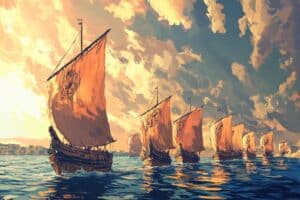
The navy grew from a cypress boat to 80-foot gold-adorned galleys under leaders like Wanandred and Ulsantis. Minerals included gold, copper, silver, bismuth, and iron, formed by natural forces. A captured Spaniard introduced copper knowledge.
XII-XIV: The Crime of Old King Osiris and the King Atlantis Gave to Egypt. The Flight of Prince Osiris
Old King Osiris married a foreign woman, causing rebellion. Prince Osiris fled to Egypt with followers, founding a court at Philae. His bride Albirothisis died en route; her ashes were placed near rapids. Osiris’ tomb near Abydos holds records.
XV-XVI: Origin of the Mongolian Race. Kling, from Atlantis, Tempted
Kling, sent to Asia, founded a Mongolian city after temptation and settlement. It differed from Yucatan’s peaceful tribes.
XVII-XVIII: An Atlantian Tradition. Battle on Mars as Described by the Watching Sage
A sage used a 100-layer glass lens to view a battle on Mars between red-robed warriors and ape-like Neptune forces, showing advanced ships and thought-form soldiers.
XIX-XXII: The Great Sea-Fight of Atlantis
Northmen under King Olaf, with Asian and Zambesi allies, attacked for plunder. A sage warned King Ambisamis. Ulsantis led 1,000 galleys to victory. Ambisamis died from liquor that day.
XXIII: The Destruction of Atlantis
Atlantis sank due to an imperfect cosmic law, not a curse. A massive wave engulfed it on a final morning. Markets bustled, priests prayed, and a herald warned before submersion near Tyre and Gom. Survivors remembered ruins, with Selestor promising future rediscovery.
This channeled account blends myth, invention, and pseudohistory. It reflects 1930s esoteric ideas rather than archaeological evidence.


Comments are closed.