
Table of Contents
The Atrahasis Epic is another ancient Mesopotamian text, dating back to around 1700 BCE, which tells a similar story of a great flood. In this narrative, the Anunnaki create humans to serve them and perform various laborious tasks. However, the humans multiply rapidly and become too noisy, disturbing the rest of the gods.
To resolve the situation, the god Enlil proposes sending a series of plagues, famines, and droughts to control the human population. Each time, the god Enki advises a wise man, Atrahasis, on how to survive the disasters. Eventually, Enlil decides to unleash a devastating flood to annihilate humanity. Again, Enki warns Atrahasis and instructs him to build a massive boat to preserve life.
After the floodwaters subside, Atrahasis offers sacrifices, and the gods, hungry and regretful for their actions, gather around the offerings. One of the gods, Enki, suggests creating a balance between gods and humans, setting limits on human population growth to prevent future disturbances.
The Atrahasis Epic is considered one of the earliest known accounts of a great flood and shares similarities with other flood myths, including the biblical story of Noah. It reflects the ancient Mesopotamian understanding of the relationship between gods and humans, the consequences of overpopulation, and the importance of balance in the natural order.
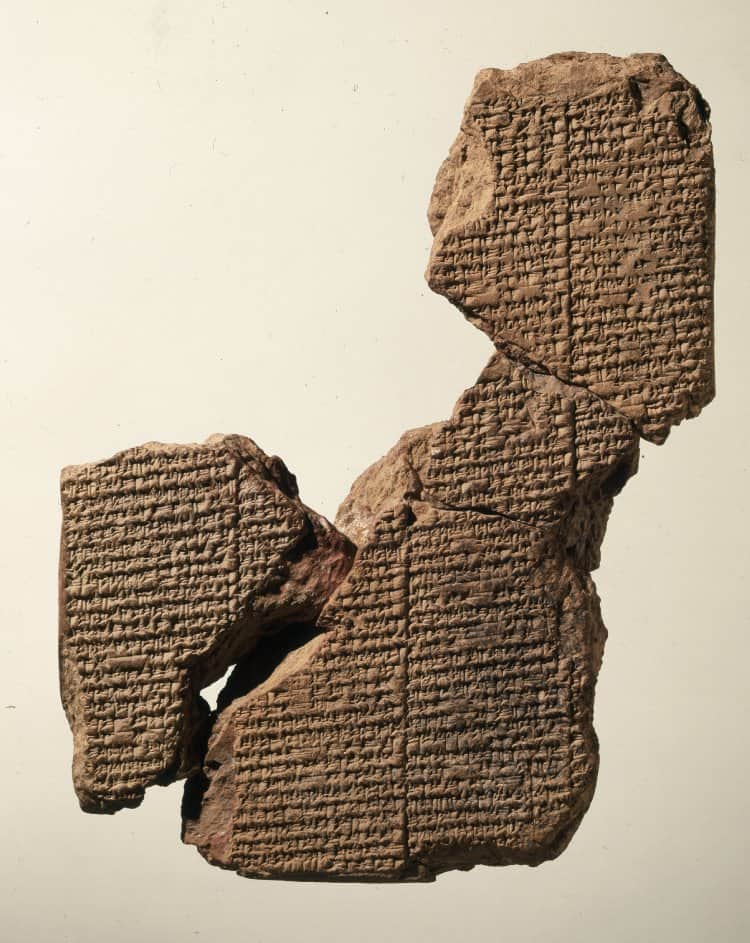
Written down in the mid-17th century BCE, the Atrahasis can be dated by the colophon to the reign of the Babylonian King Hammurabi‘s great-grandson, Ammi-Saduqa (1646-1626 BCE) though the tale itself is considered much older, passed down through oral transmission. The Sumerian Flood Story (known as the ‘Eridu Genesis’) which tells the same story, is certainly older (composed c. 2300 BCE) and Tablet XI of The Epic of Gilgamesh, which also relates the tale of the Great Flood, is even older than that.
Tablet I
The poem opens with the gods in their ranks. The great gods have divided the world. The lesser gods, the Igigi, do the digging. They cut the beds of the rivers, the Tigris and then the Euphrates. After a long time of that work they rebel. They burn their tools and march on Enlil’s house.
Part Two
Enlil is frightened and calls the great gods. They agree that a human should be made, so that the human can carry the work. Later the humans become many. Their noise keeps Enlil from sleep. He sends a plague, then hunger, then a drought. Each time Enki, who is on the side of the humans, warns Atrahasis, the wise man. Atrahasis tells his people how to turn the punishment aside, and the punishment fails.
Create humans
The gods call in the womb goddess, Belet-ili, to form the human. A god is killed so that divine flesh and blood can be mixed into the clay. The goddess nips off clay and shapes people. They are made to bear the yoke, the digging and the carrying that the lesser gods had refused. Birth is set on them, and so is death.
The later tablets tell the flood. Enlil decides that plague and famine are not enough. The gods swear to send a flood. Enki is bound by the oath, so he does not speak to the man directly. He speaks to a reed wall, and Atrahasis hears. Atrahasis builds a boat, takes animals and his household, and rides out the storm. When the water falls he offers food. The gods, hungry, gather at the offering. Enlil is angry that a human lived. Enki says that he is the one who saved him. The gods then put limits on human life and on births, so the noise will not grow without a bound.
I am not printing a translation of the tablets.
Credits and public domain
The English that used to fill this page was Stephanie Dalley, Myths from Mesopotamia (Oxford University Press, 1989). It was uncredited. That book is in copyright. I have removed it.
I did not find a public-domain English that gives the whole epic. W. G. Lambert and A. R. Millard, Atra-hasis: The Babylonian Story of the Flood (Oxford, 1969), is also in copyright. George Smith, The Chaldean Account of Genesis (London, 1876; Project Gutenberg ebook 60559), prints flood pieces from Nineveh. Those pieces are not this three-tablet epic, so I do not paste them here as if they were Atrahasis. I have no printed page of Dalley in front of me, so I do not quote her.

