
Table of Contents
The sun and the moon represent alchemical gold and silver.
Names
- Shinehah (Abraham)
- Paa Rayay (Nuwaupic)
Sun Gods
- Sol or Sunna (Norse) and Helios (Greek)
- Ra (Egypt)
- Amaterasu (Japan, Shinto)
- Surya (Hinduism), riding a chariot drawn by seven horses
- Inti (Inca)
- Utu (Sumerian), Shamash (Akkadian, Babylonian and Assyrian), god of the sun and justice, one of the Anunnaki
- Lugh (Celtic), linked with the festival of Lughnasadh
- Dazhbog (Slavic)
- Huitzilopochtli (Aztec), god of the sun and war
- Xihe (China), mother of the ten suns that the archer Hou Yi shot down
- Adonaios, one of the seven archons in Gnostic texts:
- Feminine name: Kingship, according to On the Origin of the World.
- Prophets: Isaiah, Ezekiel, Jeremiah and Daniel, according to Irenaeus, Against Heresies I.30.11.
- The 1913 Catholic Encyclopedia derives the name from the Hebrew for “the Lord”. It links it to Adonis of the Syrians, the winter sun in the myth of Tammuz. It also says that in the Mandaean system Adonaios represents the Sun.
The Sun King of Egupt
In Oahspe, the sun also gives its name to the laws of Egupt. In the Book of the Arc of Bon, the Osirian system works like the solar system. The king was the Sun King, with sub-kings as his satellites. Osiris was the Sun God over the other Gods, and his laws were the Sun laws.
The sun is a central power; its accompanying planets are satellites. In like manner the king of Egupt was the Sun King, and his sub-kings (governors) were satellites. Osiris, the highest angel in heaven, was the Sun God, that is, God of Gods; for all other Gods were his satellites. He revealed certain laws to mortals, and these were the Sun laws; and all minor laws were satellites.
Oahspe, Book of the Arc of Bon, Chapter XIV, verse 10
Life giver and destroyer
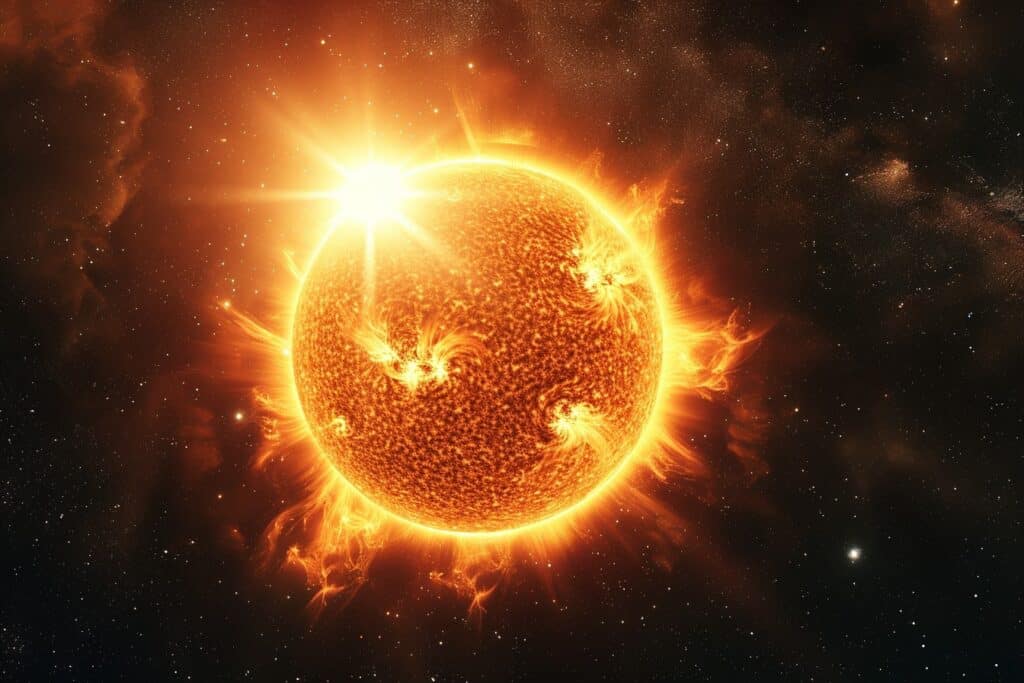
The sun, the father of light who begets all living things upon Mother Earth, the illuminator of the primordial darkness, is life giver as well as destroyer.
Richard Erdoes and Alfonso Ortiz, American Indian Myths and Legends
The Sun Calendar
The Astronomical Book of Enoch (1 Enoch 72–82) describes a solar year of 364 days. It has four seasons of 91 days. Each season has three months of 30 days, plus one extra day at the end of the third month. That makes exactly 52 weeks, so every date falls on the same weekday each year. Each year and each season starts on a Wednesday. That is the fourth day of creation in Genesis, when the lights in the sky were made. It is not known how its users squared this year with the solar year of 365.24 days.
Link: Astronomical Book (1 Enoch 72 – 82)
The two bulls in Egypt
In On the Origin of the World (Nag Hammadi Codex II), the bulls of Egypt are a sign of the sun and the moon. The text says they witness that Sophia stands above both.
The two bulls in Egypt, insofar as they indicate the sun and the moon as a mystery, exist for a witness to Sabaoth, that Sophia of the world has been exalted above the sun and the moon, from the day when she created them and sealed her heaven until the consummation of the age.
On the Origin of the World (NHC II,5)
The Five Suns
The Five Suns come from Aztec (Nahua) cosmology, as told in the Leyenda de los Soles. Each sun is an era made by the gods, and each ends in disaster. The Maya Popol Vuh has a similar story of four creations, in which humans are made from mud, wood and then maize. The five-sun scheme itself is Aztec.
| Sun | Name (Nahuatl) | Inhabitants | Ruling Deity | Destruction |
|---|---|---|---|---|
| First | Nahui Ocelotl (4-Jaguar) | Giants | Tezcatlipoca (god of night and sorcery) | Eaten by jaguars |
| Second | Nahui Ehecatl (4-Wind) | Monkeys | Quetzalcoatl (feathered serpent god) | Hurricanes and winds |
| Third | Nahui Quiahuitl (4-Rain) | Turkeys | Tlaloc (rain god) | Rain of fire from volcanoes |
| Fourth | Nahui Atl (4-Water) | Fish-people | Chalchiuhtlicue (water goddess) | Massive flood |
| Fifth | Nahui Ollin (4-Movement/Earthquake) | Humans (made from bones and blood) | Tonatiuh (sun god) | Predicted end by earthquakes |
Patricia Cori on 2012
Patricia Cori linked the eleven-year solar cycle to the Mayan calendar. In her account, the Fifth Sun, “the closing of time”, came at the end of 2012.
You may be aware that solar activity has been identified as reaching a peak in its cycle every eleven earth years. This fits like a precision watch with the Mayan calendar, for it is eleven years later (at the completion of the year 2012) that the Fifth Sun, the closing of time, occurs in the Mayan record.
Patricia Cori, newsletter ‘RA’s Ecstatic Release’, November 2003

