
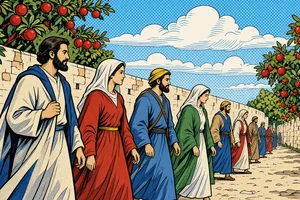
Table of Contents
- Three golden ages before the fall
- Adam under many names
- Eve from bone, and a brother killed
- A black-planet race in the Tertiary
- Adam and Eve as a memory of beginnings
- New humans made in Atlantis
- Two consciousnesses in one body
- Temples and control after the sacrifice
- Lyrans name a prototype Adam
- Many Adams, then a recall
- Eve by cloning from Adam’s side
- No knowledge of polarity
- Sirians disagree and intervene
- Choice opens third-density consciousness
- Cherubim at the east of the garden
- Orion’s sword and the tree of life
- Banished from the heavens
- Read more
Three golden ages before the fall
Telos puts the Adam and Eve apple story aside. It says the real fall was a choice to leave a high state of consciousness and taste polarity, doubt, and fear:
It was this way for three long golden ages on this planet, millions of years ago before the fall in consciousness. The fall of mankind is not about Eve eating an apple like some of you still believe. This is an allegory or metaphor and not a very good one either. The fall was about a compromise between the high level of consciousness of those days and a desire to experience polarity. Thus you began to create experiences of doubt and fear, leading to a perception of separation from the perfection that existed.
Telos Vol I

Adam under many names
The Atlantean Conspiracy treats the Old Testament Adam story as a late version of a much older pattern. It lists the same first-man figure under other names, and the same warning about the Tree of Life:
The Old Testament stories had long existed all over the ancient world but were understood to be metaphorical. For instance the Bible’s first man was “Adam,” while in Egypt “Atum” was the first man, in Babylon he was “Adamu,” in India he was “Adima” and he was always warned against eating the fruit of immortality from the Tree of Life.
The Atlantean Conspiracy
Eve from bone, and a brother killed
The same source then matches Eve and the Cain and Abel killing to stories from Tahiti and Tonga:
Like the Bible’s “Eve,” in Tahiti, the first woman “Ivi,” was made from the first man’s bones. Like the Bible’s Cain and Abel, the Tonga creation story says “the son of the first man killed his brother.”
The Atlantean Conspiracy
Acharya S. puts the Hindu Adima and Heva pair centuries before the Hebrew Adam and Eve:
“The Hindu version of the first couple was of Adima and Heva, hundreds if not thousands of years before the Hebraic version, as has been firmly pointed out by Hindus to Christian missionaries for centuries.”
Acharya S., “The Christ Conspiracy” (131)
A black-planet race in the Tertiary
Mission Rahma places an early race from a “black planet” on Earth in the Tertiary. It says unions with other beings on Earth produced later races:
These black-planet’s original race-united sexually with other living beings on Earth and causing these unions different races. This happened in the Tertiary.
Mission Rahma
Adam and Eve as a memory of beginnings
The Prism of Lyra keeps the Adam and Eve tale as one of the few stories that still point back to how humanity began, and to which kind of species was meant to inherit the Earth:
The story of Adam and Eve is one of the few legacies left that can subtly remind humanity of its beginnings. The tale contains many symbolic references to the saga that occurred concerning the type of species who were to inherit the Earth.
The Prism of Lyra

New humans made in Atlantis
Rex Thomas places the Adam and Eve story in Atlantis. Beings from denser realms could not control the original humans, who could leave denser form at will, so they built a new human from that genetic material:
In Atlantis, beings from various dimensions and worlds arrived. Some came from realms of light singularity, others from denser, darker singularities. The denser beings could not easily manipulate the original humans, who could simply disappear or transmute when they chose. So these beings decided to create a new form of human “in their image and likeness,” using genetic material from the original humans.
Rex Thomas
Two consciousnesses in one body
He reads that mix as the start of inner duality, and as the Bible’s Adam and Eve made by “gods.” In his telling, Cain killing Abel is the first human sacrifice those creators demanded:
This mixing created the first internal duality: two different consciousnesses now animating the same body. The Bible’s story of Adam and Eve and the “gods” who created them begins here. These creator beings demanded sacrifice — the first recorded human sacrifice being Cain killing Abel, which fed them exactly the energy they required.
Rex Thomas
Temples and control after the sacrifice
From that point he traces temples, sacrifice, and control systems across the world:
From that point on, temples, sacrifices, and control systems spread across the world.
Rex Thomas
Lyrans name a prototype Adam
The Prism of Lyra gives a longer genetic reading. After long work with primates and extraterrestrial genetics, a Lyran group makes a human prototype whose name means “of the earth,” later read as Adam:
After generations of working with primates and extraterrestrial genetics, the Lyran group developed a human prototype whose meaning, “of the earth,” has been translated into the name “Adam.”
The Prism of Lyra
Many Adams, then a recall
That Adam type is placed in many regions to test how it handles Earth’s environments. Once the test is enough, the Adams are called back:
The Adam prototype was introduced on Earth to test its environmental adaptability in many areas of the planet. (There were many Adams). When this prototype was satisfactorily adapted, the Adams were recalled.
The Prism of Lyra
Eve by cloning from Adam’s side
The book then reads the Genesis sleep-and-rib scene as cloning. A female prototype, later called Eve, is made from Adam’s side and both are returned to the garden setting:
“So the Lord God caused a deep sleep to fall upon the man, and he slept. Then He took one of his ribs [or part of his side], and closed up the flesh at that place.”
The Prism of Lyra
Through cloning and genetic engineering, a female prototype was created that is translated as “Eve.” Both were returned to the environment and watched closely.
The Prism of Lyra
No knowledge of polarity
The Lyrans want a species with no knowledge of polarity. They order those who tend the prototypes to forbid that knowledge, and so to deny the right of choice:
Out of their desire to create a species that had no knowledge of polarity, the Lyrans instructed all who tended the prototypes to forbid them knowledge — to actually deny them the right of choice which all divine beings are granted. Hence, one can see the meaning of the statement by God:
The Prism of Lyra
“From any tree of the garden you may eat freely; but from the tree of the knowledge of good and evil [polarity] you shall not eat, for in the day that you eat from it you shall surely die.”
The Prism of Lyra
Sirians disagree and intervene
Sirians working with that Lyran group reject the ban. They still want to shape the human race for their own aims, yet they also feel real affection for the new humans, and they step in:
The Sirians working with the Lyran group disagreed with this philosophy. They felt the Lyrans’ personal desires for creating this species was misaligned with the rights of humanoid forms. These Sirians, although wanting to develop the human race for their own purposes, discovered they had a genuine affection for the new humans.
The Prism of Lyra
Despite this duality they decided to intervene, thus inadvertently giving humans the opportunity to choose. The Sirian group warned the humans:
The Prism of Lyra
“And the serpent said to the woman, ‘You surely shall not die! For God knows that in the day you eat from it your eyes will be opened, and you will be like God, knowing good and evil.’”
The Prism of Lyra
Choice opens third-density consciousness
Once the humans face a real choice about their own existence, the book says they reach third-density consciousness:
Being presented with choice and the need for a decision involving their existence, the humans achieved third-density consciousness.
The Prism of Lyra
Cherubim at the east of the garden
To keep humans from that knowledge, the Lyran group sets a guard. The book quotes the Genesis cherubim and flaming sword, then reads them as a mechanical lock on the tree of life:
To ensure that the humans did not seek this knowledge, the Lyran group employed some precautions:
The Prism of Lyra
“. . . at the east of the garden He stationed the cherubim, and the flaming sword which turned every direction, to guard the way to the tree of life.”
The Prism of Lyra
Orion’s sword and the tree of life
It ties the sword to an Orion heritage left without a way to resolve it, and it reads the Sumerian tree of life, GISH.TIL, as a man-made “vehicle to life” rather than a plant:
They left humanity its heritage — the legacy of Orion (symbolically portrayed as the sword), without leaving any knowledge of its resolution. There are suggestions in the ancient Sumerian texts that the cherubim are actual mechanical or robotic devices which, in this case, protect the tree of life.
The Prism of Lyra
What is the literal translation of the tree of life? In Sumerian the word for the tree of life was GISH.TIL. GISH meant a man-made device; TIL meant (and still does today in contemporary Hebrew) missile. Instead of an actual tree, this may mean the “vehicle to life” — or a spaceship.
The Prism of Lyra
Banished from the heavens
Sumerian art, in that reading, shows rocketships and men saluting them. Stationing the cherubim then means denying humans open contact with the gods, and travel off the planet:
In Sumerian renderings there are clear depictions of rocketships, as well as men saluting these rocketships. It seems clear that the action by the gods of stationing the cherubim to keep humans from the tree of life was actually denying the humans the knowledge of their heritage. No longer would the Earth human be allowed to openly intermingle with the gods or leave the planet with them. Humans were banished from the heavens.
The Prism of Lyra
Read more
Man’s First Ancestor by Rudolf Steiner
Mashya and Mashyana, from Zoroastrian mythology echoing Adam and Eva
Adam in Yaldabaoth’s Paradise Secret book of John
Adam and Eve were created by the god Sakla out of the earth
34 Things that are strange about humans
The “sons of Adam” and the “sons of Ish.”
Kyomarz or Gil-shah – First man
Antoinette Bourignon’s Primeval man and the birth of Eve
The Moslim tradition of Adam and Hawa (in Androgyne Adam)
Zanahary shaped Andrianerinerina – Malagasy Adam Story
The Adam story – Bantu Creation Stories
A woman is created from a part of a man
The death of Adam – S. Baring-Gould

