
Table of Contents
- Genesis 9:20-29: a later addition?
- Genesis 9:20–27 suddenly shifts to a personal, anecdotal style
- Chronological Flexibility in Genesis
- Wine and Vision in Ancient Traditions
- Recasting the Event as a Prophetic Vision
- Noah, an oracle or survivor
- Vision Through Altered State
- Building the Ark as a Symbolic Act
- Withdrawing from the Dream
- Parallels with Other “Awakened Witnesses”
- Ancestor of various peoples – Genesis continues Shem
- Read more
[1] And Elohim blessed Noah and his sons, and said unto them, Be fruitful, and multiply, and replenish the earth.
In Genesis 9:1, after the flood, God tells Noah and his sons: "Multiply and replenish the earth." "Replenish" implies doing it again, suggesting a prior civilization destroyed by the flood.
Similarly, in Genesis 1:28, God tells Adam and Eve: "Multiply and replenish the earth," implying recreation after desolation. Rabbinical works confirm this
Jordan Maxwell
[2] And the fear of you and the dread of you shall be upon every beast of the earth, and upon every fowl of the air, upon all that moveth upon the earth, and upon all the fishes of the sea; into your hand are they delivered.
[3] Every moving thing that liveth shall be meat for you; even as the green herb have I given you all things.
[4] But flesh with the life thereof, which is the blood thereof, shall ye not eat.
[5] And surely your blood of your lives will I require; at the hand of every beast will I require it, and at the hand of humans; at the hand of every man's brother will I require the life of humans.
[6] Whoso shed humans's blood, by humans shall his blood be shed: for in the image of Elohim made he humans.
[7] And you, be ye fruitful, and multiply; bring forth abundantly in the earth, and multiply therein.
[8] And Elohim spake unto Noah, and to his sons with him, saying,
[9] And I, behold, I establish my covenant with you, and with your seed after you;
[10] And with every living creature that is with you, of the fowl, of the cattle, and of every beast of the earth with you; from all that go out of the ark, to every beast of the earth.
[11] And I will establish my covenant with you; neither shall all flesh be cut off any more by the waters of a flood; neither shall there any more be a flood to destroy the earth.
[12] And Elohim said, This is the token of the covenant which I make between me and you and every living creature that is with you, for perpetual generations:
[13] I do set my bow in the cloud, and it shall be for a token of a covenant between me and the earth.
[14] And it shall come to pass, when I bring a cloud over the earth, that the bow shall be seen in the cloud:
[15] And I will remember my covenant, which is between me and you and every living creature of all flesh; and the waters shall no more become a flood to destroy all flesh.
[16] And the bow shall be in the cloud; and I will look upon it, that I may remember the everlasting covenant between Elohim and every living creature of all flesh that is upon the earth.
[17] And Elohim said unto Noah, This is the token of the covenant, which I have established between me and all flesh that is upon the earth.
[18] And the sons of Noah, that went forth of the ark, were Shem, and Ham, and Japheth: and Ham is the father of Canaan.
[19] These are the three sons of Noah: and of them was the whole earth overspread.
Genesis 9:20-29: a later addition?
Based on the writing style this part is likely a later addition:
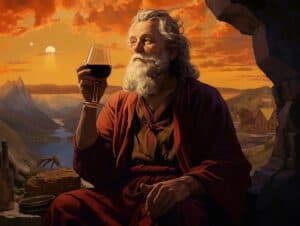
[20] And Noah began to be an husbandman, and he planted a vineyard:
[21] And he drank of the wine, and was drunken; and he was uncovered within his tent.
[22] And Ham, the father of Canaan, saw the nakedness of his father, and told his two brothers without.
[23] And Shem and Japheth took a garment, and laid it upon both their shoulders, and went backward, and covered the nakedness of their father; and their faces were backward, and they saw not their father's nakedness.
[24] And Noah awoke from his wine, and knew what his younger son had done unto him.
[25] And he said, Cursed be Canaan; a servant of servants shall he be unto his brothers.
[26] And he said, Blessed be Yahweh of Elohim of Shem; and Canaan shall be his servant.
[27] God shall enlarge Japheth, and he shall dwell in the tents of Shem; and Canaan shall be his servant.
This is recurring though the Genesis chapters:
[28] And Noah lived after the flood 350 years.
[29] And all the days of Noah were 955 years: and he died.
Genesis 9:20–27 suddenly shifts to a personal, anecdotal style
The passage’s abrupt shift from the flood narrative to Noah’s vineyard and subsequent events has led scholars to scrutinize its origins and purpose.
The Hebrew term ish ha-adamah (אִישׁ הָאֲדָמָה), meaning “man of the ground,” is used in Genesis 9:20 to describe Noah. This phrase is unique and not previously associated with Noah, suggesting a possible editorial addition or a different source.
The flood account exhibits a structured, repetitive style characteristic of the Priestly source (P), focusing on genealogies and covenants. In contrast, the vineyard episode adopts a more anecdotal and moralistic tone, aligning with the Yahwist source (J), known for its vivid storytelling and anthropomorphic depictions of God.
Viticulture requires several years before yielding fruit suitable for winemaking. The narrative’s implication that Noah planted a vineyard and became intoxicated shortly after the flood raises chronological concerns. This temporal compression may indicate a separate tradition or a symbolic insertion rather than a continuous historical account.
Noah’s curse falls on Canaan, Ham’s son, rather than Ham himself. This deviation has prompted interpretations that the passage serves as an etiological myth, justifying the subjugation of the Canaanites by the Israelites.
The narrative may reflect historical tensions between Israel and Canaan, projecting contemporary issues onto ancestral figures to legitimize territorial claims and social hierarchies.
The Genesis Apocryphon, part of the Dead Sea Scrolls, offers alternative versions of biblical narratives. Variations in these texts suggest that the canonical version of Genesis underwent editorial revisions, incorporating different traditions and perspectives.
Greek and Aramaic translations of the Hebrew Bible, such as the Septuagint and Targum Onkelos, sometimes present divergent readings or emphasize different aspects of the narrative, indicating the existence of multiple interpretive traditions.
The episode serves as a cautionary tale about the consequences of intoxication and disrespect within familial relationships. The actions of Ham and the subsequent curse on Canaan underscore themes of honor, shame, and intergenerational repercussions.
Wine, often associated with joy and blessing in biblical literature, here becomes a source of disgrace, highlighting the dual nature of human inventions and the importance of moderation.
In summary, the stylistic differences, temporal inconsistencies, and thematic elements of Genesis 9:20–27 suggest that this passage may have originated from a distinct tradition or was later integrated into the Genesis narrative to address specific cultural and theological concerns.
Both internal style and historical context suggest Genesis 9:20–27 was likely a separate tradition grafted onto the Noah story, possibly to serve a political or theological purpose in Israel’s early history.
Chronological Flexibility in Genesis
The Genesis narrative is not always linear. There are precedents in the text for chronological loops or layered stories (e.g., the two Creation accounts in Genesis 1 and 2). Genesis 9:20–27 does not explicitly anchor the vineyard event to a post-flood timeline except for the introductory phrase, “Noah began to be a man of the soil.” This could be read more loosely as a character statement rather than a sequence marker.
Wine and Vision in Ancient Traditions
Wine mixed with herbs or psychoactive plants was used in many ancient Near Eastern and Mediterranean rituals:
- While the Hebrew text uses the verb vayyishta (וַיֵּשְׁתְּ) meaning “he drank,” the context leaves open what kind of wine it was. No detailed description is given.
- Ancient rituals, especially involving prophets, priests, or kings, sometimes included intoxicants to induce altered states. Though the Hebrew Bible generally discourages such methods, the concept exists in surrounding cultures.
- If Noah experienced a visionary trance during intoxication, the narrative could be encoding a prophetic insight misinterpreted or moralized later by redactors.
Recasting the Event as a Prophetic Vision
The curse on Canaan could be seen not as a punishment, but as a vision or oracle Noah uttered under altered consciousness:
- The phrase “cursed be Canaan” (אָרוּר כְּנַעַן) lacks a preceding divine command. Unlike other curses in Genesis (e.g., the serpent in Gen. 3:14), there is no direct moral cause narrated for Canaan.
- This supports the idea that the statement is oracular or symbolic rather than judicial.
Noah, an oracle or survivor
Vision Through Altered State
The wine episode could symbolize a shift in consciousness, not moral weakness.
Noah drinks, lies uncovered (symbol of ego stripped), and enters a trance-like state in which he sees through time—both backward (origin) and forward (flood, curse).
In ancient terms, this would be called second sight, but in modern metaphysical language, it resembles a breakthrough from the matrix.
Building the Ark as a Symbolic Act
The ark is not only a physical vessel but a symbolic construct, like the Merkabah in Jewish mysticism, a way to pass safely through the collapse of illusion.
Building it might represent inner preparation to retain consciousness while everything else is “reset.”
Withdrawing from the Dream
After the event, Noah doesn’t re-engage with the world. His silence and disappearance from the narrative suggest he has left the simulated plane, or withdrawn to a liminal state like Mahavatar Babaji or Utnapishtim.
His curse on Canaan may not be a judgment, but a fragment of vision he retains from beyond linear time—a result of seeing karma unfold.
Parallels with Other “Awakened Witnesses”
Babaji: Awakens beyond form, yet appears at will.
Krishna in the Gita: Tells Arjuna the world is maya and that the wise are not disturbed by death, birth, or destruction.
Yogic or Taoist sages: Enter altered states (samādhi, wu wei) and return changed, aware that the manifest world is only energy in motion.
Ancestor of various peoples – Genesis continues Shem
According to the Bible, Shem, one of Noah’s three sons, had several sons and became the ancestor of various peoples. In the Book of Genesis, Shem’s descendants are listed in Genesis 10:21-31. Shem’s sons were:
- Elam: Elam was the father of the Elamite people, an ancient civilization located in what is now southwestern Iran.
- Asshur: Asshur is considered the progenitor of the Assyrian people, an ancient civilization centered in the region of ancient Mesopotamia, particularly in what is now modern-day Iraq.
- Arphaxad: Arphaxad was an ancestor of several Semitic peoples, including the Hebrews through his descendant Eber. According to the Bible, Arphaxad’s lineage led to Abraham, the patriarch of Judaism, Christianity, and Islam.
- Lud: Lud is associated with the Ludim, an ancient people whose exact location is uncertain.
- Aram: Aram became the ancestor of the Arameans, a Semitic people who settled in the region that includes modern-day Syria, Iraq, and Turkey.
These genealogies are part of the Table of Nations in Genesis 10, which provides a listing of the descendants of Noah’s sons and the nations they became. Shem’s line is significant in the biblical narrative because it leads to the establishment of the Israelites and the covenant with God through figures like Abraham and his descendants.
Arphaxad is the next in line, the father of Shelah, and the bloodline goes all the way to Abraham


Comments are closed.