
Table of Contents
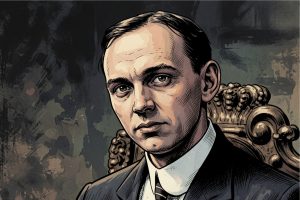
Edgar Cayce (March 18, 1877 – January 3, 1945) was an American clairvoyant who gave more than 14,000 documented psychic readings while in a self-induced trance state. He became known as the “Sleeping Prophet.” His readings primarily addressed health diagnoses and treatments, but also covered reincarnation, past lives, dreams, ancient civilizations including Atlantis, spiritual growth, and some prophecies about future events. Cayce founded the Association for Research and Enlightenment (ARE) in 1931. The organization preserves his work and continues educational activities today.
Books
The book on this site by or about Edgar Cayce.

Atlantis
Early Life and Childhood
Edgar Cayce was born on a farm near Beverly in Christian County, Kentucky, to Leslie Burr Cayce and Carrie Elizabeth Major Cayce. His parents were farmers and raised six children in the Disciples of Christ faith. The family moved to Hopkinsville, Kentucky, in 1893. Cayce completed only the eighth grade because of limited family finances. He worked on farms, in bookstores, and as a traveling salesman in his youth.
Around age 13, Edgar Cayce reported a vision of an angelic being while praying in the woods. After this experience, he developed the ability to memorize entire books by sleeping with them under his pillow. A baseball injury to his spine led him to enter a spontaneous trance and prescribe a poultice treatment for himself. These early incidents marked the beginning of his reported psychic sensitivity. He remained a devout Christian throughout his life and taught Sunday school.
Discovery of Abilities and Start of Readings
In 1900, Edgar Cayce lost his voice due to paralysis of the vocal cords. A traveling stage hypnotist and later an osteopath named Al Layne placed him in trance. In this state, Cayce diagnosed his own condition and suggested a treatment that restored his voice. Layne then used Cayce to diagnose patients remotely by providing only names and locations. Cayce began giving free medical readings while continuing his work as a photographer.
In 1903, Cayce married Gertrude Evans after a six-year engagement. They had three sons; one died in infancy in 1911. Gertrude later developed tuberculosis, and readings reportedly contributed to her recovery. Cayce maintained a photography studio in Bowling Green, Kentucky, and later in Alabama towns, though fires destroyed studios in 1906 and 1907, contributing to financial difficulties.
Career Development and National Attention
National publicity came in October 1910 through a New York Times article after Cayce collaborated with homeopath Dr. Wesley Ketchum. The partnership for medical readings ended in disputes by 1912. Cayce returned to photography work in Selma, Alabama.
To raise funds for a hospital, Cayce and partners formed the Cayce Petroleum Company and used readings to search for oil in Texas from 1919 to 1923. The venture failed. In 1923, Arthur Lammers requested readings on astrology and philosophy. These sessions introduced topics such as reincarnation and Atlantis for the first time.
With financial support from Morton Blumenthal, Cayce moved his family to Virginia Beach, Virginia, in 1925. He established the Association of National Investigators in 1927. The Cayce Hospital opened in 1928, and Atlantic University received a charter in 1930. Both institutions closed in 1931 amid the Great Depression and organizational conflicts.
Founding of the ARE and Main Period of Work
In summer 1931, Cayce reorganized his efforts into the nonprofit Association for Research and Enlightenment (ARE). The group focused on preserving readings, forming study groups, and promoting spiritual growth through prayer and meditation. Gladys Davis became his full-time stenographer in 1923 and transcribed the majority of the readings.
Edgar Cayce conducted a total of approximately 14,306 readings. Most addressed physical health and recommended treatments involving diet, natural remedies, electrotherapy, and other holistic approaches. Other readings covered reincarnation, soul development, dream interpretation, ancient history, and prophecies. Cayce described accessing a universal consciousness or Akashic Records while in trance. He insisted his ability was a divine gift and remained committed to Christian teachings, though readings incorporated ideas of karma and past lives.
Problems Faced
Edgar Cayce encountered repeated financial hardship from business failures, studio fires, and the collapse of the hospital and university projects. Demand for readings increased during World War II, but he overworked despite medical advice to limit sessions.
Legal difficulties included an arrest in New York in 1931 for fortune-telling (charges dismissed) and a 1935 arrest in Detroit for practicing medicine without a license (resulting in probation). Some readings promoted remedies such as Atomidine (nascent iodine), later criticized as unproven. Skeptics, including Martin Gardner, James Randi, and Michael Shermer, argued that the claims lacked rigorous scientific testing and that apparent successes could result from suggestion or selective reporting.
Specific predictions did not materialize on stated timelines. Examples include the rediscovery of Atlantis records around 1968–1969, the return of Jesus in 1998, and China becoming a primary center of Christianity by 1968. Some individual health readings also proved inaccurate. Critics described elements of the readings on Atlantis, Lemuria, and human origins as pseudohistory.
Accomplishments
Edgar Cayce left one of the largest collections of documented trance material from any single individual. The readings influenced the development of holistic medicine concepts, including emphasis on nutrition, mind-body connections, and preventive approaches. Ideas such as reincarnation, meditation practices, auras, and soul connections gained wider attention through books and study groups based on his work.
The ARE preserved the complete set of readings in archives and libraries in Virginia Beach. It established ongoing study groups, publications, and educational programs. Biographies, notably Thomas Sugrue’s There Is a River (1942), helped popularize Cayce’s life and ideas. His work contributed significantly to the foundations of the later New Age movement.

Death and Legacy
Cayce suffered declining health from overwork and experienced a stroke in September 1944. He died on January 3, 1945, at age 67 in Virginia Beach. Gertrude Cayce died three months later. Their sons, Hugh Lynn Cayce and Edgar Evans Cayce, took leadership roles in the ARE. The organization grew in membership and influence in subsequent decades, reaching tens of thousands of members by the late twentieth century.
The ARE continues operations today with its headquarters in Virginia Beach. It maintains the full archive of readings and offers resources on wellness and spiritual topics drawn from Cayce’s material. While conventional science has not validated the psychic mechanisms claimed in the readings, the extensive documentation and continued study of the material represent Cayce’s primary historical contribution.


Comments are closed.