
Table of Contents
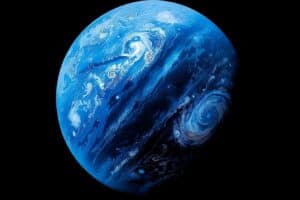
Edgar Cayce about Neptune
“Neptune and Uranus both coming within the entity’s experience through the sojourns there, those things that pertain to the mysterious, the MYSTIC forces or occult sciences, are ever of interest.” (997-1)
“Neptune making for those of the MYSTIC, especially influencing this entity in the respect that those forces as come from that as may be termed odors, INCENSEs, or such, will influence the entity in an unusual way and manner.” (1714-1)
Edgar Cayce reminds us of the influence of the planets on our consciousness. Again, he tells us that our free will decides. It is the choice-maker of our lives.
The will of the soul decides
In reading 2823-1, Cayce says every planet has a consciousness of its own. How strong its influence is depends on the person, because nothing surpasses the individual will. Knowledge of life lies within the self.
“So, all of those realms – as in Mercury, Venus, Jupiter, Saturn, Uranus – have their realms of consciousness also. As to how great the influence is depends upon the individual, for none surpass the will of the individual entity – the birthright of each soul. For, the soul is that child of the universal consciousness ye call God, and is made aware of same by the application of laws pertaining to same in the own self.
“Thus the knowledge, the understanding, the interpretation of life, lies within thine own self, as ye apply same in thy activity.” (2823-1)
Neptune, called by the Etrurians Nethunus, the God of the Mediterranean Sea, appears here to have been, when living, a Friesland Viking, or sea-king, whose home was Alderga (Ouddorp, not far from Alkmaar). link
Heindel on Neptune
Max Heindel, the Danish-born occultist who founded the Rosicrucian Fellowship, set out his teaching in The Rosicrucian Cosmo-Conception (1909). He gives Neptune a special place among the planets.
The planet of the astrologers
Heindel says Neptune does not properly belong to the solar system. In his account its influence falls on one class of people only, the astrologers.
Neptune and its satellites do not properly belong to our Solar System. The other planets—or rather their Spirits—exercise an influence over the whole of humanity, but the influence of Neptune is restricted to one particular class—the astrologers.
Max Heindel, The Rosicrucian Cosmo-Conception, 3rd ed. (1911), part II, chapter XI, p. 260
Blacket on Neptune and Cerberus
In 1884 W. S. Blacket published Researches into the Lost Histories of America. In chapter XXII he describes the flight of the gods from Central America. In his account Neptune is about to leave the Atlantic Isle, and the constellation Cerberus answers to the Caribbean Sea.
Blacket on the forsaking of the Isle
Blacket places Neptune in his boat, leaving the Isle for new territories on the Mediterranean shore.
Neptune is in his boat. He is about to forsake the Atlantic Isle that had been assigned to him, and to seek for new territories on the shores of the Mediterranean Sea; but there is danger ahead.
W. S. Blacket, Researches into the Lost Histories of America (1884), chapter XXII, p. 232
Blacket on Cerberus and the Caribbean
He then matches the constellation Cerberus with the Caribbean entrance and with the name of Haiti.
The constellation of Cerberus answers very well to the Caribbean Sea. That sea is at the entrance of the gulf of Texas, and consequently of all America. The word Cerberus clangs both with the Caribbean Sea and with the Carib Indians, who inhabit the West India Islands. One of those islands, now called St. Domingo, carries the native name of Haiti, a word that clangs as well with Hades as Cerberus does with Caribs.
W. S. Blacket, Researches into the Lost Histories of America (1884), chapter XXII, p. 232

