
Table of Contents
The term “regenerative ceremonies” comes from John Van Auken’s synthesis of the Edgar Cayce readings. He uses it in his book Edgar Cayce’s Tales of Ancient Egypt (A.R.E. Press, 2011). Cayce himself did not use this exact phrase in the surviving transcripts.
Van Auken uses the term for temple practices that joined spiritual rituals, altars and crystal devices. Their aim was to raise vibrations and rejuvenate the physical body.
Van Auken links the ceremonies to the readings
“According to Cayce’s readings, there were also regenerative ceremonies and devices that would raise the vibrations of initiates so as to rejuvenate their bodies.”
John Van Auken, Edgar Cayce's Tales of Ancient Egypt (A.R.E. Press, 2011)

(short excerpt for review and study)
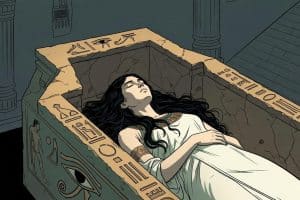
In Van Auken’s account, Cayce said these practices were first used in Atlantis. They later became part of Egyptian temple practice. Van Auken adds that some surviving temple carvings may show them.
Atlantean origins
In Cayce’s account, Atlanteans could live for hundreds of years and still look young. They did this through regular rejuvenation with crystal technology. The main crystal was the large cylinder known as the Tuaoi Stone or Firestone. It stood in a temple in Poseidia, the capital.
The crystal focused solar, cosmic and earth energies. The Atlanteans used it to make power. They also used it to restore vibrational coherence in the body.
In this view, illness and aging came from lost vibrational balance. The Atlanteans used the crystal, and sets of smaller stones, to “burn destructive forces from the body”. This helped the body rejuvenate itself.
Some summaries of the readings mention periodic meditation inside circles of 6, 11, 22 or 24 stones. The person held clear quartz as a focal point for rejuvenation and vitality.
Continuation in Egypt: the Temple of Sacrifice
Cayce stated that these Atlantean practices shaped the temple system set up in Egypt in the time of the high priest Ra-Ta. The readings call Ra-Ta a past incarnation of Cayce himself.
The Temple of Sacrifice was a place of physical cleansing and regeneration, much like a holistic hospital. It prepared people for higher spiritual work in the Temple Beautiful.
Reading 281-25 on the altars
“In the temple of sacrifice there were the altars to cleanse the bodies of those things that hindered in body, that were emblematical of the source of the stumbling block.”
Edgar Cayce, Reading 281-25 (July 17, 1935)
(short excerpt for review and study)
Other summaries of the readings say the Temple of Sacrifice removed physical and energetic pollutants from the body. It joined Atlantean technology with spiritual practice.
Music on reed and stringed instruments roused the body’s centers. It tied spiritual forces to the physical system. Purification at the altars was symbolic and practical. It let the body become “an ideal temple for the soul.”
Once purified in the Temple of Sacrifice, people could go on to the Temple Beautiful for mental and spiritual change.
How the practices worked
Cayce described three parts to this work. The first was raising the vibrations with crystals, devices, sound and focused intention. The second was purification at the altars, to clear what held back the body, the mind or the karma.
The third was preparing body, mind and spirit together. The person could then live longer, stay healthier and serve higher purposes.
In this account the ceremonies and devices were already in use in Atlantis. They were developed further in Egypt under Ra-Ta.
Initiation as death and rebirth
The book Atlantis: Insights from a Lost Civilization describes a typical initiation in the Atlantean labyrinth. Its center is death and rebirth.
The book compares this with Egyptian temple initiations and with the customs of shamans. It says Lewis Spence drew his account of Atlantean initiation from the Arcane Tradition.

