

Table of Contents
- Evidence from Billions of Years Ago
- Human evidence from Hundreds of Millions of Years Ago
- 20 million years ago
- First War: 65 million years ago (c. 65 million BCE)
- Beings with soul on Earth: about 20 million years ago (c. 20 million BCE)
- Human evidence from Over 5 Million Years Ago
- Human evidence from 2–5 Million Years Ago
- 1,000,000 Years Ago
- Human evidence from Over 1 Million Years Ago
- Fifth Root Race choosing begins: About 1,000,000 years ago (c. 1,000,000 BCE)
- 950,000 years ago
- 800,000 Years Ago
- Sinking of Atlantis: 800,000 years ago (c. 800,000 BCE)
- 500,000 Years Ago
- Arrival of the Anunnaki: about 450,000 years ago (c. 450,000 BCE)
- 300,000 years ago
- Emergence of Homo sapiens: About 300,000 years ago (c. 300,000 BCE)
- Beach sand in a deep core: 225,000 to 325,000 years old (c. 222,974 to 322,974 BCE)
- 200,000 years ago
- Homo sapiens leaves Africa: About 220,000 years ago (c. 220,000 BCE)
- Lemuria: 200,000 years ago (c. 200,000 BCE)
- Arrival of the Anunnaki: about 200,000 years ago (c. 200,000 BCE)
- Atlantis splits into Ruta and Daitya: about 200,000 years ago (c. 200,000 BCE)
- 80,000 years ago
- Moon-coloured race north of Ruta: About 100,000 B.C. (about 102,000 years ago)
- Stonehenge colony (Scott-Elliot): About 100,000 years ago (c. 100,000 BCE)
- Emigration from Atlantis to Arabia: 79,797 B.C. (about 81,823 years ago)
- Journey north to the Gobi Sea: A few years before 75,025 B.C. (a few years before about 77,051 years ago)
- Catastrophe of 75,025 BC: 75,025 BC (about 77,051 years ago)
- Flood in Egypt: about 77,000 years ago (c. 74,974 BCE)
- Lemuria: about 75,000 years ago (c. 73,000 BCE)
- Daitya almost gone: by 75,000 years ago (c. 73,000 BCE)
- Mainland villages by the Gobi Sea: About 70,000 B.C. (about 72,000 years ago)
- Homo sapiens leaves Africa: 60,000 to 80,000 years ago (c. 58,000 to 78,000 BCE)
- Toba eruption: 70,000 years ago (c. 68,000 BCE)
- Beach sand in a deep core: 20,000 to 100,000 years old (c. 17,974 to 97,974 BCE)
- 40,000 years ago
- Planet between Mars and Jupiter bursts: about 58,600 years ago (c. 56,574 BCE)
- Early destruction of Atlantis (Cayce): 50,000 BC (about 52,000 years ago)
- Ngwenya Mine: 42,000 years old (c. 40,000 BCE)
- Arrival of the Anunnaki: 40,000 years ago (c. 38,000 BCE)
- Lemuria: about 40,000 years ago (c. 38,000 BCE)
- 36,000 years ago
- Civilized nations in eastern Asia: 35,000 BC (about 37,026 years ago)
- Sphinx: an age of 36,000 years (c. 34,000 BCE)
- 35,000 years ago
- Ramtha’s lifetime: 35,000 years ago (c. 32,974 BCE)
- Aksu founded: 32,400 BC (about 34,400 years ago)
- First seeds of people: before 32,000 BC (before about 34,000 years ago)
- Tom’s first time on Earth: 34,000 years ago (c. 32,000 BCE)
- Atlantis begins: 32,000 years ago (c. 30,000 BCE)
- Founders of the Thinite nation: 28,000 BC (about 30,026 years ago)
- Second destruction of Atlantis: About 28,000 BC (about 30,000 years ago)
- 25,000 years ago
- Lemuria-Atlantis war: 25,000 years ago (c. 22,974 BCE)
- Lemuria: 15,000 to 35,000 years ago (c. 13,000 to 33,000 BCE)
- Gunung Padang: 23,000 BCE (about 25,000 years ago)
- Flood in Asia and part of Europe: 21,000 BC (about 23,026 years ago)
- 20,000 years ago
- Destruction of a second city: 20,000 BC (about 22,000 years ago)
- Arrival of the Anunnaki: about 20,000 years ago (c. 18,000 BCE)
- 16,550 years ago
- Nimrod, Atlantis, and Babylon: 16,000 BC (about 18,026 years ago)
- Second Atlantean cataclysm: About 14,000 BC (about 16,000 years ago)
- Golden age of Atlantis: c. 14,000 BCE (about 16,000 years ago)
- Recording disc found in North America: about 16,000 years ago (c. 13,974 BCE)
- Lunar era: about 25,000 BC to about 2000 BC (about 27,026 to 4,026 years ago)
- MARS arrives in Egypt: About 13,500 B.C. (about 15,526 years ago)
- 14,000 years ago
- Meltwater Pulse 1A: about 14,650 to 14,310 years ago (c. 12,700 BCE)
- Ghost-worship in Egypt: 12,000 BC (about 14,026 years ago)
- Sinking of Atlantis: about 14,000 years ago (c. 12,000 BCE)
- 13,000 years ago
- A Major Strike: about 13,000 years ago
- Atlantean-Lemurian war: c. 11,000 BC (about 13,000 years ago)
- Sinking of Atlantis: 13,000 years ago (c. 11,000 BCE)
- Sinking of Atlantis: around 11,000 BC (about 13,000 years ago)
- Younger Dryas: about 12,800 years ago (c. 10,800 BCE)
- Bunsen’s Flood: B.C. 11,000 to 10,000 (about 13,026 to 12,026 years ago)
- 11,500 years ago
- Sphinx: 10,000 BCE (about 12,000 years ago)
- Great Pyramid: about 12,000 years ago (c. 10,000 BCE)
- Destruction of Mu: About 12,000 years ago (c. 10,000 BCE)
- Destruction of Tiahuanaco: c. 10,000 BC (about 12,000 years ago)
- Sinking of Atlantis: 9,600 BCE (about 11,600 years ago)
- End of the Younger Dryas: About 11,600 years ago (c. 9,600 BCE)
- Gobekli Tepe: 9,500 BCE (about 11,500 years ago)
- Sinking of Poseidonis: 11,446 years ago (c. 9,420 BCE)
- Meltwater Pulse 1C: c. 9,400 BCE (about 11,400 years ago)
- Meltwater Pulse 1B: About 11,300 years ago (c. 9,300 BCE)
- First settlement at Megiddo: 9,228 BC (about 11,254 years ago)
- 10,000 – 12,000 years ago
- Sinking of Atlantis: 11,000 years ago (c. 9,000 BCE)
- Domesticated squash seeds at Guilá Naquitz: about 10,000 years ago (c. 7,974 BCE)
- Naquitz phase: 8900 to 6400 BC (about 10,926 to 8,426 years ago)
- Tollmann impacts: around 7640 BC (about 9,666 years ago)
- Sinking of Atlantis: c. 7,114 BCE (about 9,140 years ago)
- Oldest leavened bread at Çatalhöyük: about 8,600 years ago (6600 BC)
- Storegga tsunami: About 8,150 years ago (c. 6,120 BCE)
- 5,000 years ago
- Black Sea deluge: c. 5,600 BCE (about 7,600 years ago)
- Menes unites Egypt: about 5,510 B.C. (about 7,536 years ago)
- The Hawk returns: 6,000 to 5,000 BC (about 8,000 to 7,000 years ago)
- Additions to the Great Pyramid: about 7,000 years ago (c. 5,000 BCE)
- Noah’s Flood: 6,500 years ago (c. 4,500 BCE)
- Sinking of Atlantis: 4,292 BC (about 6,318 years ago)
- Sinking of Poseidonis: 4,292 BCE (about 6,318 years ago)
- Earliest maize cobs at Guilá Naquitz: about 6,250 years ago (5,400 carbon-14 years before the present)
- Date of Menes: 4,200 BC (about 6,226 years ago)
- Creation of the world (Ussher): 4,004 BCE (about 6,030 years ago)
- Rise of Ur and Egypt: 5,000 to 6,000 years ago (c. 3,000 to 4,000 BCE)
- Noah’s Flood: c. 3,300 BCE (about 5,300 years ago)
- Tollmann impact: around 3150 BC (about 5,176 years ago)
- Köfels observation: 29 June 3123 BC (about 5,149 years ago)
- Kurukshetra War: 3,102 BCE (about 5,128 years ago)
- Date of Abraham: 2,900 BC (about 4,926 years ago)
- Great Pyramid: 2,620 to 2,484 BC (about 4,650 to 4,510 years ago)
- Sphinx: 4,500 years ago (c. 2,500 BCE)
- Sahara becomes a desert: about 4,500 years ago (c. 2,500 BCE)
- Invasion of Sumer: About 2,400 BC (about 4,400 years ago)
- Sumer captive to Sargon: about 2,350 BC (about 4,380 years ago)
- Noah’s Flood: 2,348 BC (about 4,374 years ago)
- Sinking of Atlantis: 2,193 BC (about 4,219 years ago)
- Abraham receives a genetic upgrade: Around 2,000 BC (about 4,000 years ago)
- Date of Moses: 1,900 BC (about 3,926 years ago)
- Min-erva arrives in Attica: about 1,600 years before Christ (about 3,600 years ago)
- Thera eruption: About 1,500 BC (about 3,500 years ago)
- Exodus: c. 1,440 BCE (about 3,470 years ago)
- Shasu of Yhw at Soleb: 1390–1352 BCE (about 3,416 to 3,378 years ago)
- Kinahna in the Amarna letters: 14th century BC (about 3,426 to 3,326 years ago)
- Date of Solomon: 1,015 BC (about 3,041 years ago)
- Kurukshetra War: c. 1,000 BCE (about 3,000 years ago)
- Dome-shaped colony: some 3,000 years ago (c. 974 BCE)
- Nineveh flood tablets: about 660 years before the Christian era (about 2,690 years ago)
- Babyloniaca of Berossus: around 290 to 278 BC (about 2,316 to 2,304 years ago)
- Copper Scroll: around 70 CE (about 1,956 years ago)
- Edict of Milan: 313 CE (about 1,713 years ago)
- Dedication of Constantinople: A.C. 330 (about 1,696 years ago)
- Prose Edda: around 1222–23 (about 804 to 803 years ago)
- Start of Kosmon: March 31, 1848 (about 178 years ago)
Evidence from Billions of Years Ago
- Metallic spheres with grooves, found in South Africa, dated 2.8 billion years.
Human evidence from Hundreds of Millions of Years Ago
- Fossilized human footprints and tools near dinosaur tracks in Texas and other locations, dated 65–300 million years.
- Skeletons, nails, gold threads, and carved stones found in coal seams and sandstone blocks, dated 286–360 million years.
- A metallic vessel decorated with silver inlays, unearthed in Massachusetts, dated 600 million years.
20 million years ago
First War: 65 million years ago (c. 65 million BCE)
A recording disc in the reptilian interview dates the First War, and the end of the dinosaurs, to 65 million years ago.
This “recording disc” dates back to “procyon” 65 million years ago. It was created by the last survivors of the human race from the explosion, and was completely destroyed when we found it.
Ancient wars, Interview with a reptilian woman, Answer 18
Beings with soul on Earth: about 20 million years ago (c. 20 million BCE)
Tom says beings with soul were on Earth about 20 million years ago. He says they prepared its etheric body, its chakras and its ley lines.
Tom says beings with soul were on Earth about 20 million years ago.
The Only Planet of Choice (1993), Chapter by Chapter, Tom, in Phyllis Schlemmer
Human evidence from Over 5 Million Years Ago
- Paleolithic tools in France and other locations, dated 7–9 million years.
- Incised bones in France, Argentina, and Kenya, dated 12 million years.
- Neolithic tools from California, dated 23 million years.
- Human skeletons and artifacts in California and Belgium, dated 33–45 million years.
Human evidence from 2–5 Million Years Ago
- Tools, hearths, and artifacts in various global locations, dated at least 2 million years.
- Clay figurine from Idaho, dated 2 million years.
- Skeletons and tools in Italy, Argentina, Kenya, and California, dated 3–5 million years.
1,000,000 Years Ago
The Nemnir arrived, they were nature’s voices on Earth, known as giants or the first gods, keepers of planetary and natural information.
Matias de Stefano

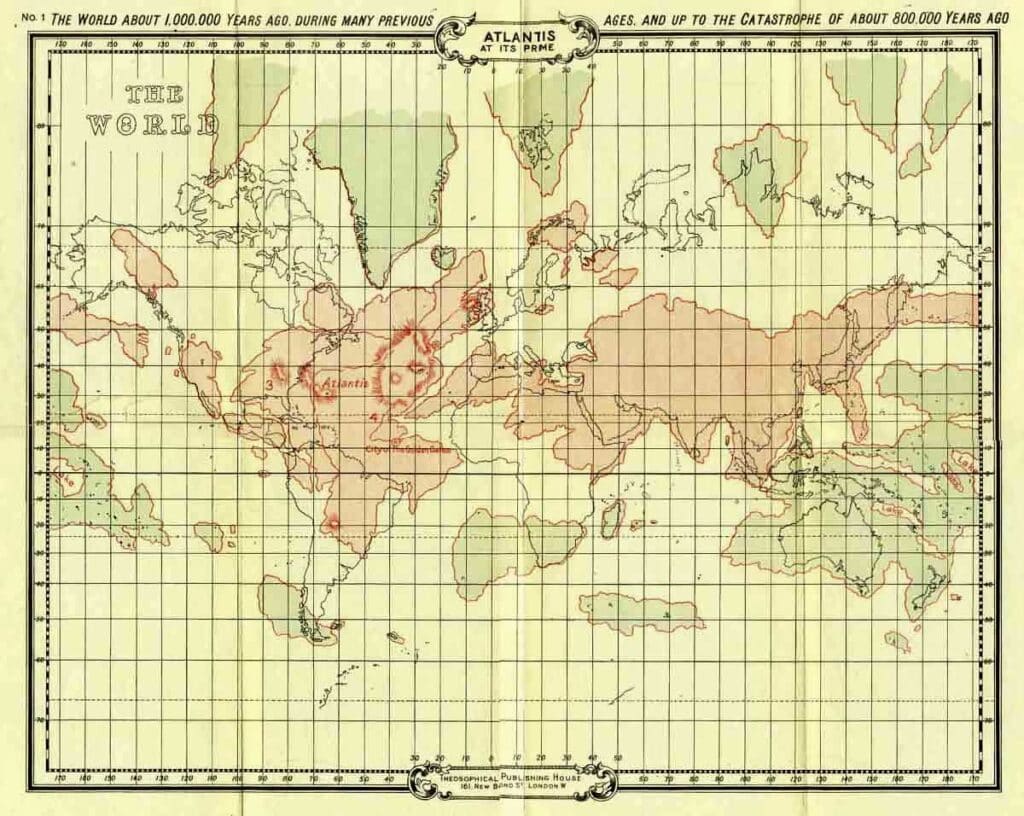
Human evidence from Over 1 Million Years Ago
- An anatomically modern human skull in Argentina, dated 1–1.5 million years.
- Eoliths in Monte Hermoso, Argentina, dated 1–2.5 million years.
- A human tooth from Java dated 1–1.9 million years.
- Incised bones in Italy, dated 1.2–2.5 million years.
- Tools and fossils from China and Siberia, dated 1.8 million years.
Fifth Root Race choosing begins: About 1,000,000 years ago (c. 1,000,000 BCE)
Besant and Leadbeater claim that the fifth Root Race began about 1,000,000 years ago. They read that figure as the start of the Manu’s choosing.
the fifth Root Race began a million years ago, as the start of the Manu’s choosing.
Beginning of the 5th Root Race, Besant and Leadbeater (1913)
950,000 years ago
Q – What exactly happened to the human evolutionary process on Earth?
A – Let’s go back in time. What we are expounding upon has to do with certain races of extraterrestrial beings that tried to conquer the galaxy a long time ago.
Extraterrestrials from the Lyra constellation came to Earth approximately 950,000 years ago.
Q – The Lyrans came here first?
A – Yes, the Lyrans lived here in very small communities for thousands of years. They did not colonize the entire planet and only had a few small bases, as they believed that your Sun (Sol) produced feelings, emotions, sensations, and thoughts within him that were difficult to navigate and could be detrimental for the Lyrans that hadn’t yet reached spiritual maturity.
A – Meanwhile, around the same time in the Pleiadian Star Cluster, a habited planet named Daytema, (which orbited the Pleione’s star system located a little over 444 light-years away from Earth), was being destroyed by a warrior race from another planet.
The Lyrans were summoned around 800,000 years ago by the Pleiadian council as the council knew that a non-permitted weapon, with the capability to destroy planets, was used against the Lyrans.
They asked the Lyrans, along with others, to assist in elucidating the right course of action. It was clear to everyone that nobody had the space to house all the survivors on their respective planets since this action could cause overpopulation and deeply compromise the natural balance of each host planet.
You can probably relate to what we are talking about since you have the perfect example right in front of you every day here on Earth. When you look around, you see a flawless illustration of what happens when planetary balance is compromised by beings on top of the food chain.
The Lyrans compassion was and still is remarkable, even to this day. They immediately decided to help and house the survivors of Planet Daytema.
Q – Who destroyed Daytema?
A – It was destroyed by Thubanians, the same warrior race that invaded Earth later on. Thubanians belong to a planet orbiting the Thuban star, situated in the Alpha Draco constellation.
Thuban, also known by terrestrials as Alpha Draconis, is a white giant star emitting low vibrations that can transverse obliquely through the mind of the observer, impairing goodness that is rooted in the heart.
Thuban is a spectral class A0III star. At one point, it was the North Pole star for the Egyptians and is 250 times more luminous than the Sun. Thuban is a star with a companion dwarf that strengthens the devious energy that is constantly produced. Thuban is also known as “the snake,” since it is associated with the energy of frivolousness, non-emotionality, and sadism.
After the attack by the Thubanians, the survivors from Daytema moved to Earth.
The Uncensored Truth of Who We Are: Part 1

800,000 Years Ago
The Annunaki and Thubanians (both from the Draco Constellation) and their influence on humanity as far back as 800,000 years ago, continuing through present times.
The Uncensored Truth of Who We Are: Part 1
Sinking of Atlantis: 800,000 years ago (c. 800,000 BCE)
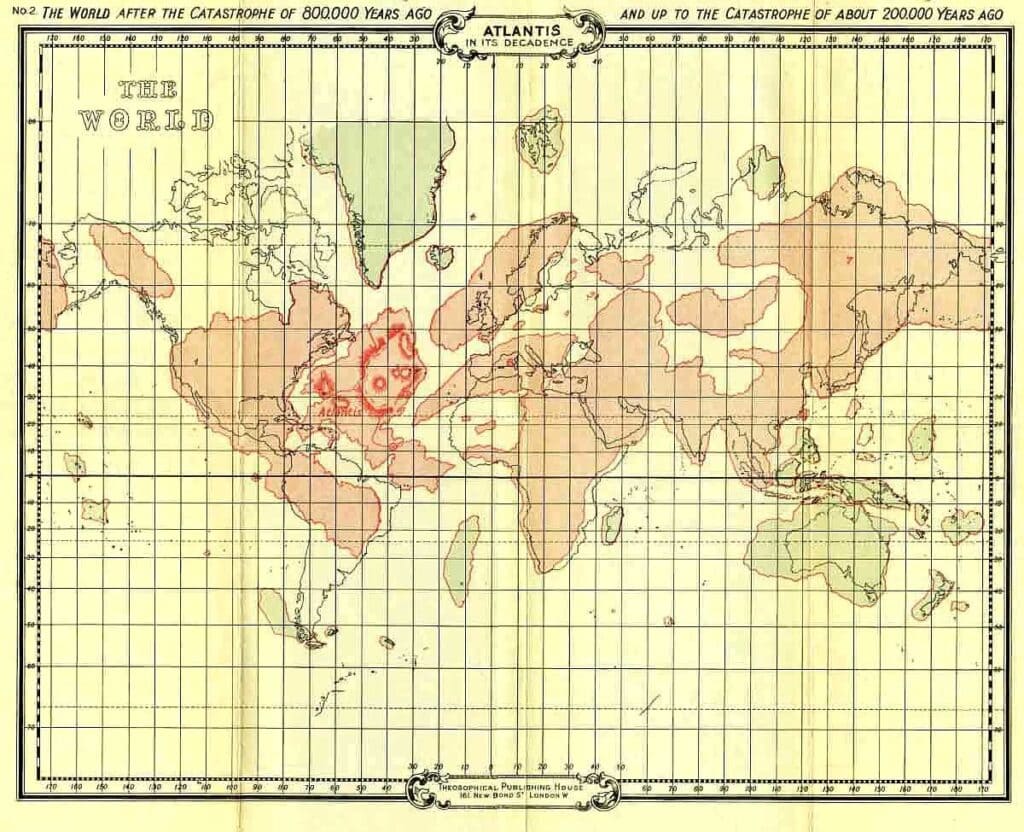
One page states 800,000 years ago for when Atlantis sank.
Map II (post-800,000 years ago catastrophe): Northern Atlantis submerged; the remainder occupied the Atlantic basin from 50° N to the equator, separated from emerging America.
The Solar System – Atlantis, Arthur E. Powell
Conflicting dates (14)
Other dates for when Atlantis sank:
- about 14,000 years ago (c. 12,000 BCE)
- 13,000 years ago (c. 11,000 BCE)
- around 11,000 BC (about 13,000 years ago)
- c. 10,500 BC (about 12,500 years ago) (see 9,600 BCE (about 11,600 years ago))
- 9,650 BCE (about 11,680 years ago) (see 9,600 BCE (about 11,600 years ago))
- 11,500 years ago (c. 9,500 BCE) (see 9,600 BCE (about 11,600 years ago))
- 9,600 BCE (about 11,600 years ago)
- 12,000 years ago (c. 10,000 BCE) (see 9,600 BCE (about 11,600 years ago))
- 9,564 BC (about 11,590 years ago) (see 9,600 BCE (about 11,600 years ago))
- 11,000 years ago (c. 9,000 BCE)
- 8,452 BCE (about 10,478 years ago) (see c. 7,114 BCE (about 9,140 years ago))
- c. 7,114 BCE (about 9,140 years ago)
- 4,292 BC (about 6,318 years ago)
- 2,193 BC (about 4,219 years ago)
500,000 Years Ago
Soffhir arrives in the middle east. They provided tree-of-life wisdom, explaining creation, symbolized by the snake offering the fruit of knowledge
Matias de Stefano
The Anunnaki, an extraterrestrial race, infused their genetic material into early hominids such as Homo erectus and Homo habilis between 300,000 to 500,000 years ago. This genetic manipulation led to the creation of Homo sapiens.
Bashar

Arrival of the Anunnaki: about 450,000 years ago (c. 450,000 BCE)
2 pages state about 450,000 years ago for when the Anunnaki arrived.
Zecharia Sitchin, translator of the Sumerian cuneiform tablets, writes that the Anunnaki arrived on Earth about 450,000 years ago to mine gold.
Groups of Elohim appear to have taken distinct roles, sometimes even competing in purpose
The same date is also given on Tablet stories and a gene edited humanity.
Conflicting dates (4)
Other dates for when the Anunnaki arrived:
- about 200,000 years ago (c. 200,000 BCE)
- 40,000 years ago (c. 38,000 BCE)
- c. 20,000 BCE (about 22,000 years ago) (see about 20,000 years ago (c. 18,000 BCE))
- about 20,000 years ago (c. 18,000 BCE)
300,000 years ago
Before frequency control was instituted 300,000 years ago by the raiding group of creator gods, the native species was somewhat clever.
Bringers of the Dawn
The frequency of light contains the history of your identity and the history of your particular consciousness. As we have said, that consciousness was scattered from your database or cellular structure because those who came in to be your gods could not control you if you had the same abilities they did. So they did the biogenetic experimentation and mutation that has been called "the Fall." That was when the ignorance of the human species became more predominant. They performed many different experimentations, which went on for a very long period of time.
Bringers of the Dawn
Emergence of Homo sapiens: About 300,000 years ago (c. 300,000 BCE)
Several pages put the emergence of Homo sapiens at about 300,000 years ago.
The current scientific consensus places the emergence of Homo sapiens at around 300,000 years ago.
DNA, 2 Active strands and 10 are dormant
The same date is also given on Extend the timeline of civilization, Genesis 2 – Enclosed gardens and Bull cults and mounds as one long tradition.
Beach sand in a deep core: 225,000 to 325,000 years old (c. 222,974 to 322,974 BCE)
Ewing dates one sand layer in a Mid-Atlantic core to 225,000 to 325,000 years old.
In the same passage Ewing dates the two sand layers in one core to 20,000 to 100,000 years and 225,000 to 325,000 years old.
Cores recovered sand from depths of roughly 2 miles (3.22 kilometers) on or near the Mid-Atlantic Ridge, Maurice Ewing, National Geographic, November 1949
200,000 years ago
Approximately 200,000 years ago, human DNA underwent a drastic change. Before this period, humans had 24 pairs of chromosomes, similar to other primates. Suddenly, this number changed to 23 pairs, which cannot be explained by natural evolution alone. This change indicates a possible intervention that altered the course of human development.
Kryon Change in DNA

Homo sapiens leaves Africa: About 220,000 years ago (c. 220,000 BCE)
A 2018 paper is quoted for a possible earlier dispersal around 220,000 years ago.
This finding changes our view on modern human dispersal and is consistent with recent genetic studies, which have posited the possibility of an earlier dispersal of Homo sapiens around 220,000 years ago.
Is the Out of Africa Theory Outdated?, Israel Hershkovitz et al., Science (2018)
Conflicting dates (1)
Other dates for Homo sapiens leaves Africa:
Lemuria: 200,000 years ago (c. 200,000 BCE)
One page states 200,000 years ago for how long Lemuria lasted.
Keppe also explores the Lemurian civilization, which predates Atlantis and existed over 200,000 years ago.
THE LOST HISTORY OF CIVILIZATION, André Keppe
Conflicting dates (3)
Other dates for how long Lemuria lasted:
Arrival of the Anunnaki: about 200,000 years ago (c. 200,000 BCE)
3 pages state about 200,000 years ago for when the Anunnaki arrived.
Matias de Stefano describes the beginning of Atlantis as originating from the arrival of the Anunnaki, giant beings from a dying planet, who settled in the Middle East around 200,000 years ago to aid their survival and advance human evolution through interbreeding with early humans.
Who Were the 12 Kings of Atlantis?
The same date is also given on The beginning of Atlantis as originating from the arrival of the Anunnaki and The beginning of Atlantis.
Conflicting dates (4)
Other dates for when the Anunnaki arrived:
- about 450,000 years ago (c. 450,000 BCE)
- 40,000 years ago (c. 38,000 BCE)
- c. 20,000 BCE (about 22,000 years ago) (see about 20,000 years ago (c. 18,000 BCE))
- about 20,000 years ago (c. 18,000 BCE)
Atlantis splits into Ruta and Daitya: about 200,000 years ago (c. 200,000 BCE)
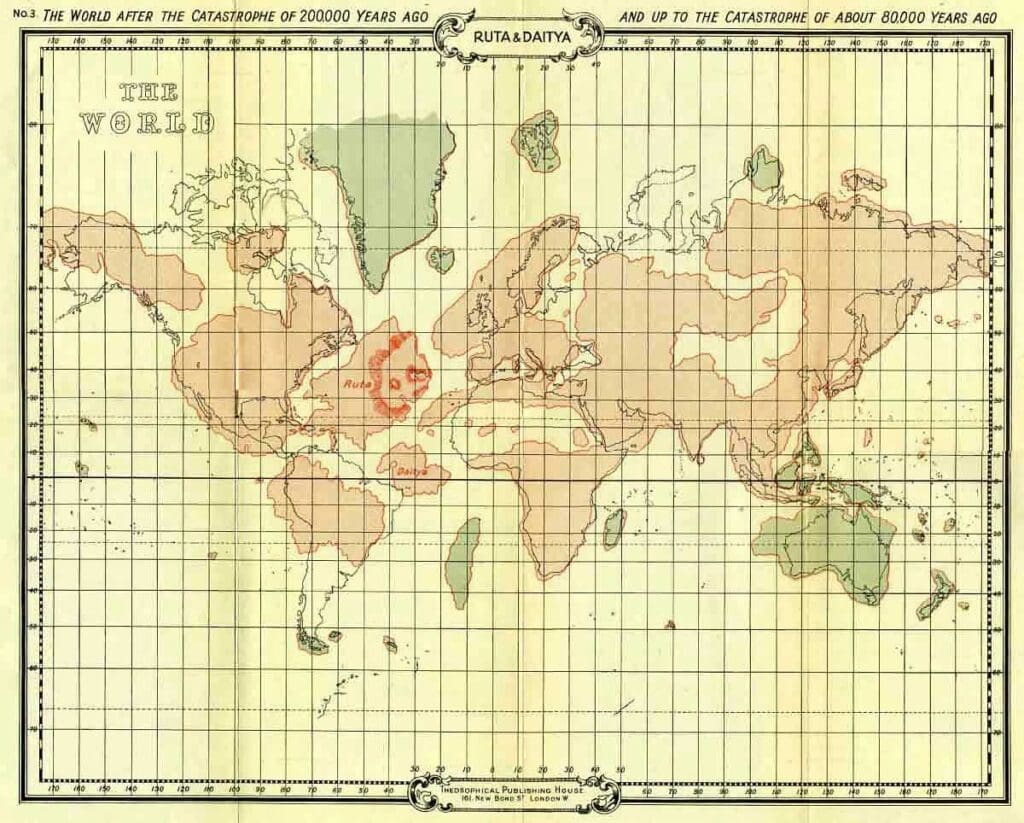
W. Scott-Elliot’s account, as summarised on the Daitya page, says Atlantis split into the islands Ruta and Daitya after about 200,000 years ago.
after about 200,000 years ago Atlantis splits into Ruta and Daitya, and by 75,000 years ago Daitya is almost gone.
Daitya: The Southern Island of Atlantis, W. Scott-Elliot

80,000 years ago

Moon-coloured race north of Ruta: About 100,000 B.C. (about 102,000 years ago)
Besant and Leadbeater claim that about 100,000 B.C. a tribe of the fifth sub-race lived in the mountains north of Ruta. They say the Stanzas of Dzyan call it the moon-coloured race.
About 100,000 B.C.: a tribe of the fifth sub-race, which the Stanzas of Dzyan call the “moon-coloured race”, lived in the mountains north of Ruta.
Beginning of the 5th Root Race, Besant and Leadbeater (1913)
Stonehenge colony (Scott-Elliot): About 100,000 years ago (c. 100,000 BCE)
Scott-Elliot says the colony that founded Stonehenge landed about 100,000 years ago.
it was in the early Akkadian days, about 100,000 years ago, that the colony of Initiates who founded Stonehenge landed on these shores
The Druids: Priests of the Oak, Stonehenge and the Atlantis Link, W. Scott-Elliot
The same date is also given on The Story of Atlantis – focus on the occult investigation of Atlantis and its sub-races.
Emigration from Atlantis to Arabia: 79,797 B.C. (about 81,823 years ago)
Besant and Leadbeater claim that in 79,797 B.C. the Manu called His people to the coast, to escape rule by the Dark Ruler.
79,797 B.C.: to escape rule by the Dark Ruler, the Manu called His people to the coast.
Beginning of the 5th Root Race, Besant and Leadbeater (1913)
Journey north to the Gobi Sea: A few years before 75,025 B.C. (a few years before about 77,051 years ago)
Besant and Leadbeater claim that a few years before 75,025 B.C. the Manu led about seven hundred of His own descendants north. They settled in the hills north of the Gobi Sea.
A few years before 75,025 B.C.: the Manu led about seven hundred of His own descendants north.
Beginning of the 5th Root Race, Besant and Leadbeater (1913)
Catastrophe of 75,025 BC: 75,025 BC (about 77,051 years ago)
Several pages date a catastrophe that sank remaining Atlantean islands to 75,025 BC.
These islands were lost in 75,025 BC.
Atlantis rose and fell in 3 distinct cycles, Charles Webster Leadbeater, Annie Besant

The same date is also given on August 2024 Update, Beginning of the 5th Root Race, The Fall of Atlantis: misuse of power and abuse of advanced technologies, The Fourth Root Race and The Solar System – Atlantis.
The stupendous character of the natural convulsion that took place about 80,000 years ago, will be apparent from the fourth map.
The Story of Atlantis – focus on the occult investigation of Atlantis and its sub-races, W. Scott-Elliot
Similar dates (1)
- About 80,000 years ago (c. 78,000 BCE): The Story of Atlantis – focus on the occult investigation of Atlantis and its sub-races, W. Scott-Elliot; Early Atlantis until 48,000 BCE
Flood in Egypt: about 77,000 years ago (c. 74,974 BCE)
Besant and Leadbeater say a flood swamped Egypt about 77,000 years ago, and that the Atlantean civilisation there ended with it.
When a flood swamped Egypt about 77,000 years ago, people tried to climb the pyramids but slipped on their smooth sides.
The Sinking of Poseidonis and Its Impact on Ancient Egypt, Besant and Leadbeater, Man: Whence, How and Whither (1913)
Lemuria: about 75,000 years ago (c. 73,000 BCE)
One page states about 75,000 years ago for how long Lemuria lasted.
Lemuria existed around 75,000 years ago, located in areas now known as the Pacific Ocean, Madagascar, New Zealand, India, Southeast Asia, Hawaii, and parts of North America. The civilization ended due to volcanic eruptions and rising sea levels, which submerged the landmass.
Lemuria: A Channeled Interview, Italia Oliver
Conflicting dates (3)
Other dates for how long Lemuria lasted:
Daitya almost gone: by 75,000 years ago (c. 73,000 BCE)
A summary of W. Scott-Elliot says Daitya was almost gone by 75,000 years ago. The same page gives Powell’s catastrophe of 75,025 B.C. for the destruction of Ruta and Daitya, and that date is already on this page.
after about 200,000 years ago Atlantis splits into Ruta and Daitya, and by 75,000 years ago Daitya is almost gone.
Daitya: The Southern Island of Atlantis, W. Scott-Elliot
Conflicting dates (2)
Other dates for when Daitya was destroyed:
Mainland villages by the Gobi Sea: About 70,000 B.C. (about 72,000 years ago)
Besant and Leadbeater claim that about 70,000 B.C. the Manu settled His people in villages on the mainland. The same account places that mainland by the Gobi Sea.
About 70,000 B.C.: He settled His people in villages on the mainland. They were already civilised and used labour-saving machinery.
Beginning of the 5th Root Race, Besant and Leadbeater (1913)
Homo sapiens leaves Africa: 60,000 to 80,000 years ago (c. 58,000 to 78,000 BCE)
Genetic studies are quoted for a migration out of Africa around 60,000 to 80,000 years ago.
Genetic studies confirm that Homo sapiens migrated out of Africa around 60,000 to 80,000 years ago, spreading across the globe.
August 2024 Update
The same date is also given on When Africa 'Colonised' China.
Conflicting dates (1)
Other dates for Homo sapiens leaves Africa:
Toba eruption: 70,000 years ago (c. 68,000 BCE)
One page states 70,000 years ago for when Toba erupted.
Toba Explosion 70,000 years ago
Atlantis rose and fell in 3 distinct cycles
An older theory tied a loss of human genetic variety to the Toba eruption about 74,000 years ago.
A human bottleneck near 900,000 years ago
Similar dates (1)
- about 74,000 years ago (c. 72,000 BCE): A human bottleneck near 900,000 years ago; August 2024 Update
Beach sand in a deep core: 20,000 to 100,000 years old (c. 17,974 to 97,974 BCE)
Ewing dates the other sand layer in that core to 20,000 to 100,000 years old.
In the same passage Ewing dates the two sand layers in one core to 20,000 to 100,000 years and 225,000 to 325,000 years old.
Cores recovered sand from depths of roughly 2 miles (3.22 kilometers) on or near the Mid-Atlantic Ridge, Maurice Ewing, National Geographic, November 1949
40,000 years ago
Planet between Mars and Jupiter bursts: about 58,600 years ago (c. 56,574 BCE)
Randolph dates the burst of a planet between Mars and Jupiter to about 58,600 years ago. The same passage puts the greatest cataclysm in a span of not less than 42,000 and not more than 58,600 years ago.
I conclude that about 58,600 years ago, the planet of this system then revolving on its axis in an orbit between those of Mars and Jupiter, BURST asunder—scattered into a million fragments, the larger ones now constituting the Asteroids
Estimates of human origins, Paschal Beverly Randolph, Pre-Adamite Man (1863)
Hyperborean civilization which left the surface of this planet well over 40,000 years ago.
Telos Vol I
- The Ngwenya Mine is estimated to be around 42,000 years old, making it one of the oldest mines known to humans.
- Cultural Explosion in Europe (Upper Paleolithic) – Rapid emergence of figurative art, musical instruments, ritual burial, and other symbolic practices across Europe.
Early destruction of Atlantis (Cayce): 50,000 BC (about 52,000 years ago)
Cayce material on these pages puts suffering and a destruction of early Atlantis in 50,000 BC.
In 50,000 BC., most of the dangerous animals perished, while the Atlanteans themselves endured horrific suffering.
Early Atlantis until 48,000 BCE
The same date is also given on Androgynous during the very early phases of the Atlantean Civilization and Edgar Cayce: First cycle of Atlantis.
Ngwenya Mine: 42,000 years old (c. 40,000 BCE)
4 pages state 42,000 years old for the age of the Ngwenya Mine. It is also stated as 42,000 years BP; about 42,000 years old.
Deposits at Ngwenya were worked at least 42,000 years BP (Before Present).
The Ngwenya Mine
The same date is also given on Planets, Locations, Objects and Animals and Locations, objects & materials.
The Ngwenya Mine is estimated to be around 43,000 years old, making it one of the oldest mines known to humans.
Little People
Similar dates (1)
- about 43,000 years old (c. 41,000 BCE): Little People; The Ngwenya Mine
Arrival of the Anunnaki: 40,000 years ago (c. 38,000 BCE)
One page states 40,000 years ago for when the Anunnaki arrived.
Exploration of the idea that the Anunnaki arrived on Earth 40,000 years ago and modified the DNA of Homo species.
34 Things that are strange about humans
Conflicting dates (4)
Other dates for when the Anunnaki arrived:
- about 450,000 years ago (c. 450,000 BCE)
- about 200,000 years ago (c. 200,000 BCE)
- c. 20,000 BCE (about 22,000 years ago) (see about 20,000 years ago (c. 18,000 BCE))
- about 20,000 years ago (c. 18,000 BCE)
Lemuria: about 40,000 years ago (c. 38,000 BCE)
One page states about 40,000 years ago for how long Lemuria lasted.
Kryon describes Lemuria as an ancient civilization that existed around 40,000 years ago on Earth, which had different geological and climatic conditions.
Lemurians: androgynous with group focused consciousness
Conflicting dates (3)
Other dates for how long Lemuria lasted:
36,000 years ago
The Lords of the Word came to restore earth 36,000 years ago after the destruction in the time of Memphis.
I (Isis) was here thirty-six thousand years ago, in the time of Memphis. I then came from Sirius to make good the destruction on this planet.
Dolores Canon
Civilized nations in eastern Asia: 35,000 BC (about 37,026 years ago)
Randolph’s table dates civilized nations on the plateaus of eastern Asia to 35,000 B.C.
Civilized Nations on the Plateaus of Eastern Asia
35,000
Estimates of human origins, Paschal Beverly Randolph, Pre-Adamite Man (1863)
Sphinx: an age of 36,000 years (c. 34,000 BCE)
One page states an age of 36,000 years for when the Sphinx was built.
Some researchers and public figures have proposed that the Sphinx was constructed as early as 12,000 to 13,000 years ago, with some extreme claims suggesting an age of 36,000 years.
Is the Giza Sphinx 12,000 Years Old?
Conflicting dates (6)
Other dates for when the Sphinx was built:
- c. 10,500 BCE (about 12,500 years ago) (see 10,000 BCE (about 12,000 years ago))
- 9,000 to 12,000 years old (c. 7,000 to 10,000 BCE) (see 10,000 BCE (about 12,000 years ago))
- 10,000 to 13,000 years ago (c. 8,000 to 11,000 BCE) (see 10,000 BCE (about 12,000 years ago))
- 10,000 BCE (about 12,000 years ago)
- 12,000 to 13,000 years ago (c. 10,000 to 11,000 BCE) (see 10,000 BCE (about 12,000 years ago))
- 4,500 years ago (c. 2,500 BCE)
35,000 years ago
The Lemurian civilization basically existed from 35,000 years to 15,000 years ago – the longest single-governed civilization on Earth.
Kryon
Ramtha’s lifetime: 35,000 years ago (c. 32,974 BCE)
Ramtha says his one lifetime on Earth was 35,000 years ago.
I lived but one lifetime upon this plane, what is called in your understanding of time 35,000 years ago.
Ramtha is a purported ancient entity channeled by JZ Knight, Ramtha, Ramtha: The White Book (2004)
Aksu founded: 32,400 BC (about 34,400 years ago)
2 pages state 32,400 BC for the founding of Aksu, also spelled Akesu, in the Tarim Basin. Tom calls its teacher the Hawk.
Akesu was a colony near the Tarim Basin in western China, founded in 32,400 BC. Its teacher was the Hawk.
The Only Planet of Choice (1993), Chapter by Chapter, Tom, in Phyllis Schlemmer
The same date is also given on Briefing for the Landing on Planet Earth (1977), Chapter by Chapter.
First seeds of people: before 32,000 BC (before about 34,000 years ago)
Tom says the first seeds of people on Earth were placed before 32,000 BC. Colonists then came in 32,400 BC, which is its own item.
Seeds were placed before 32,000 BC. Then, in 32,400 BC, colonists came with a leader called the Hawk.
The Only Planet of Choice (1993), Chapter by Chapter, Tom, in Phyllis Schlemmer
Tom’s first time on Earth: 34,000 years ago (c. 32,000 BCE)
Tom says his first time on Earth was 34,000 years ago. Holroyd’s account puts the first arrivals at Aksu, and Adam and Eve, in that same period.
But the original time that I was on the Planet Earth or identified with your Planet Earth was 34,000 of your years ago.
The Only Planet of Choice (1993), Chapter by Chapter, Tom, in Phyllis Schlemmer, chapter 2
The same date is also given on Briefing for the Landing on Planet Earth (1977), Chapter by Chapter.
Atlantis begins: 32,000 years ago (c. 30,000 BCE)
Tom says Atlantis began 32,000 years ago. The same sentence puts the end at 11,000 years ago, which is its own item.
Atlantis ended 11,000 years ago of your time and it began 32,000 years ago.
Edgar Cayce: First cycle of Atlantis, The Only Planet of Choice (Phyllis Schlemmer), ch. 11

The same date is also given on The Only Planet of Choice (1993), Chapter by Chapter.
Founders of the Thinite nation: 28,000 BC (about 30,026 years ago)
Randolph’s table gives 28,000 B.C. as the earliest date of the founders of the Thinite nation.
Earliest Date of the Founders of the Thinite Nation
28,000
Estimates of human origins, Paschal Beverly Randolph, Pre-Adamite Man (1863)
Second destruction of Atlantis: About 28,000 BC (about 30,000 years ago)
A second destruction of Atlantis is dated to about 28,000 BC.
Second destruction (~28,000 BC): Renewed corruption and experiments by the Sons of Belial led to further land loss and climatic changes.
Atlantean Wars
The same date is also given on Androgynous during the very early phases of the Atlantean Civilization.
25,000 years ago
Atlantis and Lemuria, the two highest civilizations of the time, battled each other over the direction of other civilizations on the planet. (thermo-nuclear)
Telos Vol I
Lemuria-Atlantis war: 25,000 years ago (c. 22,974 BCE)
Telos dates a battle between Atlantis and Lemuria to 25,000 years ago.
As a result of wars, great devastation took place on Lemuria and Atlantis. 25,000 years ago, Atlantis and Lemuria, the two highest civilizations of the time, battled each other over the direction of other civilizations on the planet.
Ancient wars, Telos Volume I
Conflicting dates (1)
Other dates for the war between Atlantis and Lemuria:
Lemuria: 15,000 to 35,000 years ago (c. 13,000 to 33,000 BCE)
2 pages state 15,000 to 35,000 years ago for how long Lemuria lasted.
The Lemurians had a full, mature civilization from 35,000 years ago to about 15,000 years ago.
The enlightened Human Being: 100,000 years of humanity, Lee Carroll | Kryon
The same date is also given on Kryon's Channeling – The history of humanity.
Conflicting dates (3)
Other dates for how long Lemuria lasted:
Gunung Padang: 23,000 BCE (about 25,000 years ago)
Gunung Padang is given a construction layer dated to 23,000 BCE.
Gunung Padang: In Indonesia, this site features layers of construction, with the oldest dating back to 23,000 BCE.
Extend the timeline of civilization
Flood in Asia and part of Europe: 21,000 BC (about 23,026 years ago)
Randolph’s table dates a flood in Asia and part of Europe to 21,000 B.C.
The Flood in Asia and part of Europe
21,000
Estimates of human origins, Paschal Beverly Randolph, Pre-Adamite Man (1863)
Conflicting dates (1)
Other dates for this flood:
20,000 years ago
| Period/Arc | Ruler/Dominion | Duration (Years) | Approximate Start Date (BCE/CE) | Approximate End Date (BCE/CE) | Notes |
|---|---|---|---|---|---|
| Suth | Suth | 3,000 | ~19,752 BCE | ~16,752 BCE | Arc of Suth; wisdom seen by Jehovih; precedes population expansion. |
| Iz | Iz | 3,100 | ~16,752 BCE | ~13,652 BCE | Begat by Suth; dominion period. |
| Aph | Aph | 3,600 | ~13,652 BCE | ~10,052 BCE | Begat by Iz; reign period. |
| Apollo | Apollo | 2,800 | ~10,052 BCE | ~7,252 BCE | Begat by Aph; reign period. |
| Osiris | Osiris (the first) | 3,300 | ~7,252 BCE | ~3,952 BCE | Begat by Apollo; associated with idols/heavenly figures like Vishnu, Etau, Ram, Osiris in Orachnebauhgalah. |
| Abraham and Brahma | Abraham and Brahma | 2,400 | ~3,952 BCE | ~1,552 BCE | Begat by Osiris; reign period. |
| Moses and Capilya | Moses and Capilya | 3,400 | ~1,552 BCE | 1848 CE | Begat by Abraham and Brahma; reign period leading to Kosmon. |
| Kosmon | Kosmon | Ongoing (33rd year in 1881) | 1848 CE | Present | Begat by Moses and Capilya; current era of combined wisdom; Great Serpent in 64th Huy of C'Vorkum orbit. |
Destruction of a second city: 20,000 BC (about 22,000 years ago)
One account places the destruction of a second city at 20,000 BC.
The second city was immensely more ancient, and very conservatively, its destruction may be placed at 20,000 BC.!
How I found the lost Atlantis, the source of all civilization, Paul Schliemann
Arrival of the Anunnaki: about 20,000 years ago (c. 18,000 BCE)
One page states about 20,000 years ago for when the Anunnaki arrived.
And since the Aessir arrived on earth around 20,000 years ago (according to Mathias de Stefano's past memories).
Sumerian King List
Similar dates (1)
- c. 20,000 BCE (about 22,000 years ago): Human lifespan declines
Conflicting dates (3)
Other dates for when the Anunnaki arrived:
16,550 years ago
Nimrod, Atlantis, and Babylon: 16,000 BC (about 18,026 years ago)
Randolph’s table dates Nimrod, Atlantis, and Babylon to 16,000 B.C.
Date of Nimrod, Atlantis, and Babylon
16,000
Estimates of human origins, Paschal Beverly Randolph, Pre-Adamite Man (1863)
- Around 9550 B.C., as dated by astronomers from Potsdam Observatory from writings in the ruins of Tiahuanaco—the (96.6 kilometers) thick shell of the Earth shifted its position once more in half to a third of a day, 7,000 years (16,550 BCE) after the previous shift.
Second Atlantean cataclysm: About 14,000 BC (about 16,000 years ago)
Spence dates a second Atlantean cataclysm to about 14,000 BC.
About 14,000 BC. a second cataclysm occurs, and this compels large numbers of the Atlanteans (Magdalenians) to fly to the European area.
The History of Atlantis (1926)
The same date is also given on The History of Atlantis.
Golden age of Atlantis: c. 14,000 BCE (about 16,000 years ago)
One page says the golden age of Atlantis began around 14,000 BCE and lasted about 1,500 years.
Atlantis’ Golden Age: began around 14,000 BCE and lasted around 1500 years
Atlantis’ Golden Age: began around 14,000 BCE and lasted around 1500 years
Recording disc found in North America: about 16,000 years ago (c. 13,974 BCE)
The same interview says the disc that records the First War was found about 16,000 years ago.
It was discovered by our archaeologists about 16,000 years ago on a continent called North America.
Ancient wars, Interview with a reptilian woman, Answer 18
Lunar era: about 25,000 BC to about 2000 BC (about 27,026 to 4,026 years ago)
Anne Baring dates the lunar era from about 25,000 BC to about 2000 BC.
Baring dates the lunar era from about 25,000 BC to about 2000 BC.
The lunar period, Anne Baring
MARS arrives in Egypt: About 13,500 B.C. (about 15,526 years ago)
Besant and Leadbeater date the arrival of MARS in Egypt, and his marriage to SATURN, to about 13,500 B.C.
About 13,500 B.C.
MARS arrives in Egypt and marries SATURN
The Sinking of Poseidonis and Its Impact on Ancient Egypt, Besant and Leadbeater, Man: Whence, How and Whither (1913)
14,000 years ago
So the change in weather in 16,000 BC it was forced by them so they could clear the planet of all these beings that were not able to adapt to this change of weather. The cold that Nemnir were used to, the Hyperborea civilization were used to that cold. But the Aessir wasn’t.
Matias de Stefano
Meltwater Pulse 1A: about 14,650 to 14,310 years ago (c. 12,700 BCE)
Meltwater Pulse 1A is dated to about 14,650 to 14,310 years ago.
I place Meltwater Pulse 1A earlier: about 14,650 to 14,310 years ago (c. 12,700 BCE), melting ice sheets raised the seas by (45.9 to 59.1 feet) (Deschamps et al., Nature 2012).
The Dual Cataclysm That Ended a Civilization
Conflicting dates (1)
Other dates for Meltwater Pulse 1A:
- c. 9,650 BCE (about 11,680 years ago): The earth to spin off balance
Ghost-worship in Egypt: 12,000 BC (about 14,026 years ago)
Randolph’s table dates ghost-worship in Egypt to 12,000 B.C.
Date of Ghost-worship in Egypt
12,000
Estimates of human origins, Paschal Beverly Randolph, Pre-Adamite Man (1863)
Sinking of Atlantis: about 14,000 years ago (c. 12,000 BCE)
One page states about 14,000 years ago for when Atlantis sank.
I think Atlantis sank slowly. As the polar ice sheets melted, the pressure on the crust dropped. The crust flexed, and land near the equator slowly sank. This started around 14,000 years ago, but it likely took a few thousand years. It was a slow process, like the sea level rise we see today.
Glacial isostatic adjustment
Conflicting dates (14)
Other dates for when Atlantis sank:
- 800,000 years ago (c. 800,000 BCE)
- 13,000 years ago (c. 11,000 BCE)
- around 11,000 BC (about 13,000 years ago)
- c. 10,500 BC (about 12,500 years ago) (see 9,600 BCE (about 11,600 years ago))
- 9,650 BCE (about 11,680 years ago) (see 9,600 BCE (about 11,600 years ago))
- 11,500 years ago (c. 9,500 BCE) (see 9,600 BCE (about 11,600 years ago))
- 9,600 BCE (about 11,600 years ago)
- 12,000 years ago (c. 10,000 BCE) (see 9,600 BCE (about 11,600 years ago))
- 9,564 BC (about 11,590 years ago) (see 9,600 BCE (about 11,600 years ago))
- 11,000 years ago (c. 9,000 BCE)
- 8,452 BCE (about 10,478 years ago) (see c. 7,114 BCE (about 9,140 years ago))
- c. 7,114 BCE (about 9,140 years ago)
- 4,292 BC (about 6,318 years ago)
- 2,193 BC (about 4,219 years ago)
13,000 years ago
A Major Strike: about 13,000 years ago
Approximately 5,000 years ago, a major strike occurred, larger than the one 13,000 years ago.
Kryon
Atlantean-Lemurian war: c. 11,000 BC (about 13,000 years ago)
Two pages date the Atlantean-Lemurian war to around 11,000 BC, and say it caused a flood.
Atlantean-Lumerian War: The Atlantean-Lemurian War occurred around 11,000 BC and caused a global flood.
Atlantean Wars
The same date is also given on Channeling the Galactic Council of 9.
Conflicting dates (1)
Other dates for the war between Atlantis and Lemuria:
Sinking of Atlantis: 13,000 years ago (c. 11,000 BCE)
3 pages state 13,000 years ago for when Atlantis sank. Tom calls that end the destruction of Altea. A pole shift account uses the same figure for the sinking.
It was begun approximately 150 years before the destruction of Altea, 13,000 of your years ago, in the colony in which it had been begun.
Pyramid of Giza, The Only Planet of Choice (Phyllis Schlemmer), ch. 12
The same date is also given on The Only Planet of Choice (1993), Chapter by Chapter and Pole Shifts: The Tilting Earth and the End of Atlantis.
Conflicting dates (14)
Other dates for when Atlantis sank:
- 800,000 years ago (c. 800,000 BCE)
- about 14,000 years ago (c. 12,000 BCE)
- around 11,000 BC (about 13,000 years ago)
- c. 10,500 BC (about 12,500 years ago) (see 9,600 BCE (about 11,600 years ago))
- 9,650 BCE (about 11,680 years ago) (see 9,600 BCE (about 11,600 years ago))
- 11,500 years ago (c. 9,500 BCE) (see 9,600 BCE (about 11,600 years ago))
- 9,600 BCE (about 11,600 years ago)
- 12,000 years ago (c. 10,000 BCE) (see 9,600 BCE (about 11,600 years ago))
- 9,564 BC (about 11,590 years ago) (see 9,600 BCE (about 11,600 years ago))
- 11,000 years ago (c. 9,000 BCE)
- 8,452 BCE (about 10,478 years ago) (see c. 7,114 BCE (about 9,140 years ago))
- c. 7,114 BCE (about 9,140 years ago)
- 4,292 BC (about 6,318 years ago)
- 2,193 BC (about 4,219 years ago)
Sinking of Atlantis: around 11,000 BC (about 13,000 years ago)
Tom said Atlantis ended around 11,000 BC. He calls its true name Altean.
Tom said Atlantis was a colony from Aksu. It stretched from Greece to the Americas and ended around 11,000 BC. Its true name was Altean.
Briefing for the Landing on Planet Earth (1977), Chapter by Chapter, Tom, in Stuart Holroyd
Conflicting dates (14)
Other dates for when Atlantis sank:
- 800,000 years ago (c. 800,000 BCE)
- about 14,000 years ago (c. 12,000 BCE)
- 13,000 years ago (c. 11,000 BCE)
- c. 10,500 BC (about 12,500 years ago) (see 9,600 BCE (about 11,600 years ago))
- 9,650 BCE (about 11,680 years ago) (see 9,600 BCE (about 11,600 years ago))
- 11,500 years ago (c. 9,500 BCE) (see 9,600 BCE (about 11,600 years ago))
- 9,600 BCE (about 11,600 years ago)
- 12,000 years ago (c. 10,000 BCE) (see 9,600 BCE (about 11,600 years ago))
- 9,564 BC (about 11,590 years ago) (see 9,600 BCE (about 11,600 years ago))
- 11,000 years ago (c. 9,000 BCE)
- 8,452 BCE (about 10,478 years ago) (see c. 7,114 BCE (about 9,140 years ago))
- c. 7,114 BCE (about 9,140 years ago)
- 4,292 BC (about 6,318 years ago)
- 2,193 BC (about 4,219 years ago)
Younger Dryas: about 12,800 years ago (c. 10,800 BCE)
One page states about 12,800 years ago for when the Younger Dryas began.
The Dual Cataclysm That Ended a Civilization and The earth to spin off balance both point to the nanodiamonds and ash in Greenland ice cores at the start of the Younger Dryas, about 12,800 years ago.
Greenland: Atlantean Migrations, Hyperborea and the Ice Cores
Younger Dryas onset ~10,900–9,700 BCE with possible comet impact ~10,800 BCE (12,800 years ago), leaving nanodiamonds and ash in Greenland ice cores.
The earth to spin off balance, Dolores Cannon

10500 BC: Global; Younger Dryas begins
3000 BC: Notes and References
Silva explains the Younger Dryas period, an ice age event that began around 10,800 BCE and lasted approximately 800 years, believed to be triggered by a large meteorite impact.
The Vatican’s Suppression of the 'Shining Ones' from History, Next Level Soul Podcast, Freddy Silva
The Younger Dryas impact hypothesis (YDIH) suggests that a cosmic event around 10,835 BCE, involving Earth's interaction with a fragmented comet, initiated the Younger Dryas mini ice age.
Taurid meteor stream, Martin B. Sweatmen
Sweatman theorizes that the calendar was created to commemorate significant comet impacts that occurred around 10,850 BCE.
Göbekli Tepe
The title is "Evidence for a Solar Flare Cause of the Pleistocene Mass Extinction." The paper argues that a massive solar proton event caused the extinction of many large mammals at the start of the Younger Dryas period about 12,900 years ago.
Did a Massive Solar Flare Cause the Pleistocene Megafauna Extinction?
LaViolette proposes that one super-sized solar proton event (SPE), or several, struck around 12,837 calibrated years before present (cal yr BP).
Did a Massive Solar Flare Cause the Pleistocene Megafauna Extinction?, Paul A. LaViolette, Radiocarbon (2011)
Similar dates (7)
- about 12,900 years ago (c. 10,900 BCE): Did a Massive Solar Flare Cause the Pleistocene Megafauna Extinction?
- c. 10,850 BCE (about 12,880 years ago): Göbekli Tepe
- c. 10,835 BCE (about 12,861 years ago): Taurid meteor stream, Martin B. Sweatmen; Younger Dryas: The Last Cold Snap and the Fall of Atlantis
- c. 10,800 BCE (about 12,800 years ago): The Vatican’s Suppression of the 'Shining Ones' from History, Next Level Soul Podcast, Freddy Silva
- 12,837 cal yr BP (about 12,761 years ago): Did a Massive Solar Flare Cause the Pleistocene Megafauna Extinction?, Paul A. LaViolette, Radiocarbon (2011)
- 10,500 BC (about 12,500 years ago): 3000 BC: Notes and References
- 10,900 to 9,700 BCE (about 12,900 to 11,700 years ago): The earth to spin off balance, Dolores Cannon
Bunsen’s Flood: B.C. 11,000 to 10,000 (about 13,026 to 12,026 years ago)
Bunsen, as Randolph quotes him, dates the Flood to B.C. 11,000 to 10,000.
Then comes the Flood, a "Convulsion in Northern Asia". Bunsen dates it to B.C. 11,000 to 10,000 and has the Arians leave the sources of the Oxus and Jaxartes, and the Semites leave the sources of the Euphrates and Tigris.
The first man, Hephestus, Baron von Bunsen, in Paschal Beverly Randolph, Pre-Adamite Man (1863)
11,500 years ago
The final submergence of Poseidonis in 9,564 BCE
W. Scott-Elliot
- Around 9550 B.C., as dated by astronomers from Potsdam Observatory from writings in the ruins of Tiahuanaco—the (96.6 kilometers) thick shell of the Earth shifted its position once more in half to a third of a day, 7,000 years after the previous shift.
Sphinx: 10,000 BCE (about 12,000 years ago)
2 pages state 10,000 BCE for when the Sphinx was built. It is also stated as 12,000 years ago.
The Sphinx was built about the same time [as the pyramids 12,000 years ago], within maybe a thousand years.
The Sphinx
The same date is also given on Our history.
Schoch estimated that the Sphinx had to be between 9,000 and 12,000 years old, when the climate in Egypt was much wetter.
The Atlantean Conspiracy
The Sphinx (Giza, Egypt): Erosion patterns suggest construction between 10,000 and 13,000 years ago.
Alien Underwater Bases | Contact from Pleiades and Sirius Star Systems, The 5th Kind
Some researchers and public figures have proposed that the Sphinx was constructed as early as 12,000 to 13,000 years ago, with some extreme claims suggesting an age of 36,000 years.
Is the Giza Sphinx 12,000 Years Old?
The Sphinx, built around 10,500 BC alongside the Great Pyramid, originally depicted Anubis—a reclining canine figure.
About Moses, God and ET Contact, Darryl Anka | Bashar
Similar dates (4)
- 12,000 to 13,000 years ago (c. 10,000 to 11,000 BCE): Is the Giza Sphinx 12,000 Years Old?
- c. 10,500 BCE (about 12,500 years ago): About Moses, God and ET Contact, Darryl Anka | Bashar; Sky Gods, Atlanteans, and Ancient Kings
- 10,000 to 13,000 years ago (c. 8,000 to 11,000 BCE): Alien Underwater Bases | Contact from Pleiades and Sirius Star Systems, The 5th Kind
- 9,000 to 12,000 years old (c. 7,000 to 10,000 BCE): The Atlantean Conspiracy; The Sphinx
Conflicting dates (2)
Other dates for when the Sphinx was built:
Great Pyramid: about 12,000 years ago (c. 10,000 BCE)
One page states about 12,000 years ago for when the Great Pyramid was built.
The Great Pyramid of Giza, built around 10,500 BC, facilitated astral projection for initiate priests.
Bashar Reveals the Truth About Humanity’s Greatest Mysteries
Similar dates (1)
- c. 10,500 BC (about 12,500 years ago): Bashar Reveals the Truth About Humanity’s Greatest Mysteries; About Moses, God and ET Contact
Conflicting dates (4)
Other dates for when the Great Pyramid was built:
- 2,580 to 2,560 BCE (about 4,610 to 4,590 years ago) (see 2,620 to 2,484 BC (about 4,650 to 4,510 years ago))
- c. 2,560 BCE (about 4,590 years ago) (see 2,620 to 2,484 BC (about 4,650 to 4,510 years ago))
- 4,500 years ago (c. 2,500 BCE) (see 2,620 to 2,484 BC (about 4,650 to 4,510 years ago))
- 2,620 to 2,484 BC (about 4,650 to 4,510 years ago)
Destruction of Mu: About 12,000 years ago (c. 10,000 BCE)
Churchward dates the destruction of Mu to about 12,000 years ago.
In Churchward it is a Pacific Naacal motherland of about 64 million people, submerged around 12,000 years ago.
What Was the Lost Continent of Mu?
The same date is also given on Lemurians: androgynous with group focused consciousness.
Destruction of Tiahuanaco: c. 10,000 BC (about 12,000 years ago)
Posnansky is cited for a destruction of Tiahuanaco around 10,000 BC. The shell shift of about 9,550 B.C. quoted above is a different claim.
The German-Bolivian scientist Posnansky estimates that Tiahuanaco was destroyed around 10,000 BC.
The Chronicle of Akakor
The same date is also given on Tiahuanaco: The Andean City in the Atlantis Research.
Sinking of Atlantis: 9,600 BCE (about 11,600 years ago)
2 pages state 9,600 BCE for when Atlantis sank.
Plato's submergence of Atlantis ≈ 9,600 BCE
Floods, Meteor strikes and Mantel shifts
The same date is also given on Our Story of Atlantis (1903).
By his arithmetic from Solon's visit in 600 BC. and a 9,000-year gap, Atlantis sank 11,500 years ago, but only to awash.
The Children of Mu (1933)
It remained that mountainous region in the decadence of Atlantis, and of Ruta in the Ruta and Daitya epoch, and it practically constituted Poseidonis, the last remnant, submerged in 9564 BC.
The Lost Lemuria (1904)
By 9,650 BCE, ice melts flood the coasts—Atlantis sinks, but ships sail off, carrying wisdom to the Americas.
The Dual Cataclysm That Ended a Civilization
This culminated in the collapse of two captured asteroids (former moons from the destroyed planet Maldek) 12,000 years ago-one sinking Mu (or Hopi Kasskara) in the Pacific, the other Atlantis in the Atlantic.
Before Atlantis: Antarctic, Hyperborean, Lemurian and Atlantean humanity
This placement aligns with the overall structure of Cayce’s Atlantis material, which covers a long span from early soul projections and land configurations (before 50,000 BC) through the three destruction cycles down to the final sinking around 10,500 BC.
Edgar Cayce: First cycle of Atlantis
Similar dates (5)
- c. 10,500 BC (about 12,500 years ago): Edgar Cayce: First cycle of Atlantis
- 12,000 years ago (c. 10,000 BCE): Before Atlantis: Antarctic, Hyperborean, Lemurian and Atlantean humanity; Umaur: land of the Incas in a far later day
- 9,650 BCE (about 11,680 years ago): The Dual Cataclysm That Ended a Civilization
- 9,564 BC (about 11,590 years ago): The Lost Lemuria (1904)
- 11,500 years ago (c. 9,500 BCE): The Children of Mu (1933); The Lost Continent of Mu (1926)
Conflicting dates (9)
Other dates for when Atlantis sank:
- 800,000 years ago (c. 800,000 BCE)
- about 14,000 years ago (c. 12,000 BCE)
- 13,000 years ago (c. 11,000 BCE)
- around 11,000 BC (about 13,000 years ago)
- 11,000 years ago (c. 9,000 BCE)
- 8,452 BCE (about 10,478 years ago) (see c. 7,114 BCE (about 9,140 years ago))
- c. 7,114 BCE (about 9,140 years ago)
- 4,292 BC (about 6,318 years ago)
- 2,193 BC (about 4,219 years ago)
End of the Younger Dryas: About 11,600 years ago (c. 9,600 BCE)
These pages line a destruction up with the close of the Younger Dryas, about 11,600 years ago. One of them states that ending as about 9,600 BC.
The destruction is dated to about 11,600 years ago and lined up with the close of the Younger Dryas.
Atlantis placed on the Azores Plateau
The same date is also given on LaCroix lecture on a lost world civilization and Jimmy Corsetti on the Richat Structure and Atlantis.
Gobekli Tepe: 9,500 BCE (about 11,500 years ago)
One page states 9,500 BCE for the age of Gobekli Tepe.
Gobekli Tepe, discovered in 1963, has been carbon dated at 9,500 BCE.
Human lifespan declines
Gobekli Tepe (Southeast Turkey): A megalithic site, dated to 10,000 years ago, buried intentionally around 8,000 years ago.
Alien Underwater Bases | Contact from Pleiades and Sirius Star Systems, The 5th Kind
The first stone circles at Göbekli Tepe in southeastern Turkey were raised around 9600 BCE.
Did Genesis Combine Two Floods? The Priestly and Yahwist Noah Stories
Gobekli Tepe, dated to 12,000 years ago, includes advanced carvings and structures.
Was Angkor Wat Built 1 Million Years Ago? Proof of Older Civilization | Part IV, Praveen Mohan
Similar dates (3)
- 12,000 years ago (c. 10,000 BCE): Was Angkor Wat Built 1 Million Years Ago? Proof of Older Civilization | Part IV, Praveen Mohan
- c. 9,600 BCE (about 11,600 years ago): Did Genesis Combine Two Floods? The Priestly and Yahwist Noah Stories; Extend the timeline of civilization
- 10,000 years ago (c. 8,000 BCE): Alien Underwater Bases | Contact from Pleiades and Sirius Star Systems, The 5th Kind
Sinking of Poseidonis: 11,446 years ago (c. 9,420 BCE)
One page states 11,446 years ago for when Poseidonis sank.
The process lasted until 11,446 years ago, when its last island, which we may properly call Poseidonis, sank with a crash.
Os Exilados da Capela (1987)
Final submergence of Poseidonis 9564 BC. | More differentiated Mammals. | Cultivated Forests. |
The Lost Lemuria (1904)
Similar dates (1)
- 9,564 BC (about 11,590 years ago): The Lost Lemuria (1904); The Sinking of Poseidonis and Its Impact on Ancient Egypt
Meltwater Pulse 1C: c. 9,400 BCE (about 11,400 years ago)
Meltwater Pulse 1C is placed around 9,400 BCE.
Around 9,400 BCE, Meltwater Pulse 1C caused a rapid sea level rise of several meters due to ice sheet collapse, likely devastating Atlantean coastal and island settlements.
Events leading to the final destruction of Atlantis
Meltwater Pulse 1B: About 11,300 years ago (c. 9,300 BCE)
Meltwater pulse 1B is placed around 11,300 years ago.
The second, called meltwater pulse 1B, is placed around 11,300 years ago.
Did Genesis Combine Two Floods? The Priestly and Yahwist Noah Stories
First settlement at Megiddo: 9,228 BC (about 11,254 years ago)
Tom said the first settlement at Megiddo was in 9228 BC.
Tom said its first settlement was in 9228 BC and called it a stronghold of "truth."
Briefing for the Landing on Planet Earth (1977), Chapter by Chapter, Tom, in Stuart Holroyd
10,000 – 12,000 years ago
At one time, the planet was sealed off and put in quarantine because there were forces that fought here. There have been incredible wars upon this planet, and some of the vestiges of these wars still exist as very barren areas upon the planet. This was the time of chaos and confusion when creator gods fought creator gods. During the most recent wave of the wars, about ten or twelve thousand years ago, Earth was sealed off because those beings who operated with light lost the battle. Light does not always win, you know. Light is not always the victor as you think of a victor, for light must learn to integrate with all portions of itself.
Bringers of the Dawn
Sinking of Atlantis: 11,000 years ago (c. 9,000 BCE)
2 pages state 11,000 years ago for when Atlantis sank. It is also stated as about 11,000 years ago. The same sentence dates the beginning to 32,000 years ago, which is its own item.
Atlantis ended 11,000 years ago of your time and it began 32,000 years ago.
Edgar Cayce: First cycle of Atlantis, The Only Planet of Choice (Phyllis Schlemmer), ch. 11
The same date is also given on The Only Planet of Choice (1993), Chapter by Chapter.
Conflicting dates (14)
Other dates for when Atlantis sank:
- 800,000 years ago (c. 800,000 BCE)
- about 14,000 years ago (c. 12,000 BCE)
- 13,000 years ago (c. 11,000 BCE)
- around 11,000 BC (about 13,000 years ago)
- c. 10,500 BC (about 12,500 years ago) (see 9,600 BCE (about 11,600 years ago))
- 9,650 BCE (about 11,680 years ago) (see 9,600 BCE (about 11,600 years ago))
- 11,500 years ago (c. 9,500 BCE) (see 9,600 BCE (about 11,600 years ago))
- 9,600 BCE (about 11,600 years ago)
- 12,000 years ago (c. 10,000 BCE) (see 9,600 BCE (about 11,600 years ago))
- 9,564 BC (about 11,590 years ago) (see 9,600 BCE (about 11,600 years ago))
- 8,452 BCE (about 10,478 years ago) (see c. 7,114 BCE (about 9,140 years ago))
- c. 7,114 BCE (about 9,140 years ago)
- 4,292 BC (about 6,318 years ago)
- 2,193 BC (about 4,219 years ago)
Domesticated squash seeds at Guilá Naquitz: about 10,000 years ago (c. 7,974 BCE)
UNESCO calls the Cucurbitaceae seeds in Guilá Naquitz ten thousand years old, and the earliest known domesticated plants in the Americas.
Ten thousand-year-old Cucurbitaceae seeds in one cave, Guilá Naquitz, are considered to be the earliest known evidence of domesticated plants in the continent
Guilá Naquitz Cave, located in present-day Oaxaca, Mexico, UNESCO World Heritage Centre, list 1352
Naquitz phase: 8900 to 6400 BC (about 10,926 to 8,426 years ago)
Mexico’s nomination file dates Flannery’s Naquitz phase to 8900 to 6400 BC.
It names Flannery's earliest archaic phase the Naquitz phase and dates it to 8900 to 6400 BC.
Guilá Naquitz Cave, located in present-day Oaxaca, Mexico, CONACULTA and INAH, nomination file 1352, citing Kent V. Flannery (1986)
Tollmann impacts: around 7640 BC (about 9,666 years ago)
Alexander Tollmann proposed impacts around 7640 BC and 3150 BC.
Alexander Tollmann later proposed impacts around 7640 BC and 3150 BC.
The Sumerian clay tablet planisphere, Alexander Tollmann
Similar dates (1)
- around 3150 BC (about 5,176 years ago): The Sumerian clay tablet planisphere, Alexander Tollmann
Sinking of Atlantis: c. 7,114 BCE (about 9,140 years ago)
2 pages state c. 7,114 BCE for when Atlantis sank.
The sinking of Atlantis is described as occurring about 9,000 years before that same reference point, or around 7,114 BCE.
Main city of Atlantis
The same date is also given on Floods, Meteor strikes and Mantel shifts.
The First Cataclysm (8,452 BCE): The sinking of the "Great Atlantis," the original continent.
Spirits from a planet orbiting the star Capella were exiled to Earth in ancient times
Similar dates (1)
- 8,452 BCE (about 10,478 years ago): Spirits from a planet orbiting the star Capella were exiled to Earth in ancient times; Os Exilados da Capela
Conflicting dates (13)
Other dates for when Atlantis sank:
- 800,000 years ago (c. 800,000 BCE)
- about 14,000 years ago (c. 12,000 BCE)
- 13,000 years ago (c. 11,000 BCE)
- around 11,000 BC (about 13,000 years ago)
- c. 10,500 BC (about 12,500 years ago) (see 9,600 BCE (about 11,600 years ago))
- 9,650 BCE (about 11,680 years ago) (see 9,600 BCE (about 11,600 years ago))
- 11,500 years ago (c. 9,500 BCE) (see 9,600 BCE (about 11,600 years ago))
- 9,600 BCE (about 11,600 years ago)
- 12,000 years ago (c. 10,000 BCE) (see 9,600 BCE (about 11,600 years ago))
- 9,564 BC (about 11,590 years ago) (see 9,600 BCE (about 11,600 years ago))
- 11,000 years ago (c. 9,000 BCE)
- 4,292 BC (about 6,318 years ago)
- 2,193 BC (about 4,219 years ago)
Oldest leavened bread at Çatalhöyük: about 8,600 years ago (6600 BC)
The page dates the oldest known leavened bread, found at Çatalhöyük, to 8,600 years ago, which it also states as approximately 6600 BC.
Archeologists discovered at the ancient site of Çatalhöyük a piece of bread dating back 8,600 years, making it the oldest known example of leavened bread in the world.
The Discovery of the World's Oldest Bread in Çatalhöyük
Through the use of advanced technological equipment, researchers confirmed that the spongy residue found near the ancient oven is indeed leavened bread, dating back to approximately 6600 BC.
The Discovery of the World's Oldest Bread in Çatalhöyük, TÜBİTAK Marmara Research Center
Storegga tsunami: About 8,150 years ago (c. 6,120 BCE)
The Storegga tsunami is dated to about 8,150 years ago. The same sentence says parts of Doggerland were still above water 7,000 years ago, which it also states as 5,000 BCE.
The findings also show that parts of Doggerland survived major flooding events, including the Storegga tsunami around 8,150 years ago, and parts of the landscape remained above water as late as 7,000 years ago (5,000 BCE).
The Oera Linda Book Reviewed – placing the event in 6,115 BCE
5,000 years ago
Approximately 5,000 years ago, a major strike occurred, larger than the one 13,000 years ago. It caused two effects on the planet. The first was a significant shift in the Earth's mantle, changing the planet's axial tilt from 28 degrees to 23 and 1/3 degrees. This event had a substantial impact.
Kryon
The male vibrations came into power in recent times some five thousand years ago. In order to slowly recognize who they were, they completely and totally disassociated themselves from anything that was formerly in power: the matriarchal movement and females. Females operate traditionally through the realms of intuition and feeling. Males have also been carriers of intuition and feeling a multitude of times, but in this recent separation they did not carry feelings with them. There was a huge schism, and the males and females on the planet came into great conflict. Why did this occur? It was a setup. It was set up by the creator gods who took over the planet and raided the reality—feeding, keeping themselves alive and functioning, and nourishing themselves off emotional turmoil.
Bringers of the Dawn
The final battle of this war occurred on the ground and in orbit about 5,000 years ago. They used powerful sonic weapons to destroy our underground cities, while we destroyed many of their ground installations and space bases. Your ancestors, frightened and unable to understand the events, recorded them in various religions and mythologies.
4,943 Years ago – according to your time scale – the Ilojim left this planet again
Lacerta Interview
Black Sea deluge: c. 5,600 BCE (about 7,600 years ago)
Two pages give the Black Sea deluge hypothesis as around 5,600 BCE.
Black Sea Deluge Hypothesis: Suggests that around 5600 BCE, the breaching of the Bosporus Strait led to the rapid flooding of the Black Sea basin.
Unified Catastrophe Theory
Menes unites Egypt: about 5,510 B.C. (about 7,536 years ago)
Besant and Leadbeater place Menes’ union of Egypt within a few years of 5,510 B.C.
The appendix says its own date for this reunification, "though not yet verified with perfect exactitude", falls within a few years of 5,510 B.C., the date then favoured by "the most distinguished living Egyptologist" for the start of the First Dynasty.
The Sinking of Poseidonis and Its Impact on Ancient Egypt, Besant and Leadbeater, Man: Whence, How and Whither (1913)
The Hawk returns: 6,000 to 5,000 BC (about 8,000 to 7,000 years ago)
Tom says the Hawk and his son returned around 6,000 to 5,000 BC.
Both the Hawk and his son returned around 6,000 to 5,000 BC.
The Only Planet of Choice (1993), Chapter by Chapter, Tom, in Phyllis Schlemmer
Additions to the Great Pyramid: about 7,000 years ago (c. 5,000 BCE)
Tom says additions were made to the Great Pyramid about 7,000 years ago. The same passage puts the destruction of Altea at 13,000 years ago, and says the work began about 150 years before that destruction.
Additions came about 7,000 years ago.
The Only Planet of Choice (1993), Chapter by Chapter, Tom, in Phyllis Schlemmer
Noah’s Flood: 6,500 years ago (c. 4,500 BCE)
Chan Thomas puts Noah’s flood at 6,500 years ago.
This was the time which the Talmud states was the setting of the Pleiades below the horizon, when the Holy Land was moved into a "region of terrible cold" for many generations—actually for 5,000 years until Noah’s flood, 6,500 years ago.
The Adam and Eve Story, Chan Thomas
Conflicting dates (4)
Other dates for when Noah's flood is dated:
- About 4,000 BCE (about 6,000 years ago) (see c. 3,300 BCE (about 5,300 years ago))
- c. 3,300 BCE (about 5,300 years ago)
- c. 2,900 BCE (about 4,900 years ago) (see 2,348 BC (about 4,374 years ago))
- 2,348 BC (about 4,374 years ago)
Sinking of Atlantis: 4,292 BC (about 6,318 years ago)
One page states 4,292 BC for when Atlantis sank.
Edgard Armond's Capela exiles, his Lemuria, and his two Atlantis sinkings, with 8452 BC, 4292 BC, and the Sais figure of 9,500 years.
Os Exilados da Capela
Conflicting dates (14)
Other dates for when Atlantis sank:
- 800,000 years ago (c. 800,000 BCE)
- about 14,000 years ago (c. 12,000 BCE)
- 13,000 years ago (c. 11,000 BCE)
- around 11,000 BC (about 13,000 years ago)
- c. 10,500 BC (about 12,500 years ago) (see 9,600 BCE (about 11,600 years ago))
- 9,650 BCE (about 11,680 years ago) (see 9,600 BCE (about 11,600 years ago))
- 11,500 years ago (c. 9,500 BCE) (see 9,600 BCE (about 11,600 years ago))
- 9,600 BCE (about 11,600 years ago)
- 12,000 years ago (c. 10,000 BCE) (see 9,600 BCE (about 11,600 years ago))
- 9,564 BC (about 11,590 years ago) (see 9,600 BCE (about 11,600 years ago))
- 11,000 years ago (c. 9,000 BCE)
- 8,452 BCE (about 10,478 years ago) (see c. 7,114 BCE (about 9,140 years ago))
- c. 7,114 BCE (about 9,140 years ago)
- 2,193 BC (about 4,219 years ago)
Sinking of Poseidonis: 4,292 BCE (about 6,318 years ago)
One page states 4,292 BCE for when Poseidonis sank.
The Second Cataclysm (4,292 BCE): The destruction of the remaining island of Poseidonis, a large remnant of Atlantis.
Spirits from a planet orbiting the star Capella were exiled to Earth in ancient times
Conflicting dates (2)
Other dates for when Poseidonis sank:
- 9,564 BC (about 11,590 years ago) (see 11,446 years ago (c. 9,420 BCE))
- 11,446 years ago (c. 9,420 BCE)
Earliest maize cobs at Guilá Naquitz: about 6,250 years ago (5,400 carbon-14 years before the present)
Piperno and Flannery date maize cobs from the cave to 5,400 carbon-14 years before the present, which the page also states as about 6,250 calendar years ago.
…produced dates of 5,400 carbon-14 years before the present (about 6,250 calendar years ago), making those cobs the oldest in the Americas.
Guilá Naquitz Cave, located in present-day Oaxaca, Mexico, D. R. Piperno and K. V. Flannery, PNAS (2001)
Date of Menes: 4,200 BC (about 6,226 years ago)
Randolph’s table dates Menes to 4,200 B.C.
Date of Menes
4,200
Estimates of human origins, Paschal Beverly Randolph, Pre-Adamite Man (1863)
Creation of the world (Ussher): 4,004 BCE (about 6,030 years ago)
Ussher dated the creation of the world to 4,004 BCE.
Ussher's chronology, which dated the creation of the world to 4004 BCE, was widely accepted and became part of religious education.
The Story of History Education
The same date is also given on Earth's history spanned approximately 6,000 years.
Rise of Ur and Egypt: 5,000 to 6,000 years ago (c. 3,000 to 4,000 BCE)
Tom places the rise of Ur in Sumer, and of Egypt, at 5,000 to 6,000 years ago.
Ur in Sumer and Egypt came 5,000 to 6,000 years ago. Sumer was the first known city civilisation in Mesopotamia.
Briefing for the Landing on Planet Earth (1977), Chapter by Chapter, Tom, in Stuart Holroyd
Noah’s Flood: c. 3,300 BCE (about 5,300 years ago)
The same page says an earlier hypothesis put that younger flood at about 3,300 BCE.
When I started, I placed it near 3300 BCE.
Did Genesis Combine Two Floods? The Priestly and Yahwist Noah Stories
Noah (Biblical Tradition): Noah, as a flood survivor, could parallel Aph’s role in guiding the I’hins, but Noah is a mortal prophet, not a divine figure like Aph, and his flood is later (~4,000 BCE).
Aph (Etherean God)
Similar dates (1)
- About 4,000 BCE (about 6,000 years ago): Aph (Etherean God)
Conflicting dates (3)
Other dates for when Noah's flood is dated:
- 6,500 years ago (c. 4,500 BCE)
- c. 2,900 BCE (about 4,900 years ago) (see 2,348 BC (about 4,374 years ago))
- 2,348 BC (about 4,374 years ago)
Tollmann impact: around 3150 BC (about 5,176 years ago)
The same sentence that gives 7640 BC also gives Tollmann’s later impact around 3150 BC.
Alexander Tollmann later proposed impacts around 7640 BC and 3150 BC.
The Sumerian clay tablet planisphere, Alexander Tollmann
Similar dates (1)
- around 7640 BC (about 9,666 years ago): around 7640 BC (about 9,666 years ago)
Köfels observation: 29 June 3123 BC (about 5,149 years ago)
Bond and Hempsell date the tablet’s observation to just before dawn on 29 June 3123 BC.
Using computer reconstructions of the night sky, they date the observation to just before dawn on 29 June 3123 BC (Julian calendar).
The Sumerian clay tablet planisphere, Alan Bond and Mark Hempsell
Kurukshetra War: 3,102 BCE (about 5,128 years ago)
2 pages state 3,102 BCE for when the Kurukshetra War was fought. It is also stated as c. 3,102 BCE.
Research suggests the war took place around 1000 BCE, though popular tradition dates it to 3102 BCE, marking the start of the Kali Yuga.
The Kurukshetra War – 3102 BCE
Other dates include 3162 BCE (Vedveer Arya), 3067 BCE (B. N. Achar, using planetarium software), 1198 BCE (Dieter Koch), 1197 BCE (Kesheo Lakshman Daftari), and 950 BCE (V. S. Dubey, John Keay, B. B. Lal).
The Kurukshetra War – 3102 BCE
In 3140 BCE, the Kurukshetra War ended, and in 3102 BCE, Krishna left his body. Three to four months after the war, the Kali Yuga began. As of 2012 AD, Krishna’s era ended 5,114 years ago
Sadhguru
Similar dates (3)
- 3,162 BCE (about 5,188 years ago): The Kurukshetra War – 3102 BCE
- 3,140 BCE (about 5,170 years ago): Sadhguru
- 3,067 BCE (about 5,093 years ago): The Kurukshetra War – 3102 BCE
Conflicting dates (4)
Other dates for when the Kurukshetra War was fought:
- 1,198 BCE (about 3,224 years ago) (see c. 1,000 BCE (about 3,000 years ago))
- 1,197 BCE (about 3,223 years ago) (see c. 1,000 BCE (about 3,000 years ago))
- c. 1,000 BCE (about 3,000 years ago)
- 950 BCE (about 2,980 years ago) (see c. 1,000 BCE (about 3,000 years ago))
Date of Abraham: 2,900 BC (about 4,926 years ago)
Randolph’s table dates Abraham to not less than 2,900 B.C.
Date of Abraham, probably not less than
2,900
Estimates of human origins, Paschal Beverly Randolph, Pre-Adamite Man (1863)
Great Pyramid: 2,620 to 2,484 BC (about 4,650 to 4,510 years ago)
2 pages state 2,620 to 2,484 BC for when the Great Pyramid was built.
A reanalysis of the data gave a completion date for the pyramid between 2620 and 2484 BC, based on the younger samples.
The Great Pyramid of Thoth, not Khufu
The same date is also given on The Pharaohs: Sun Kings, Living Gods and the Exodus.
Academics believe the Great Pyramid of Giza to have been built around 2,560 BCE.
Extend the timeline of civilization
The Great Pyramid of Giza, constructed during the Fourth Dynasty for Pharaoh Khufu, was built around 2580–2560 BCE.
Egyptologists FINALLY Opened Egypt's Pyramid Door & Unlocked the Sphinx's Hatch, Life's Biggest Questions
Similar dates (3)
- 2,580 to 2,560 BCE (about 4,610 to 4,590 years ago): Egyptologists FINALLY Opened Egypt's Pyramid Door & Unlocked the Sphinx's Hatch, Life's Biggest Questions
- c. 2,560 BCE (about 4,590 years ago): Extend the timeline of civilization; Our history
- 4,500 years ago (c. 2,500 BCE): Pyramid of Giza; OSIRIS & ORION: The Pyramids & Sphinx Represent A Very Mysterious Epoch
Conflicting dates (2)
Other dates for when the Great Pyramid was built:
- c. 10,500 BC (about 12,500 years ago) (see about 12,000 years ago (c. 10,000 BCE))
- about 12,000 years ago (c. 10,000 BCE)
Sphinx: 4,500 years ago (c. 2,500 BCE)
2 pages state 4,500 years ago for when the Sphinx was built. It is also stated as c. 2,500 BC.
Conventional Egyptology dates the construction of the Sphinx to the Fourth Dynasty, around 2500 BC, during the reign of Pharaoh Khafre.
The Sphinx
The same date is also given on The First Ancient Humans Suddenly Disappeared.
Conflicting dates (6)
Other dates for when the Sphinx was built:
- an age of 36,000 years (c. 34,000 BCE)
- c. 10,500 BCE (about 12,500 years ago) (see 10,000 BCE (about 12,000 years ago))
- 9,000 to 12,000 years old (c. 7,000 to 10,000 BCE) (see 10,000 BCE (about 12,000 years ago))
- 10,000 to 13,000 years ago (c. 8,000 to 11,000 BCE) (see 10,000 BCE (about 12,000 years ago))
- 10,000 BCE (about 12,000 years ago)
- 12,000 to 13,000 years ago (c. 10,000 to 11,000 BCE) (see 10,000 BCE (about 12,000 years ago))
Sahara becomes a desert: about 4,500 years ago (c. 2,500 BCE)
Jimmy Corsetti cites studies that date the Sahara’s change from a tropical environment to a desert to about 4,500 years ago.
the Sahara turned from a tropical environment into a desert about 4,500 years ago.
The Sahara: Fertile Land and Inland Sea Before the Desert, Jimmy Corsetti
Invasion of Sumer: About 2,400 BC (about 4,400 years ago)
The same account dates the invasion of Sumer to about 2400 BC.
About 2400 BC, Sumer was invaded from the west and north by Semitic tribes, and by about 2350 BC was captive to the warrior king Sargon the Great, who founded the Semite Akkadian Dynasty, whose empire stretched from the Persian Gulf to the Mediterranean.
Sargon of Akkad: The King Who Ended Sumer, Jim Marrs, Our Occulted History
Sumer captive to Sargon: about 2,350 BC (about 4,380 years ago)
Jim Marrs says Sumer was captive to Sargon the Great by about 2350 BC.
About 2400 BC, Sumer was invaded from the west and north by Semitic tribes, and by about 2350 BC was captive to the warrior king Sargon the Great, who founded the Semite Akkadian Dynasty, whose empire stretched from the Persian Gulf to the Mediterranean.
Sargon of Akkad: The King Who Ended Sumer, Jim Marrs, Our Occulted History
Noah’s Flood: 2,348 BC (about 4,374 years ago)
Randolph cites an account that puts Noah’s flood in 2,348 BC. The same sentence dates Deucalion’s flood to 1,503 BC, and the deluge of Xisuthrus to at least 10,000 years before the Christian era.
One account tells us that Noah's Flood took place, BC. 2,348; and another fixes that of Deucalion at 1,503 BC.; while the Deluge of Xisuthrus, dates at least 10,000 years before the Christian era.
Pre-Adamite Man (1888)
The flood layers at Shuruppak and Kish, and the break in the King List, point to about 2900 BCE.
Did Genesis Combine Two Floods? The Priestly and Yahwist Noah Stories
Similar dates (1)
- c. 2,900 BCE (about 4,900 years ago): Did Genesis Combine Two Floods? The Priestly and Yahwist Noah Stories
Conflicting dates (3)
Other dates for when Noah's flood is dated:
- 6,500 years ago (c. 4,500 BCE)
- About 4,000 BCE (about 6,000 years ago) (see c. 3,300 BCE (about 5,300 years ago))
- c. 3,300 BCE (about 5,300 years ago)
Sinking of Atlantis: 2,193 BC (about 4,219 years ago)
One page states 2,193 BC for when Atlantis sank.
Timaeus and Critias: Plato's Island of Atlantis: Plato’s account of the sunken island, which Ottema matches to the sinking of Atland in 2193 BC.
The Oera Linda Book, Wiliam R. Sandbach
Conflicting dates (14)
Other dates for when Atlantis sank:
- 800,000 years ago (c. 800,000 BCE)
- about 14,000 years ago (c. 12,000 BCE)
- 13,000 years ago (c. 11,000 BCE)
- around 11,000 BC (about 13,000 years ago)
- c. 10,500 BC (about 12,500 years ago) (see 9,600 BCE (about 11,600 years ago))
- 9,650 BCE (about 11,680 years ago) (see 9,600 BCE (about 11,600 years ago))
- 11,500 years ago (c. 9,500 BCE) (see 9,600 BCE (about 11,600 years ago))
- 9,600 BCE (about 11,600 years ago)
- 12,000 years ago (c. 10,000 BCE) (see 9,600 BCE (about 11,600 years ago))
- 9,564 BC (about 11,590 years ago) (see 9,600 BCE (about 11,600 years ago))
- 11,000 years ago (c. 9,000 BCE)
- 8,452 BCE (about 10,478 years ago) (see c. 7,114 BCE (about 9,140 years ago))
- c. 7,114 BCE (about 9,140 years ago)
- 4,292 BC (about 6,318 years ago)
Abraham receives a genetic upgrade: Around 2,000 BC (about 4,000 years ago)
Tom says Abraham received a genetic upgrade around 2000 BC.
Around 2000 BC Abraham received a genetic upgrade.
Briefing for the Landing on Planet Earth (1977), Chapter by Chapter, Tom, in Stuart Holroyd
Date of Moses: 1,900 BC (about 3,926 years ago)
Randolph’s table dates Moses to 1,900 B.C.
Date of Moses
1,900
Estimates of human origins, Paschal Beverly Randolph, Pre-Adamite Man (1863)
Min-erva arrives in Attica: about 1,600 years before Christ (about 3,600 years ago)
William R. Sandbach’s introduction dates Min-erva’s arrival in Attica to about 1600 years before Christ.
the introduction to William R. Sandbach's translation dates Min-erva's arrival in Attica to about 1600 years before Christ, the period when Greek mythology was beginning to form.
Attica: Flood Kings, Athena and Min-erva, William R. Sandbach
Thera eruption: About 1,500 BC (about 3,500 years ago)
One page says the Minoan empire ended about 1,500 BC with the eruption on Santorini.
Their empire ended about 1500 BC with the gigantic eruption of the volcano on the island of Santorini, which sent millions of tons of volcanic ash into the atmosphere, produced intense atmospheric shockwaves, and generated disastrous tsunamis.
Minoan Civilization: Colony of Atlantis
Buried trees and traces in Greenland ice are set near 1600 BCE, with debris dozens of meters thick.
Akrotiri, the Thera eruption, and Atlantis
Similar dates (1)
- c. 1,600 BCE (about 3,600 years ago): Akrotiri, the Thera eruption, and Atlantis; A "thalassocracy" a civilization that derives its power and influence from the sea
Exodus: c. 1,440 BCE (about 3,470 years ago)
One page states c. 1,440 BCE for when the Exodus happened.
If Solomon's reign began around 970 BCE, this places the Exodus around 1440 BCE.
A case for the Exodus between 6,000 and 4,200 BCE, during the African Humid Period
The Israelites' Exodus is traditionally dated to around 1450-1200 BC, depending on historical and Biblical interpretations.
A "thalassocracy" a civilization that derives its power and influence from the sea
Who was the pharaoh of the Exodus?: Expedition Bible argues for Amenhotep II and 1446 BC.
The Israelites: Exodus, the Ark, Manna and the Other Gods
This must have happened after the time of Moses, so that at the date of the Exodus (1564 BC.) the track between Suez and the Bitter Lakes was still navigable, but could be forded dry-foot at low water.
The Oera Linda Book, Wiliam R. Sandbach
Similar dates (3)
- 1,564 BC (about 3,590 years ago): The Oera Linda Book, Wiliam R. Sandbach
- 1,446 BC (about 3,472 years ago): The Israelites: Exodus, the Ark, Manna and the Other Gods; Who was the pharaoh of the Exodus
- 1,450 to 1,200 BC (about 3,480 to 3,200 years ago): A "thalassocracy" a civilization that derives its power and influence from the sea
Shasu of Yhw at Soleb: 1390–1352 BCE (about 3,416 to 3,378 years ago)
An Egyptian inscription at Soleb, from the reign of Amenhotep III, names a land of the Shasu of Yhw.
An Egyptian inscription at Soleb from the time of Amenhotep III (1390–1352 BCE) mentions a "land of the Shasu of Yhw", nomads from Midian and Edom, though the link to the god's name is uncertain.
When does Yahweh enter human evolution?, inscription at Soleb
Kinahna in the Amarna letters: 14th century BC (about 3,426 to 3,326 years ago)
The page says the Akkadian name Kinahna appears in the Amarna letters of the 14th century BC.
Akkadian: appears as Kinâḫna in the Amarna letters (14th century BC) and Egyptian texts.
Canaanites, Amarna letters
Date of Solomon: 1,015 BC (about 3,041 years ago)
Randolph’s table dates Solomon to 1,015 B.C.
Date of Solomon
1,015
Estimates of human origins, Paschal Beverly Randolph, Pre-Adamite Man (1863)
Kurukshetra War: c. 1,000 BCE (about 3,000 years ago)
One page states c. 1,000 BCE for when the Kurukshetra War was fought.
Research suggests the war took place around 1000 BCE, though popular tradition dates it to 3102 BCE, marking the start of the Kali Yuga.
The Kurukshetra War – 3102 BCE
Other dates include 3162 BCE (Vedveer Arya), 3067 BCE (B. N. Achar, using planetarium software), 1198 BCE (Dieter Koch), 1197 BCE (Kesheo Lakshman Daftari), and 950 BCE (V. S. Dubey, John Keay, B. B. Lal).
The Kurukshetra War – 3102 BCE
Similar dates (3)
- 1,198 BCE (about 3,224 years ago): The Kurukshetra War – 3102 BCE
- 1,197 BCE (about 3,223 years ago): The Kurukshetra War – 3102 BCE
- 950 BCE (about 2,980 years ago): The Kurukshetra War – 3102 BCE
Conflicting dates (4)
Other dates for when the Kurukshetra War was fought:
- 3,162 BCE (about 5,188 years ago) (see 3,102 BCE (about 5,128 years ago))
- 3,140 BCE (about 5,170 years ago) (see 3,102 BCE (about 5,128 years ago))
- 3,102 BCE (about 5,128 years ago)
- 3,067 BCE (about 5,093 years ago) (see 3,102 BCE (about 5,128 years ago))
Dome-shaped colony: some 3,000 years ago (c. 974 BCE)
Lacerta says her people settled the dome-shaped colony some 3,000 years ago.
Her people settled it some 3,000 years ago and reshaped its roof into a low dome built partly into the rock.
Dome-shaped colony, Lacerta Files
Nineveh flood tablets: about 660 years before the Christian era (about 2,690 years ago)
George Smith dates the Nineveh copies of the flood tablets to the time of Assurbanipal.
Of the inscription describing the Flood, there are fragments of three copies containing the same texts; these copies belong to the time of Assurbanipal, or about 660 years before the Christian era, and they were found in the library of that monarch in the palace at Nineveh.
Nineveh: The Assyrian Capital and Its Flood Tablets, George Smith, The Chaldean Account of the Deluge
Babyloniaca of Berossus: around 290 to 278 BC (about 2,316 to 2,304 years ago)
Berossus wrote the Babyloniaca in Greek around 290 to 278 BC.
He wrote his *Babyloniaca*, a history of Babylonia in three books, in Greek around 290 to 278 BC for the Seleucid king Antiochus I.
Oannes from Mesopotamian, Berossus
Copper Scroll: around 70 CE (about 1,956 years ago)
Several scholars settle on around 70 CE for the Copper Scroll, the year the Romans destroyed the Temple.
Frank Moore Cross proposed 25 to 75 CE, William F. Albright 70 to 135 CE, and Józef Milik about 100 CE. Several scholars settle on around 70 CE, the year the Romans destroyed the Temple in Jerusalem.
The Copper Scroll, Frank Moore Cross; William F. Albright; Józef Milik
Similar dates (3)
- 25 to 75 CE (about 2,001 to 1,951 years ago): The Copper Scroll, Frank Moore Cross
- about 100 CE (about 1,926 years ago): The Copper Scroll, Józef Milik
- 70 to 135 CE (about 1,956 to 1,891 years ago): The Copper Scroll, William F. Albright
Edict of Milan: 313 CE (about 1,713 years ago)
Wes Huff says Constantine issued the Edict of Milan in 313 CE.
Wes Huff argues that Constantine issued the Edict of Milan in 313 CE, did not make Christianity the official religion and played no role in forming the biblical canon.
Constantine: Nicaea, the Edict of Milan and the Cross, Wes Huff
Dedication of Constantinople: A.C. 330 (about 1,696 years ago)
Randolph says Constantinople was dedicated as the new seat of empire in A.C. 330.
Finally, from the establishment of the empire to the solemn dedication of Constantinople as the new seat of empire, in A. C. 330, is also exactly 360 years ; for 330 of Christ is 360 of the era of Actium.
Cyclical time in ancient legends, P. B. Randolph, Pre-Adamite Man (1863)
Prose Edda: around 1222–23 (about 804 to 803 years ago)
Snorri Sturluson wrote the Prose Edda around 1222–23.
Ægir and the Wave Maidens appear in several Norse poetic and prose sources, including the Prose Edda, written by Snorri Sturluson around 1222–23, and the Poetic Edda, a 13th-century manuscript of older poems by unknown authors.
Ægir and his daughters, the nine wave maidens, Snorri Sturluson
Start of Kosmon: March 31, 1848 (about 178 years ago)
Oahspe dates the start of Kosmon, the day the angels of heaven were made known to mortals, to March 31, 1848.
Oahspe dates the day the angels of heaven were made known to mortals, the start of Kosmon, to March 31, 1848.
Cycles of time, Oahspe (1882)

