
Table of Contents
The Basques live in the western Pyrenees, on both sides of the border between Spain and France. Their language, Euskara, is a language isolate. That means no other living language has been proven to be related to it.
Nobody has settled where the Basques came from, and that gap is where the stories grow. Some are folklore about a goddess in the mountains. Others are theories about a lost homeland in the Atlantic.
Euskara, Tubal and the first language
Basque Myths: Ancient Origins, Legends, and Mysteries is the overview. It says Basque myths mix biblical family trees, oral folklore and older beliefs, and that many were written down in the 19th and 20th centuries, especially by the anthropologist José Miguel de Barandiarán.
One legend makes Euskara the language of Eden. Dolores Cannon repeats it in her book The Starcrash Legend:
Their legends claim it was spoken by Adam and Eve, and that one of the sons of Noah settled in the mountains before the confusion of tongues at the Tower of Babel.
The Starcrash Legend – Dolores Cannon

Another tradition names Tubal, a son of Japheth in Genesis 10, as the ancestor of the Basques and the Iberians. The page says the story gave noble families in a Christian Europe an ancient and scriptural ancestor.
Mari and the fire in the sky
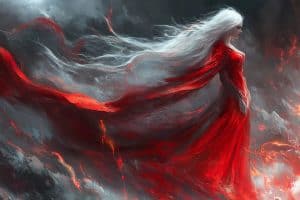
Mari, Supreme Deity: Goddess of Nature, Weather, and Justice describes the central figure of Basque belief. She is not a creator. She governs weather and justice, lives in caves inside mountains such as Anboto, and often appears dressed in red.
She changes shape. The page lists a noble woman with fiery hair, a bird of prey, a serpent or dragon, and a fireball in the sky. Every seven years she moves from one mountain home to another.
Gods Who Travel in Fire: Mari, Ezekiel and Elijah’s Chariot puts that journey next to Ezekiel’s whirlwind and fire. It reads the likeness as a possible memory of real craft, which is a paleo-contact reading. Paleo-contact is the idea that advanced beings had contact with humans in the distant past. The page says plainly that the passages do not have to describe the same thing.
Mari’s partner is the serpent-dragon Sugaar, according to Basque mythology – Atlantis connection?. Andrew Tomas gives the Basque serpent as Erensuge, the seven-headed one, which leads into The Seven-Headed Dragon: Revelation, the Beast of Babylon and the Naga of Mu.
Water spirits and giant builders
The Lamiak are female spirits of rivers, springs and bridges. Lamiak are mythical female beings closely linked to rivers, springs, and fountains describes them with long golden hair and the feet of a duck, goose or goat. Legends credit them with building bridges, roads and dolmens, which are prehistoric stone tombs.
The Mairu are giants who raised the same kind of monuments. Basque mythology – Atlantis connection? says stone circles are called Mairubaratz, the Garden of the Mairu. Where Lamiak and Mairu both get the credit, the builders are women in some tellings and giants in others.
The Atlantis side
Edgar Cayce’s readings, which I treat as channeled material, name the Pyrenees as the end of one Atlantean voyage. Atlanteans set sail for Egypt but ended up in the Pyrenees quotes it:
In Atlantis during periods of the breaking up of the land. Set sail for Egypt, but ended up in the Pyrenees in what are now Portuguese, French and Spanish lands.
Edgar Cayce

The same page says the Basques have myths of an ancestral homeland in the ocean called Atlaintika. That is a story the page reports, not a confirmed fact.
In The Iberian Colonies of Atlantis, Ignatius Donnelly quotes Winchell that the Iberians came from Atlantis, and then names their descendants:
The Iberians are represented to-day by the Basques.
Ignatius Donnelly, Atlantis: The Antediluvian World, Part V, Chapter IV

Atlantis: From Legend to Discovery (1972) adds the memory of a destruction by fire and water and a flight into caves, and Tomas sets Basque and Maya counting by twenties side by side.
Daniel Wilson is the skeptic. In The Lost Atlantis and Other Ethnographic Studies (1892) he treats Basque as a surviving language of pre-Aryan Europe. He says the idea that Basque is a stepping-stone to American languages has proved illusory beyond a general likeness in grammar.
Related pages
- Basque Myths: Ancient Origins, Legends, and Mysteries
- Mari, Supreme Deity: Goddess of Nature, Weather, and Justice
- Lamiak are mythical female beings closely linked to rivers, springs, and fountains
- Basque mythology – Atlantis connection?
- Gods Who Travel in Fire: Mari, Ezekiel and Elijah’s Chariot
- Atlanteans set sail for Egypt but ended up in the Pyrenees
- The Iberian Colonies of Atlantis
- Atlantis: From Legend to Discovery (1972)
- The Lost Atlantis and Other Ethnographic Studies (1892)
For every page I tagged with Basque, see the Basque tag archive.

