
Table of Contents
- Introduction
- Origins and Etymology
- Mari’s Appearance and Forms
- Sacred Locations – Caves and Mountains
- Her Most Sacred Caves and Mountains
- Mari as a Weather and Natural Force Deity
- Mari’s Role as a Judge and Punisher
- Forms of Punishment
- Connection to Sugaar – Mari’s Male Consort
- Sugaar’s Role
- Mari and Christianity – Survival and Adaptation
- Mari’s Connection to Other Mythologies
- a. Pre-Indo-European Goddesses
- b. Indo-European Storm and Sky Deities
- c. Other European Female Spirits
- Worship and Survival of Mari’s Traditions
- a. Pre-Christian Worship
- b. Modern Beliefs
- Key Symbols and Associations
- 12. Mari’s Legacy – Why She is Unique
Introduction
Mari is the supreme deity in Basque mythology, considered a goddess of nature, weather, fertility, and justice. She is not a creator deity, but rather a powerful, otherworldly being who governs the forces of nature and maintains balance in the world.
Unlike many European pagan traditions, Basque mythology is not polytheistic—i. Instead, revolves around Mari as the dominant spiritual force. ShMaris closely associated with mountains, storms, caves, and fire, and she represents both benevolence and destruction.
Origins and Etymology
- The name Mari may derive from pre-Indo-European roots, possibly linked to the Basque word ama (mother) or amari (old woman).
- Some theories suggest a connection to the earth and fertility, linking Mari to ancient earth goddess traditions.
- Though her name is similar to the Christian Virgin Mary, she has pre-Christian origins, and some legends were adapted over time to fit Christian beliefs.
Mari’s Appearance and Forms
Mari is a shape-shifter, appearing in multiple forms depending on her mood and purpose. Her most common forms include:
- A noble woman with long golden or fiery hair.
- A woman riding a chariot pulled by fire horses.
- A bird of prey (crow, vulture, or swallow).
- A serpent or dragon.
- A fireball flying through the sky.
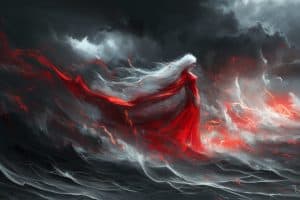
She often appears dressed in red, and her presence is marked by lightning, storms, or whirlwinds.
Sacred Locations – Caves and Mountains
Mari is primarily a cave-dwelling goddess, living inside mountains across the Basque Country. She moves between these locations every seven years, traveling through the sky in a storm of fire.
Her Most Sacred Caves and Mountains
- Anboto (43.0833, -2.5667)
- Her most famous home, often called “Mari de Anboto”.
- This limestone mountain is the heart of her legend.
- Aketegi (42.9167, -2.4167)
- The second-most important site where she resides.
- Gorbea (43.0333, -2.7333)
- A mountain associated with her weather-controlling powers.
- Txindoki (43.0333, -2.1000)
- Legends say she appears here as a luminous figure.
Each of these mountains has caves or deep chasms where Mari is believed to descend into the earth.
Mari as a Weather and Natural Force Deity
Mari’s most famous power is her control over weather:
- When she leaves her cave, she brings drought.
- When she returns home, she brings rain.
- If she is angry, she creates storms, whirlwinds, and lightning.
Basque shepherds and farmers observed her presence to predict the weather, a tradition that may date back thousands of years.
Mari’s Role as a Judge and Punisher
Mari is not a merciful deity—she is strict and punishes those who:
- Lie or steal.
- Break their oaths.
- Mistreat the land or animals.
Forms of Punishment
- She transforms liars and thieves into animals.
- She sends storms to destroy crops of those who disrespect the land.
- She can curse entire villages if they anger her.
Because of this, some scholars believe Mari represents an ancient moral code, enforcing justice without a written law.
Connection to Sugaar – Mari’s Male Consort
Mari is often linked to Sugaar, a serpent or dragon-like god. He is considered her husband or consort.
Sugaar’s Role
- He is not equal to Mari—he is a lesser supernatural being.
- When Mari and Sugaar meet, they create storms and thunder.
- Some legends say that their union produces great leaders or powerful figures.
- Sugaar is linked to fire and serpents, which fits Mari’s storm-making abilities.
Together, they may symbolize a balance between chaos (Sugaar) and order (Mari).
Mari and Christianity – Survival and Adaptation
- With the spread of Christianity, many of Mari’s stories were demonized.
- Priests labeled her a witch or a demon, saying she tempted men into evil.
- However, in remote Basque villages, she remained a respected figure, sometimes merged with the Virgin Mary.
To this day, Basque Christians still tell stories of Mari, showing that she was never completely erased from Basque culture.
Mari’s Connection to Other Mythologies
a. Pre-Indo-European Goddesses
- Similar to Gaia (Greek), Danu (Celtic), and Terra Mater (Roman).
- Unlike them, Mari is not a mother goddess—she is a ruler, not a creator.
b. Indo-European Storm and Sky Deities
- Similar to Perun (Slavic), Zeus (Greek), and Thor (Norse) in her control over lightning and storms.
- However, unlike male thunder gods, Mari is not a warrior—her power is absolute, not dependent on battles.
c. Other European Female Spirits
- Similar to Morgan le Fay (Arthurian myth), both as a mystical woman and a shape-shifter.
- Similar to the Fairy Queen of Celtic folklore, as she lives in caves and influences nature.
Worship and Survival of Mari’s Traditions
a. Pre-Christian Worship
- No temples or shrines—she was worshiped through natural places.
- People left offerings in caves (milk, bread, flowers).
- No sacrifices—her worship was based on respecting nature.
b. Modern Beliefs
- Mari survives in Basque folklore, especially among older generations.
- Some neo-pagan and feminist movements see Mari as a symbol of independence and female power.
- Her name is still used in Basque literature, music, and traditions.
Key Symbols and Associations
| Symbol | Meaning |
|---|---|
| Mountains & Caves | Mari’s sacred dwellings, entrances to the supernatural world. |
| Lightning & Storms | Her power to control nature and punish wrongdoing. |
| Fire & Gold | Her divine presence, appearing as a fireball or luminous being. |
| Animals (Birds, Serpents, Goats) | Her shape-shifting abilities. |
| Red Dress | Her fiery and otherworldly nature. |
12. Mari’s Legacy – Why She is Unique
Mari stands out as one of the most powerful female deities in European mythology:
- She is not a fertility or mother goddess, but a ruler of nature and justice.
- She has no husband or male counterpart who controls her.
- She is a pre-Christian figure who still influences Basque identity today.


Comments are closed.