
Table of Contents
- Influence on Iberian Pantheons
- Myths of the Historical Period
- Jaun Zuria and Sugaar in Biscay
- Saint Michael in the Aralar Range
- The Coat of Arms of Navarre and the Battle of Las Navas de Tolosa
- The Battle of Amaiur and Navarre’s Fall
- The Basque Giants of Prehistoric Builders
- Similar to Other European Giant Myths
- Related Mythical Figures
Influence on Iberian Pantheons
The Iberian Peninsula hosted Indo-European-speaking groups such as the Lusitanians and Celtiberians, yet evidence suggests their mythologies incorporated elements from an earlier non-Indo-European Basque substrate. This blending appears in certain deities and figures with potential proto-Basque roots, reflecting cultural exchanges over millennia.
The Mairu, or Mauriaks, represent mythical Basque giants credited with erecting dolmens and other prehistoric megaliths. These beings embody ancient engineering feats in folklore.
Iberian and Galician tales of the Enchanted Mouras—supernatural females who protect concealed treasures—likely stem from Basque Mairu traditions. Similar motifs of guardian spirits and hidden wealth persist across regions, indicating shared pre-Roman origins.
Endovelicus served as a prominent Lusitanian and Celtiberian deity associated with healing, the underworld, and prophetic oracles. His cult extended across modern Portugal and western Spain, with numerous inscriptions and sanctuaries attesting to his worship.
Scholars propose that Endovelicus’s name could derive from proto-Basque terms, such as links to “ene” (my) or “bela” (crow), or associations with Basque names like Eneko. However, this remains speculative, as alternative Indo-European etymologies exist, highlighting the complex linguistic layers in Iberian prehistory.
Myths of the Historical Period
Jaun Zuria and Sugaar in Biscay
Jaun Zuria, known as “The White Lord,” is the legendary inaugural Lord of Biscay. Folklore describes his mother as a Scottish princess and his father as Sugaar, a serpent-dragon deity. Their encounter occurred in the Basque village of Mundaka, where Sugaar, often depicted as a malevolent storm-bringer and consort to the goddess Mari, impregnated her. This myth underscores themes of divine lineage in Basque nobility.
Saint Michael in the Aralar Range
The Aralar Range features legends of Saint Michael manifesting to assist a local noble turned hermit. This narrative likely integrates pre-Christian Basque mountain spirits into Christian lore, symbolizing the syncretism of pagan deities with saints during the medieval Christianization of the region.
The Coat of Arms of Navarre and the Battle of Las Navas de Tolosa
The Navarrese coat of arms displays golden chains, derived from the Battle of Las Navas de Tolosa in 1212 CE. According to legend, King Sancho VII of Navarre breached the Almohad Caliph’s defenses, seizing chains that guarded the enemy camp. This emblem commemorates a pivotal Christian victory in the Reconquista and embodies Basque martial heritage.
The Battle of Amaiur and Navarre’s Fall
The Battle of Amaiur in 1522 CE signified the conclusive loss of Navarre’s independence to Castile. It stands as an emblem of Basque resilience against external conquest, with its legacy enduring in nationalist narratives and cultural commemorations, such as annual remembrances that highlight themes of autonomy and resistance.
The Basque Giants of Prehistoric Builders
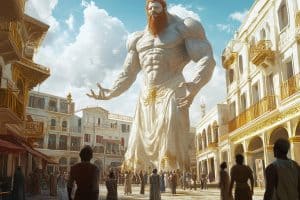
The Mairu, alternatively termed Mauriak or Maro, form a core element of Basque folklore as mythical giants linked to the erection of dolmens, megalithic tombs, and stone circles throughout the Basque Country and adjacent areas. Comparable to pan-European giant legends, they symbolize prehistoric human achievements in landscape alteration.
Origins and Meaning of the Name
The term Mairu connects linguistically to “Moorish” or “pagan,” paralleling the Mouros Encantados in Portuguese and Galician myths. This association does not denote historical Moors but rather evokes ancient, pre-Christian or enigmatic populations. Linguistic analysis points to proto-Basque roots, potentially preserving memories of Neolithic megalith builders who inhabited the region before Indo-European migrations.
Description of the Mairu
Mairu are portrayed as colossal beings with immense strength, effortlessly transporting massive boulders. They are attributed with creating Neolithic and Bronze Age structures like dolmens (trikuharriak), cromlechs, and menhirs. Often seen as a fading race, their decline coincides with the rise of human societies or the advent of Christianity, reflecting motifs of cultural transition.
This depiction resembles the Nephilim in Hebrew texts—giant offspring of divine beings and humans—emphasizing a shared archetype of primordial strength and eventual obsolescence.
Connection to Dolmens and Megalithic Culture
Basque dolmens and menhirs frequently carry Mairu-related names, such as Mairubaratz (“Garden of the Mairu”) for stone circles. Legends recount giants hurling or dropping stones upon hearing church bells or encountering Christian symbols, explaining the scattered megaliths. This ties into broader European folklore where ancient monuments are ascribed to supernatural constructors.
Notable megalithic sites associated with the Mairu include:
- Dolmen of Aizkomendi (Álava), a chamber tomb exemplifying Neolithic burial practices.
- Aralar megalithic complex (Navarre), featuring multiple dolmens and pastoral enclosures.
- Mairubaratzak of the Pyrenees (stone circles), used for ancient rituals and alignments.
Additional sites, like the Dolmen of Sorginetxe (“Witch’s House”) in Aralar, blend Mairu tales with witch lore, illustrating overlapping mythological layers.
The Mairu epitomize a bygone pre-Christian epoch, with their extinction linked to Christianity’s expansion. This narrative reinforces ideas of lost pagan wisdom and the triumph of monotheism, common in European folklore transitions.
Similar to Other European Giant Myths
- The Tuatha Dé Danann in Irish mythology, a divine race of builders and warriors, mirror the Mairu’s supernatural prowess and retreat from the world.
- Norse Jötnar, primordial giants responsible for natural formations, share the Mairu’s role in shaping terrain and conflicting with newer orders.
Further parallels exist with Greek Cyclopes, one-eyed giants who forged divine weapons and built cyclopean walls, underscoring a continental pattern of attributing antiquity to colossal beings.
Related Mythical Figures
- Mairu Beltz (Black Mairu): A shadowy variant, embodying malevolent or spectral qualities in some tales.
- Basajaun (Wild Lord): A benevolent forest giant who safeguards wildlife and imparts knowledge to humans, such as agriculture and metallurgy; often conflated with Mairu as an archaic entity.
- Lamia (Lamiak): Aquatic female spirits with bird-like feet; certain legends credit them, rather than Mairu, with megalith construction, portraying them as seductive builders of bridges and fountains. This reflects gender diversity in Basque mythic laborers.


Comments are closed.