
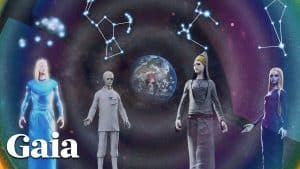
The society we have today was shaped by polytheism and monotheism. Monotheism emerged through Christianity, Judaism, and Islam, while polytheism arose from Roman civilization—through its republic and empire—and Greek philosophy.
These two approaches to understanding the divine on Earth originated from a single source. Monotheism sought to explain the universe as one mind or being expressed in many forms. These forms became the faces of polytheism, which honored each to connect with divine information from various perspectives and dimensions. This allowed everyone to relate to God’s will, wisdom, and love in different ways.
The historical development of polytheism and monotheism was linked to beings from other planets and stars. This caused confusion when discussing gods, goddesses, priests, and priestesses.
The concept of human gods on Earth began in Atlantean times, guided by Arcturians and Orion people. They helped us recognize our inner power through our blood, cells, and DNA. They taught that every god was a projection, so we should honor the sun as a projection of God and then become the sun ourselves. The pursuit of enlightenment aimed to transform humans into suns, moons, and stars on Earth.
The core idea of a universal god and goddess was that the divine is divided across levels of consciousness, with each dimension offering a unique way to understand it. In the material world, the divine was grasped through nature.
Nature provided the first code for understanding the universe’s workings. Life emerged from water, so we attributed divinity to every form of water, dividing it into categories like sea gods, rain, lakes, and rivers—each offering a different perspective.
This pattern applied to fire, earth, air, and all natural elements, including plants and animals. Each had distinct forms leading to a central core. For us, the greatest gods came from the sky: the moon, sun, and stars. These shaped our realities on Earth, which we initially saw as separate.
We realized that the unreachable sky represented the most divine aspects, while tangible elements helped us evolve and connect with higher realities. This is why we compared flowers to sunlight and achieved solar enlightenment through flower petals, inspiring concepts like chakras.
Daily realities helped us grasp creation’s power and our interconnectedness through God in various forms. From the beginning, when humans first recognized our place on Earth, this concept united us. Every culture understood that the sun, moon, and stars created this reality and shaped us in their image.
In history, when Anunnaki, Nephilim, Lyrans, and other beings—both from and outside the confederation—arrived from the skies, humans viewed them as gods from the stars. They brought creation and information, leading us to treat them as divine representatives on Earth.
Initially, humans recognized the divine through vibrations and words that defined each god’s energy. Words like “An,” “Mu,” “Ra,” or “On” encapsulated packages of information. For example, “Ra” or “On” represented the sky’s full knowledge in a single vibration, allowing efficient transmission to children or other cultures.
When the Anunnaki arrived and saw us naming universal gods with these vibrations, they claimed those names for themselves. They positioned themselves as intermediaries: to honor the sun, one had to visit their temple and offer gifts, so they could relay the message.
This created pyramidal civilizations, where the divine was accessible only through earthly gods. It disconnected humanity from the trinity process and direct divine connection, fostering the idea that these gods and goddesses were our sole intermediaries. Humans revered them without fear, allowing control because they seemed like divine messengers.
During humanity’s creation and societal development, the Anunnaki spread worldwide, conquering human species and creation ideas. They opposed the first two species aiding us with wisdom: the Nephilim and Sophia.
The Nephilim were nature’s voices on Earth, known as giants or the first gods, keepers of planetary and natural information. Sophia provided tree-of-life wisdom, explaining creation, symbolized by the snake offering the fruit of knowledge.
These species operated independently in separate regions, making them hard to access. For humans, Nephilim and Sophia concepts were challenging to grasp. The Anunnaki became central because they interacted more with humans, claiming to protect us—even though half sought control.
The Anunnaki fought species like Nephilim and Sophia to rule the world, portraying themselves as protectors against “snakes” and “giants.” They controlled civilizations as divine messengers, becoming the midpoint between humanity and the self.
When humans were ready to control the planet, new giants arrived: Arcturians, Orion people, and Sirians. They came after the Anunnaki’s chaos, declaring themselves messengers from fifth- and sixth-dimensional realms. They accused the Anunnaki of exploitation, dividing them into true protectors and pretenders, then banished the latter to underground “hell” cities guarded by keepers.
This allowed humans to rule the new civilization. Arcturians, Orion people, and Sirians became new gods for humans, but without demanding the title. I recall one, Yeshua, who taught relating to the divine in the stars. In an Atlantean desert temple, someone asked why she allowed being called a god. She replied, “I never asked to be called god, but I am part of God. I have no issue with it, as I am.”
They taught humans to become gods. Denying godhood would discourage us from reaching their consciousness level. We aspired to be like them, so they permitted the title to inspire us.
These beings prepared humans to become gods and goddesses on Earth. After banishing the Anunnaki underground, their teachings enabled civilizations to embody divinity. They instructed their “sons” in Mu, Lemuria, and Atlantis on the path to divinity.
These became the first priests and priestesses, incarnating higher-dimensional divine concepts on Earth. Thus, Atlantean people became god-like figures for all humans.
Comments are closed.