
Table of Contents
- Function
- Yi-ha, the Sanscrit – the original language
- Possible locations
- Key Considerations for an Ideal Location
- Ideal Locations Near Baalbek
- Advantages of Using Baalbek or Nearby High Points
- Babel as a Response to Post-Flood Trauma
- Post-Flood Context and Fear of Scattering
- Building the Tower to Avoid Scattering
- Babel as a Response to Post-Flood Trauma
- Scattering in Light of the Great Flood
- Dating
- Peleg and the “Division of the Earth”
- Estimated Timing
- Alternative Interpretation
Function
According to Jim Marrs:
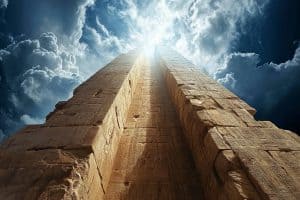
It may have been Nimrod’s attempt to thwart Enlil’s dispersion plan that led to the Old Testament story of the Tower of Babel. This narrative began at Baalbek, believed to be a post-Flood center for Anunnaki space-shuttle operations. The massiveness of the 1,100-ton granite block of the Trilithon, and others weighing more than 300 tons each, buttresses the idea that this may have once been a landing or launch pad.
One explanation for the trouble at Babel was that the humans there attempted to construct their own launch tower, apparently hoping to produce their own shem, or flying vehicle, with a view toward arguing
against the breakup of humanity with the off-world ruler, An. “Come, let us build ourselves a city with a tower that reaches to the heavens,” they were quoted in Genesis 11:4 (New International Version) as saying, “so that we may make a shem for ourselves and not be scattered over the face of the whole earth.”
An Arabic text found at Baalbek stated that Nimrod and his followers also tried to construct a shem there. “Shem, inadvertendy misunderstood, was rendered by most translators as a sign for the word ‘name. However, it originally signified ‘that which goes up,’ ” explained author Turnage. “Sitchin designates the origin of shem as Mesopotamian, originating from the word mu or the Semitic derivative shu-mu, or sham … ‘that by which one is remembered/ evolving into ‘name’ The original meaning of the words, however, was originally connected with the concept of something that flies.”
“The realization that mu or shem in many Mesopotamian texts should be read not as ‘name’ but as ‘sky vehicle’ opens the way to the understanding of the true meaning of many ancient tales, including the biblical story of the Tower of Babel,” wrote Sitchin. Even Sitchin’s critics agree that shem or shamaim (heaven) stem horn the word shamah translated as “that which is highward.”
Yi-ha, the Sanscrit – the original language
The word ritual, in English, can be traced back to ritvij, the present Sanscrit word for priest, or teacher of sacred things. Nearly all the Hebrew words pertaining to the mythical Tower of Babel, and the confusion of languages, correspond with Yi-ha, and its descendant language, the Sanscrit. In English we have babble, and gad, and gab, which are real Sanscrit words, as spoken. source
Possible locations
If the Tower of Babel were theorized to be a launching tower for spaceships, and the stones were sourced from Baalbek (home to some of the largest megalithic stones in history), the ideal location for such a structure would need to consider several factors. These include geographical advantages, proximity to Baalbek, and physical attributes conducive to space launches.
Key Considerations for an Ideal Location
Proximity to Baalbek:
To minimize transportation challenges for the massive stones, the site should be relatively close to Baalbek, where the quarrying took place.
Altitude:
A higher altitude reduces the amount of atmospheric drag and energy needed for a launch. High-altitude locations like Qurnat as Sawda’ or the nearby mountain ranges in Lebanon would be ideal.
Latitude:
Equatorial regions are optimal for space launches due to the Earth’s rotation, which provides an additional velocity boost (Coriolis effect). While Baalbek is far from the equator (latitude ~34°N), it could still be a feasible northern launch site.
Geological Stability:
A site with solid bedrock and minimal seismic activity is necessary to support the massive weight of the stones and the stress of a launch.
Historical and Mythological Context:
The site should align with ancient myths or traditions that point to advanced engineering or astronomical significance.
Ideal Locations Near Baalbek
- Qurnat as Sawda’ (3,088 meters (10131 feet))
- As the highest peak in Lebanon and the Levant, Qurnat as Sawda’ offers both altitude and proximity to Baalbek (~30 km).
- Its elevation reduces atmospheric drag, making it suitable for theoretical launches.
- Mount Hermon (2,814 meters (9232 feet))
- Located southeast of Baalbek, Mount Hermon is also a historically significant site, often linked with ancient myths and cosmic symbolism.
- Its relatively high elevation and commanding view make it a contender.
- Baalbek Itself
- The original location of the Baalbek stones may have been chosen intentionally. Its flat plateau is naturally fortified and has excellent visibility for observation and alignment with celestial phenomena.
Advantages of Using Baalbek or Nearby High Points
- Massive Megalithic Base: The megalithic platform at Baalbek is already capable of supporting extraordinary weight, making it plausible for constructing a monumental structure like a launch tower.
- Strategic Location: Baalbek lies in a region historically associated with ancient trade, technological prowess, and mythology.
Conclusion
If the Tower of Babel were a launch tower and its stones were from Baalbek, Qurnat as Sawda’ or Mount Hermon would be ideal due to their proximity, altitude, and stability. Alternatively, Baalbek itself might have been the intended site, leveraging the existing megalithic foundation and its central role in ancient myth and history.
Babel as a Response to Post-Flood Trauma
The phrase “scattered over the face of the whole earth” from Genesis 11:4 carries layers of potential meaning, and it’s reasonable to explore whether it could be an indirect reference to the Great Flood.
Post-Flood Context and Fear of Scattering
After the Flood, Noah’s descendants were commanded by God to:“Be fruitful and increase in number; multiply on the earth and fill it.” (Genesis 9:1)
This command implied dispersal across the earth. However, the survivors of the Flood might have seen the global destruction as a warning, possibly associating dispersion with vulnerability to further catastrophes.
The Flood had already destroyed all pre-Flood civilizations, leaving Noah’s family as the few survivors. This memory might have ingrained a fear of further scattering or isolation.
Building the Tower to Avoid Scattering
In Genesis 11:4, the builders of Babel state:“Come, let us build ourselves a city, with a tower that reaches to the heavens, so that we may make a shem for ourselves and not be scattered over the face of the whole earth.”
“Make a shem for ourselves”: This could reflect a desire for security, legacy, and centralization, ensuring unity and strength to avoid the perceived chaos of dispersion.
“Not be scattered”: This fear could stem from their historical memory of the Flood, where scattering across the earth represented destruction, isolation, and loss of community. The Flood had dramatically reshaped the earth, leaving survivors to start anew; unity and staying together might have been seen as a safeguard against such devastation.
Babel as a Response to Post-Flood Trauma
The Flood likely destroyed a global or widespread civilization (e.g., the speculative Atlantean society or pre-Flood human population).
Babel could symbolize a collective attempt to reclaim what was lost:
Unity through Centralization: A single city with a monumental tower could have been a way to counteract the dispersion caused by the Flood.
Fear of Future Catastrophes: Building a tower “to the heavens” might reflect a desire to protect against another flood (e.g., by reaching higher ground or appeasing the heavens).
Scattering in Light of the Great Flood
- The use of “scattered” could serve a dual purpose:
- Literal Scattering: Post-Flood survivors were physically scattered as the waters receded, creating new landscapes and separating survivors.
- Symbolic Scattering: The Flood marked a fracturing of pre-Flood unity, both physically (geographic isolation) and socially (loss of civilizations and shared culture).
Conclusion
The builders’ fear of being “scattered over the face of the whole earth” may harken back to the Great Flood, which they perceived as a catastrophic scattering event. Their unity and the construction of Babel could reflect both a trauma response to the Flood and a defiance of God’s command to disperse and populate the earth.
This interpretation ties the Tower of Babel to the broader narrative of human resilience, fear, and rebellion following the Flood.
Dating
The Bible provides genealogies in Genesis 10–11, listing the descendants from Noah through several generations until the Tower of Babel. Let’s align these generations with an assumed timeline:
- Noah: If the flood occurred in 9,564 BCE, Noah’s sons (Shem, Ham, and Japheth) were likely born by around 9,500 BCE.
- Generational Timing:
- Early biblical generations often had children relatively late (e.g., Noah was 500 years old when his sons were born). However, post-Flood lifespans and reproductive ages decreased. Using this trend:
- First post-Flood generation (Shem, Ham, Japheth): ~9,500 BCE.
- Second generation (e.g., Arphaxad, Cush): ~9,300 BCE.
- Third generation (e.g., Nimrod): ~9,100 BCE.
- Early biblical generations often had children relatively late (e.g., Noah was 500 years old when his sons were born). However, post-Flood lifespans and reproductive ages decreased. Using this trend:
- Nimrod and Babel: Nimrod, Ham’s grandson (through Cush), is identified as the founder of Babel. He likely rose to prominence during the third or fourth post-Flood generation, around 9,100–8,900 BCE.
Peleg and the “Division of the Earth”
- Peleg is a key chronological marker. The Bible says:“In the days of Peleg, the Earth was divided.” (Genesis 10:25)This “division” is traditionally associated with the scattering at Babel. Peleg was born approximately 4–5 generations after Noah. If each generation averages around 200–300 years (allowing for declining lifespans), Peleg would have lived around 8,800–8,600 BCE.
Estimated Timing
Babel’s Construction: Based on these calculations and assumptions:
The Tower of Babel likely occurred 8,800–8,600 BCE, about 700–1,000 years after the flood in 9,564 BCE.
Alternative Interpretation
If the “division of the Earth” refers not just to linguistic scattering but also to geological events or migrations following the flood, the timing might slightly vary. However, based on genealogical lifespans, 8,800–8,600 BCE remains a plausible timeframe for the Tower of Babel.


Comments are closed.