
Table of Contents
What is the original name of Babylon in Hebrew
The original name of Babylon was “Babilim” in the Akkadian language. It is believed to mean “Gate of the Gods” (from “bab” meaning gate and “ilu” meaning gods).
The name “Babylon” is derived from the Akkadian name “Babilim”, which means “Gate of the Gods.” The city was originally named Babilim by the Akkadians, a Semitic people who inhabited Mesopotamia. The name “Babylon” is the Greek form of this original Akkadian name, introduced later when the Greeks encountered the city during their conquests under Alexander the Great. Therefore, the name Babylon came into broader use through Greek influence, though its roots lie in the Akkadian language.
What is the hebrew original word for Babylon?
The original Hebrew word for Babylon is בָּבֶל (Bavel). בָּבֶל (Bavel) is used in the Hebrew Bible to refer to the ancient city of Babylon, which was a significant city in Mesopotamia, located in what is now modern-day Iraq.
Tower of Babylon
The original Hebrew word for the “Tower of Babel” is מִגְדַּל בָּבֶל (Migdál Bável).
- מִגְדַּל (Migdál) means “tower.”
- בָּבֶל (Bável) refers to “Babel” or “Babylon.”
The phrase “Migdál Bável” appears in the Hebrew Bible in Genesis 11:4-9.
The Hebrew word מִגְדַּל (Migdál) can have several translations depending on the context. While it primarily means “tower,” other possible translations and related meanings:
- Fortress: In some contexts, מִגְדַּל can refer to a strong, fortified structure, similar to a fortress or stronghold.
- Watchtower: It can also refer to a watchtower, which is a high structure used for observation and surveillance.
- Pillar: Although less common, in certain poetic or metaphorical uses, it might refer to something tall and upright, like a pillar.
- Elevated Structure: In general, it can be used to describe any tall, elevated structure.
The exact translation depends on the specific usage within the text.
Greek References to Babylon
Herodotus, the Greek historian from the 5th century BCE, provides one of the most detailed Greek descriptions of Babylon in his Histories. He describes the city’s walls, gates, and temples, including a “temple of Zeus Belus” (likely referring to the god Marduk, who was associated with the ziggurat Etemenanki).
Strabo, a Greek geographer and historian from the 1st century BCE, also refers to Babylon in his Geography. He mentions the city’s extensive construction projects but does not specifically name or describe the Etemenanki.
Babylon = (Tower of) Babel
The words “Babel” and “Babylon” in the Hebrew language share the same root word, בָּבֶל (Bavel).
- Tower of Babel: In Hebrew, this is מִגְדַּל בָּבֶל (Migdál Bável), with “Bavel” referring to the location where the tower was constructed.
- Babylon: The name for the ancient city itself is also בָּבֶל (Bavel).
The story of the Tower of Babel in Genesis 11:1-9 is often interpreted as an etiology (a story explaining the origin of something), particularly explaining the origin of different languages and the name of the city of Babylon. The narrative plays on the Hebrew word “Bavel,” associating it with the Hebrew verb בלל (balal), meaning “to confuse” or “to mix,” as in the story, God confuses the language of the people so they cannot understand one another.
Therefore, both the Tower of Babel and the city of Babylon are referred to by the same Hebrew word, בָּבֶל (Bavel).
Βαβυλών (Babylṓn) is used in the Septuagint (the Greek translation of the Hebrew Bible) and other Greek texts to refer to the ancient city of Babylon. This term is directly transliterated from the Hebrew בָּבֶל (Bavel), maintaining the name’s phonetic qualities while adapting it to the Greek language.
In Greek literature, Babylṓn is commonly used in references to the city, its empire, and its cultural and historical significance, just as in Hebrew texts.
Etemenanki
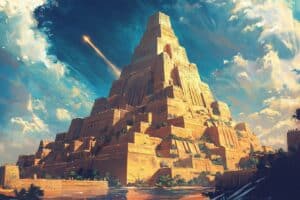
There was a structure in ancient Babylon that is often associated with the biblical Tower of Babel. This structure is the Etemenanki, a massive ziggurat dedicated to the god Marduk.
Etemenanki means “Temple of the Foundation of Heaven and Earth” in Sumerian. It was a ziggurat, a type of stepped pyramid, located in the city of Babylon.
The ziggurat was believed to have been built during the reign of King Nebuchadnezzar II in the 6th century BCE, though its foundations date back to an earlier period.
Etemenanki is thought to have been about 91 meters (298.56 feet) tall, making it a dominant feature of the Babylonian skyline.
The destruction of Babylon
Greek and Roman sources did mention the destruction of Babylon, though their accounts varied and often focused on different aspects of the city’s decline.
Herodotus (Histories, Book I) provides a detailed account of Babylon’s conquest by the Persian king Cyrus the Great in 539 BCE. He describes how Cyrus diverted the Euphrates River, allowing his troops to enter the city and capture it. However, Herodotus does not focus extensively on the physical destruction of the city itself, but more on the conquest and the end of Babylonian independence.
Xenophon, in his work Cyropaedia, also describes the capture of Babylon by Cyrus. Like Herodotus, he focuses on the strategic aspects of the conquest rather than the destruction of the city’s structures. Xenophon’s account is somewhat idealized, portraying Cyrus as a model leader.
Strabo, writing in the 1st century BCE, mentions Babylon’s decline in his Geography. He notes that by his time, Babylon had significantly deteriorated and that much of the city lay in ruins. He attributes the city’s decline to the shifting of the Euphrates River and the rise of other cities, such as Seleucia, which drew away inhabitants and resources.
Pliny the Elder, a Roman author from the 1st century CE, also comments on the decay of Babylon in his Natural History. He describes how the city, once so great, had become deserted and ruined by his time. Pliny’s account emphasizes the contrast between Babylon’s former glory and its desolation.
Diodorus Siculus, a Greek historian from the 1st century BCE, provides a more detailed narrative about the decline and destruction of Babylon. He mentions how later rulers, such as the Seleucid kings, dismantled parts of Babylon to use its materials for building new cities like Seleucia. This contributed to the city’s gradual destruction and abandonment.
Atlantis Connection
Herodotus describes the city’s walls, gates, and temples, including a “temple of Zeus Belus” – Zeus is a God associated with Atlantis.
In Revelation 18, the verse Thus shall Babylon Sink might reference to a city of Atlantis that sunk. Simular to ‘Thus shall Babylon sink, to rise no more, because of the disaster that I am bringing upon her, and they shall become exhausted’ from Jeremiah 51:64
Sir A. E. Wallace Budge, the Keeper of Egyptian Antiquities at the British Museum noted that Babylon and the surrounding regions, especially the people of Saba, cultivated astrology and kept records of births and astrological observations for 25,000 years. The Star Lore of Babylon
See More
The “Whore of Babylon” a symbolic figure described in the Book of Revelation


Comments are closed.