
Table of Contents
- Atlantis
- Geographical Location and Size
- Civilization and Society
- Technological and Spiritual Development
- Racial Subgroups
- Cataclysms and Sinking
- Survivors and Influence
- Cultural and Religious Impact
- Spiritual Decline and Destruction
- Legacy and Modern Traces
- Egyptian Civilization and Atlantean Influence
- Geological Changes and Migration
- Cultural and Religious Influence
- Historical Traditions
The “Exile of the Capellans” is a concept found in some Spiritist works. It explains that spirits from a planet orbiting the star Capella, in the Auriga constellation, were exiled to Earth in ancient times.
These spirits were sent here due to their resistance to moral progress in their home world. Upon reincarnating on Earth, they supposedly contributed significantly to the advancement of human civilizations, bringing knowledge and driving cultural and spiritual development.
Another prominent source is On the Way to the Light, dictated by the spirit Emmanuel and psychographed by Chico Xavier. It details the planet’s evolutionary journey and the role of the Capellans in this process.
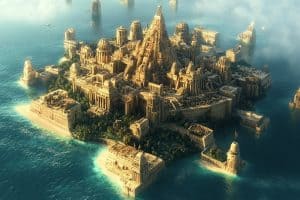
Atlantis
The book Os Exilados da Capela by Edgard Armond presents a detailed account of Atlantis, describing it as the homeland of the Fourth Root Race (Atlanteans). Here is a comprehensive overview based on the text:
Geographical Location and Size
- Atlantis was a vast continent located between present-day Europe and the Americas, stretching from the northern coast of Africa to the Sargasso Sea. It included regions now represented by the Azores, Cape Verde, and Canary Islands.
- The continent’s size was approximately 5,400,000 km², about half the size of Brazil.
Civilization and Society
- The Atlanteans were described as physically strong, with red-brown or yellow skin, beardless faces, and dynamic personalities. They were proud, ambitious, and highly developed in terms of material achievements.
- Their civilization lasted for around 70,000 years, reaching its peak in technological and societal development.
Technological and Spiritual Development
- The Atlanteans had advanced knowledge of natural laws, including control over the elements—earth, water, and air. They also mastered metallurgy and built cities rich in gold, with some palaces entirely constructed from this metal.
- They developed psychic abilities and practiced magic, including both white and black magic. Their use of elementals and otherworldly beings was common.
Racial Subgroups
The Atlantean civilization consisted of several sub-races, each contributing differently to the society:
- Romahals: Early sub-race with limited perception but a strong ability to name objects and interact with them.
- Travlatis: Focused on leadership and the concept of royalty, worshiping their ancestors and leaders.
- Toltecas: Administrators with copper-red skin.
- Semitas: A sub-race that eventually contributed to modern Semitic peoples.
- Acádios: Known for their navigation and trade.
Cataclysms and Sinking
Atlantis was destroyed in two major cataclysms:
- The First Cataclysm (8,452 BCE): The sinking of the “Great Atlantis,” the original continent.
- The Second Cataclysm (4,292 BCE): The destruction of the remaining island of Poseidonis, a large remnant of Atlantis.
These events caused significant geological changes, including:
- The formation of the Andes in South America.
- The drying of Lake Tritonis, leading to the formation of the Sahara Desert.
- The breaking of the Isthmus of Gibraltar, creating the Mediterranean Sea.
Survivors and Influence
After the cataclysm, survivors migrated to various regions, influencing emerging civilizations:
- Egypt: Survivors contributed to the rise of the Egyptian civilization, bringing advanced knowledge of architecture and mummification.
- Americas: Some survivors settled in elevated regions, becoming ancestors of the Aztecs, Mayas, Incas, and Native American tribes.
- Northern Africa: Others formed African civilizations with distinct cultural and spiritual traditions.
Cultural and Religious Impact
The Atlantean influence extended to many ancient civilizations, including the Egyptians, Mayans, and pre-Columbian cultures.
Shared practices included pyramid construction, mummification, and religious symbols, reflecting the transference of Atlantean knowledge.
Spiritual Decline and Destruction
Despite their advancements, the Atlanteans succumbed to moral decay, driven by excessive materialism and the misuse of psychic powers. This led to societal corruption and, eventually, their downfall.
Legacy and Modern Traces
Modern remnants of the Atlantean civilization are suggested to exist among the Basques, certain indigenous groups in the Americas, and isolated communities in Venezuela and Peru.
Some believe the slow rise of the Atlantic seabed indicates a potential future reemergence of Atlantis.
The book Os Exilados da Capela by Edgard Armond establishes several connections between Egypt and Atlantis:
Egyptian Civilization and Atlantean Influence
The survivors of the Atlantean cataclysm migrated to different parts of the world, including the northern coast of Africa. These survivors brought advanced knowledge and contributed to the rise of civilizations such as the Egyptians.
The Fraternidade Kobda, a spiritual brotherhood that emerged after the Atlantean collapse, influenced Egypt. This group initially promoted spiritual growth but degenerated into the authoritarian rule of the pharaohs.
Geological Changes and Migration
The sinking of Atlantis caused significant geological shifts, including the formation of the Sahara Desert through the drying of Lake Tritonis and the breaking of the Isthmus of Gibraltar, which created the Mediterranean Sea.
Survivors who reached the Mediterranean region settled in areas like Egypt and contributed to the advancement of local cultures.
Cultural and Religious Influence
The spiritual and scientific knowledge brought by Atlantean survivors was integrated into Egyptian religious practices, architecture, and societal structures.
The practice of mummification and the construction of pyramids in Egypt were attributed to knowledge transferred from Atlantean traditions.
Historical Traditions
Egyptian priests from Saïs shared the story of Atlantis with Solon, affirming that the continent sank around 9,500 years before their time.
This same narrative aligns with the accounts given by Plato in his works Timaeus and Critias, which also reference Egypt as a custodian of Atlantean history.
The book presents the idea that the decline of Atlantean civilization led to the dispersion of survivors, with Egypt becoming one of the key centers where their cultural and spiritual heritage continued to evolve.
For further reading, you can consult the following works:
- “The Exiled from Capella” – Edgard Armond. Available in PDF format: (limiarespirita.com.br)
- “On the Way to the Light” – Emmanuel (psychographed by Chico Xavier).
There are also lectures and studies available online discussing this topic, such as the video series The Exiled from Capella, available on YouTube:
These resources can provide a more detailed understanding of the exile of the Capellans and their supposed influence on humanity’s spiritual evolution.
Comments are closed.