
Table of Contents
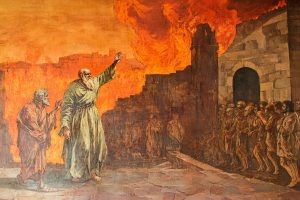
The destruction of Sodom was fabricated to instill fear of “God,” with natural disasters misattributed as divine acts, used by elites to manipulate people.
To understand Genesis 19, splitting the story into two layers could provide clarity:
- Angelic Visit: The initial account of the “angels” visiting Sodom describe an encounter —higher-dimensional beings acting as messengers and intervening to assist Lot and his family.
- Later Addition of Destruction: The narrative of the city’s destruction, potentially a natural disaster, might have been added later. This addition could serve to frame the event as divine punishment, promoting fear and religious control.
Later Addition of Destruction
In Genesis 19:13-24, the destruction narrative consistently uses YHWH, which aligns with the J (Yahwist) source. However, the surrounding stories of Abraham often intersperse YHWH and Elohim, raising questions about coherence.
Word Choice for “Destruction”
The Hebrew uses terms like:
- שחת (shachat, “to destroy”): Often used in contexts of moral corruption or divine judgment.
- גפרית ואש (gophrith va’esh, “brimstone and fire”): Unique phrasing that occurs only in highly stylized judgment passages, such as Deuteronomy 29:23, which might indicate later editorial influence.
This specific language might reflect theological framing to emphasize divine retribution, potentially added after composing the core narrative.
Sentence Length and Phrasing
The verses describing the destruction (Genesis 19:24-25) are unusually concise and dramatic compared to the surrounding text:
Genesis 19:24-25:
“Then the Lord rained upon Sodom and upon Gomorrah brimstone and fire from the Lord out of heaven; and he overthrew those cities, and all the plain, and all the inhabitants of the cities, and that which grew upon the ground.”
These sentences are action-packed and focus on sweeping destruction, lacking the dialogue or detailed interactions present in earlier verses. In contrast, verses like Genesis 19:1-11 are slower, with rich narrative elements, character actions, and conversations.
Abrupt Shift in Tone
The tone changes abruptly between the earlier narrative (verses 1-22) and the destruction narrative (verses 23-29):
- Earlier verses: Focus on Lot’s interactions with the “angels,” his moral struggle, and detailed dialogue. The narrative builds tension and emphasizes human choices.
- Destruction verses: Short, declarative sentences describe a cosmic event with little character involvement, giving the impression of an external editorial layer.
This contrast may indicate that the destruction verses were added later to complete the story in a way consistent with other judgment narratives.
Repetitive Phrasing
Some repetitive phrases in the destruction verses may reflect editorial stitching:
- Genesis 19:24:
*“Then the Lord rained upon Sodom and upon Gomorrah brimstone and fire from the Lord out of heaven.”*The phrase “from the Lord” is repeated, which is redundant in Hebrew style and could suggest a later theological emphasis inserted to reinforce divine authorship of the event.
Break in Narrative Flow
The destruction narrative interrupts the flow of the story:
Genesis 19:23:
“The sun was risen upon the earth when Lot entered into Zoar.”
This peaceful, observational detail shifts abruptly to the catastrophic destruction in the next verse (19:24). The calmness of Lot’s arrival in Zoar contrasts sharply with the sudden, dramatic imagery of fire and brimstone.
Theological Emphasis
The destruction narrative has a distinct theological focus compared to earlier verses:
- Words like “brimstone,” “fire,” and “overthrew” (haphak, הפך) are heavily judgmental and emphasize divine wrath, which aligns with themes from later biblical texts like Deuteronomy and prophetic books (e.g., Isaiah, Jeremiah).
- This theological tone contrasts with the earlier, more grounded narrative of interaction between Lot and the “angels,” which feels more personal and less apocalyptic.
Lot’s Wife Episode
The story of Lot’s wife turning into a pillar of salt (Genesis 19:26) is stylistically distinct:
- The verse is self-contained and symbolic, differing from the narrative style of the rest of the chapter.
- Its inclusion feels like a moralistic aside, potentially added to reinforce the lesson of obedience and the consequences of looking back.
Comparison to Similar Stories
When compared to other biblical judgment stories, such as the Flood (Genesis 6–9) or the Tower of Babel (Genesis 11), the destruction of Sodom feels more abrupt and less developed. The Flood story, for instance, includes detailed descriptions of divine planning, Noah’s actions, and the aftermath, while the Sodom destruction lacks similar elaboration.
Genesis 19 with Likely Later Additions Struck Through and Elohim Restored
Genesis 19:1
”And there came two malʾāḵîm of YHWH (of Elohim) to Sodom at even; and Lot sat in the gate of Sodom: and Lot seeing them rose up to meet them; and he bowed himself with his face toward the ground.”
Genesis 19:2
”And he said, Behold now, my lords, turn in, I pray you, into your servant’s house, and tarry all night, and wash your feet, and ye shall rise up early, and go on your ways. And they said, Nay; but we will abide in the street all night.”
Genesis 19:3
”And he pressed upon them greatly; and they turned in unto him, and entered into his house; and he made them a feast, and did bake unleavened bread, and they did eat.”
Genesis 19:4
”But before they lay down, the men of the city, even the men of Sodom, compassed the house round, both old and young, all the people from every quarter.”
Genesis 19:5
”And they called unto Lot, and said unto him, Where are the men which came in to thee this night? bring them out unto us, that we may know them.”
Genesis 19:6
”And Lot went out at the door unto them, and shut the door after him,”
Genesis 19:7
”And said, I pray you, brethren, do not so wickedly.”
Genesis 19:8
”Behold now, I have two daughters which have not known man; let me, I pray you, bring them out unto you, and do ye to them as is good in your eyes: only unto these men do nothing; for therefore came they under the shadow of my roof.”
Genesis 19:9
”And they said, Stand back. And they said again, This one fellow came in to sojourn, and he will needs be a judge: now will we deal worse with thee, than with them. And they pressed sore upon the man, even Lot, and came near to break the door.”
Genesis 19:10
”But the men put forth their hand, and pulled Lot into the house to them, and shut to the door.”
Genesis 19:11
”And they smote the men that were at the door of the house with blindness, both small and great: so that they wearied themselves to find the door.”
Genesis 19:12
”And the men said unto Lot, Hast thou here any besides? son in law, and thy sons, and thy daughters, and whatsoever thou hast in the city, bring them out of this place:”
Genesis 19:13
”For we will destroy this place, because the cry of them is waxen great before the face of YHWH; and YHWH hath sent us to destroy it (Elohim has sent us to destroy it).”
Genesis 19:14
”And Lot went out, and spake unto his sons in law, which married his daughters, and said, Up, get you out of this place; for YHWH will destroy this city. But he seemed as one that mocked unto his sons in law.”
Genesis 19:15
”And when the morning arose, then the malʾāḵîm of YHWH (of Elohim) hastened Lot, saying, Arise, take thy wife, and thy two daughters, which are here; lest thou be consumed in the iniquity of the city.”
Genesis 19:16
”And while he lingered, the men laid hold upon his hand, and upon the hand of his wife, and upon the hand of his two daughters; YHWH being merciful unto him: and they brought him forth, and set him without the city.”
Genesis 19:17
”And it came to pass, when they had brought them forth abroad, that he said, Escape for thy life; look not behind thee, neither stay thou in all the plain; escape to the mountain, lest thou be consumed.”
Genesis 19:18
”And Lot said unto them, Oh, not so, my lord:”
Genesis 19:19
”Behold now, thy servant hath found grace in thy sight, and thou hast magnified thy mercy, which thou hast shewed unto me in saving my life; and I cannot escape to the mountain, lest some evil take me, and I die.”
Genesis 19:20
”Behold now, this city is near to flee unto, and it is a little one: Oh, let me escape thither, (is it not a little one?) and my soul shall live.”
Genesis 19:21
”And he said unto him, See, I have accepted thee concerning this thing also, that I will not overthrow this city, for the which thou hast spoken.”
Genesis 19:22
”Haste thee, escape thither; for I cannot do any thing till thou be come thither. Therefore the name of the city was called Zoar.”
Genesis 19:23
”The sun was risen upon the earth when Lot entered into Zoar.”
Genesis 19:24
”Then YHWH rained upon Sodom and upon Gomorrah brimstone and fire from YHWH out of heaven
Genesis 19:25
”And he overthrew those cities, and all the plain, and all the inhabitants of the cities, and that which grew upon the ground
Genesis 19:26
”But his wife looked back from behind him, and she became a pillar of salt.”
Genesis 19:27
”And Abraham gat up early in the morning to the place where he stood before YHWH (Elohim):”
Genesis 19:28
”And he looked toward Sodom and Gomorrah, and toward all the land of the plain, and beheld, and, lo, the smoke of the country went up as the smoke of a furnace.”
Genesis 19:29
”And it came to pass, when Elohim destroyed the cities of the plain, that Elohim remembered Abraham, and sent Lot out of the midst of the overthrow, when he overthrew the cities in the which Lot dwelt.”


Comments are closed.