
Table of Contents
English Translation
- And when Abram was ninety years old and nine, the LORD appeared to Abram, and said unto him, I am the Almighty God; walk before me, and be thou perfect.
- And I will make my covenant between me and thee, and will multiply thee exceedingly.
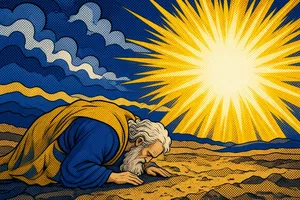
- And Abram fell on his face: and God talked with him, saying,
- As for me, behold, my covenant is with thee, and thou shalt be a father of many nations.
- Neither shall thy name any more be called Abram, but thy name shall be Abraham; for a father of many nations have I made thee.
- And I will make thee exceeding fruitful, and I will make nations of thee, and kings shall come out of thee.
- And I will establish my covenant between me and thee and thy seed after thee in their generations for an everlasting covenant, to be a God unto thee, and to thy seed after thee.
- And I will give unto thee, and to thy seed after thee, the land wherein thou art a stranger, all the land of Canaan, for an everlasting possession; and I will be their God.
- And God said unto Abraham, Thou shalt keep my covenant therefore, thou, and thy seed after thee in their generations.
- This is my covenant, which ye shall keep, between me and you and thy seed after thee; Every man child among you shall be circumcised.
- And ye shall circumcise the flesh of your foreskin; and it shall be a token of the covenant betwixt me and you.
- And he that is eight days old shall be circumcised among you, every man child in your generations, he that is born in the house, or bought with money of any stranger, which is not of thy seed.
- He that is born in thy house, and he that is bought with thy money, must needs be circumcised: and my covenant shall be in your flesh for an everlasting covenant.
- And the uncircumcised man child whose flesh of his foreskin is not circumcised, that soul shall be cut off from his people; he hath broken my covenant.
- And God said unto Abraham, As for Sarai thy wife, thou shalt not call her name Sarai, but Sarah shall her name be.
- And I will bless her, and give thee a son also of her: yea, I will bless her, and she shall be a mother of nations; kings of people shall be of her.
- Then Abraham fell upon his face, and laughed, and said in his heart, Shall a child be born unto him that is an hundred years old? and shall Sarah, that is ninety years old, bear?
- And Abraham said unto God, O that Ishmael might live before thee!
- And God said, Sarah thy wife shall bear thee a son indeed; and thou shalt call his name Isaac: and I will establish my covenant with him for an everlasting covenant, and with his seed after him.
- And as for Ishmael, I have heard thee: Behold, I have blessed him, and will make him fruitful, and will multiply him exceedingly; twelve princes shall he beget, and I will make him a great nation.
- But my covenant will I establish with Isaac, which Sarah shall bear unto thee at this set time in the next year.
- And he left off talking with him, and God went up from Abraham.
- And Abraham took Ishmael his son, and all that were born in his house, and all that were bought with his money, every male among the men of Abraham’s house; and circumcised the flesh of their foreskin in the selfsame day, as God had said unto him.
- And Abraham was ninety years old and nine, when he was circumcised in the flesh of his foreskin.
- And Ishmael his son was thirteen years old, when he was circumcised in the flesh of his foreskin.
- In the selfsame day was Abraham circumcised, and Ishmael his son.
- And all the men of his house, born in the house, and bought with money of the stranger, were circumcised with him.
Genesis 17 (King James Version, KJV)
Notes
After Genesis 16, where Hagar bears Ishmael, the LORD appears again when Abram is ninety-nine years old. The chapter renews the covenant, changes the names of Abram and Sarai, promises Isaac, and institutes circumcision as the sign. The wider reading of Ishmael and Isaac as two blessed nations is already set out on The origins of two great nations. This page stays with the rite, the names, and the title El Shaddai.
When I read this chapter, I stop at the name El Shaddai.
I am the Almighty God
The King James Version opens:
And when Abram was ninety years old and nine, the LORD appeared to Abram, and said unto him, I am the Almighty God; walk before me, and be thou perfect.
Genesis 17:1 (KJV)
Most English Bibles turn El Shaddai into “God Almighty” or “the Almighty”. On El Shaddai that translation is treated as a problem, because it hides who stands behind the name.
The usual translation is inaccurate
Paul Wallis, in The Eden Conspiracy, calls El Shaddai an ancient patriarchal name, kept mainly in the priestly tradition, and says the usual rendering does not hold.
“El Shaddai – an ancient divine name of the patriarchal period, rarely used outside the Pentateuch. [It is] preserved mainly in the priestly tradition…The usual translation ‘Almighty God’ is inaccurate…”
Paul Wallis, The Eden Conspiracy

On the same El Shaddai page, Wallis also gives lexicon readings such as “the powerful one of the mountains” or “the destroyer”. Mauro Biglino reaches a close reading: “Lord of the steppe” or “destroyer”, rather than “Almighty”. Exodus 6:3 later has the speaker say that he appeared to Abraham, Isaac and Jacob as God Almighty, and that by the name JEHOVAH he was not known to them. Yahweh deliberately woven throughout the Hebrew Scriptures reads that as a sign that the patriarchs first knew El Shaddai, and that the later identification with Yahweh is editorial.
Abram becomes Abraham, Sarai becomes Sarah
The name change is stated in the King James Version:
Neither shall thy name any more be called Abram, but thy name shall be Abraham; for a father of many nations have I made thee.
Genesis 17:5 (KJV)
Abraham and Brahma walks through the Hebrew letters. Abram is aleph, bet, resh, mem. In Genesis 17:5 the he is added, and the name becomes Abraham. Sarai is told she will be Sarah, and the chapter promises that she will bear a son, Isaac. Abraham falls on his face and laughs, asking in himself whether a child can be born to a man a hundred years old, and to Sarah, ninety years old (Genesis 17:17). Having children through divine intervention records those ages. The birth itself arrives in Genesis 21.
Ishmael is not dropped. Abraham asks that Ishmael might live before God. The answer is that the covenant line is named through Isaac, and that Ishmael too will be fruitful and will father twelve princes and a great nation. That double blessing is the subject of The origins of two great nations.
On God led Abraham to the ancient land of Ham, Stuart Holroyd’s Briefing for the Landing on Planet Earth is reviewed as reading Genesis 17 as a promise that Abraham will be “the father of a multitude of nations” (p. 221), a breeding plan as much as a religious promise. That is Holroyd’s reading of the sessions he published, not a claim made by Genesis itself. The book page is Briefing for the Landing on Planet Earth.
The token in the flesh
Circumcision is given as the token of the covenant, for every male, the child of eight days, the one born in the house, and the one bought with money from a foreigner:
And ye shall circumcise the flesh of your foreskin; and it shall be a token of the covenant betwixt me and you.
Genesis 17:11 (KJV)
Circumcision gathers that biblical sign beside later claims that Donnelly traced the custom to Atlantis, and beside the Oahspe’s later withdrawal of the law. The Gerim stays with the biblical use: the slave bought from a foreigner receives the same mark, so the sign marks the covenant, not birth into the family line. That page also notes Mauro Biglino’s comparison of the rite to the brand that marks one owner’s cattle from another’s.
Yahweh first emerges as a personal, covenantal deity in the story of Abraham reads the introduction of circumcision, together with the land promises, as a sign that Yahweh was guiding one chosen lineage. The next chapter is Genesis 18, The three visitors, where the birth of Isaac is announced again, and Sarah laughs in the tent.

