
Table of Contents
English Translation
- Then again Abraham took a wife, and her name was Keturah.
- And she bare him Zimran, and Jokshan, and Medan, and Midian, and Ishbak, and Shuah.
- And Jokshan begat Sheba, and Dedan. And the sons of Dedan were Asshurim, and Letushim, and Leummim.
- And the sons of Midian; Ephah, and Epher, and Hanoch, and Abidah, and Eldaah. All these were the children of Keturah.
- And Abraham gave all that he had unto Isaac.
- But unto the sons of the concubines, which Abraham had, Abraham gave gifts, and sent them away from Isaac his son, while he yet lived, eastward, unto the east country.
- And these are the days of the years of Abraham’s life which he lived, an hundred threescore and fifteen years.
- Then Abraham gave up the ghost, and died in a good old age, an old man, and full of years; and was gathered to his people.
- And his sons Isaac and Ishmael buried him in the cave of Machpelah, in the field of Ephron the son of Zohar the Hittite, which is before Mamre;
- The field which Abraham purchased of the sons of Heth: there was Abraham buried, and Sarah his wife.
- And it came to pass after the death of Abraham, that God blessed his son Isaac; and Isaac dwelt by the well Lahai-roi.
- Now these are the generations of Ishmael, Abraham’s son, whom Hagar the Egyptian, Sarah’s handmaid, bare unto Abraham:
- And these are the names of the sons of Ishmael, by their names, according to their generations: the firstborn of Ishmael, Nebajoth; and Kedar, and Adbeel, and Mibsam,
- And Mishma, and Dumah, and Massa,
- Hadar, and Tema, Jetur, Naphish, and Kedemah:
- These are the sons of Ishmael, and these are their names, by their towns, and by their castles; twelve princes according to their nations.
- And these are the years of the life of Ishmael, an hundred and thirty and seven years: and he gave up the ghost and died; and was gathered unto his people.
- And they dwelt from Havilah unto Shur, that is before Egypt, as thou goest toward Assyria: and he died in the presence of all his brethren.
- And these are the generations of Isaac, Abraham’s son: Abraham begat Isaac:
- And Isaac was forty years old when he took Rebekah to wife, the daughter of Bethuel the Syrian of Padan-aram, the sister to Laban the Syrian.
- And Isaac intreated the LORD for his wife, because she was barren: and the LORD was intreated of him, and Rebekah his wife conceived.
- And the children struggled together within her; and she said, If it be so, why am I thus? And she went to enquire of the LORD.
- And the LORD said unto her, Two nations are in thy womb, and two manner of people shall be separated from thy bowels; and the one people shall be stronger than the other people; and the elder shall serve the younger.
- And when her days to be delivered were fulfilled, behold, there were twins in her womb.
- And the first came out red, all over like an hairy garment; and they called his name Esau.
- And after that came his brother out, and his hand took hold on Esau’s heel; and his name was called Jacob: and Isaac was threescore years old when she bare them.
- And the boys grew: and Esau was a cunning hunter, a man of the field; and Jacob was a plain man, dwelling in tents.
- And Isaac loved Esau, because he did eat of his venison: but Rebekah loved Jacob.
- And Jacob sod pottage: and Esau came from the field, and he was faint:
- And Esau said to Jacob, Feed me, I pray thee, with that same red pottage; for I am faint: therefore was his name called Edom.
- And Jacob said, Sell me this day thy birthright.
- And Esau said, Behold, I am at the point to die: and what profit shall this birthright do to me?
- And Jacob said, Swear to me this day; and he sware unto him: and he sold his birthright unto Jacob.
- Then Jacob gave Esau bread and pottage of lentiles; and he did eat and drink, and rose up, and went his way: thus Esau despised his birthright.
Genesis 25 (King James Version, KJV)
Notes
Genesis 25 is a hinge chapter. Abraham takes another wife, Keturah, and has more sons. He dies at a hundred and seventy-five years, and Isaac and Ishmael bury him in the cave of Machpelah, bought in Genesis 23. Isaac inherits the covenant line. Rebekah, married to Isaac at the close of Genesis 24, conceives twins after a long barrenness, and Esau sells his birthright to Jacob.
When I read this chapter, I keep the burial at Machpelah and the sale of the birthright in the same frame: one generation is laid down, and the next is already divided.
Keturah and the death of Abraham
After Sarah’s death, Abraham takes a wife named Keturah. She bears Zimran, Jokshan, Medan, Midian, Ishbak and Shuah. Chronological Nations and Tribes notes that the Midianites later descend from Abraham through Keturah. Abraham gives gifts to the sons of the concubines and sends them eastward, away from Isaac, and he gives all that he has to Isaac.
Later legends, gathered in Baring-Gould’s Abraham chapter, sometimes identify Keturah with Hagar, brought back after Sarah’s death. Genesis itself does not make that identification. It simply names Keturah as a wife taken again, and it keeps Hagar’s son Ishmael in a separate genealogy later in the same chapter.
Abraham dies in a good old age, full of years, and is gathered to his people. Isaac and Ishmael bury him in the cave of Machpelah, in the field of Ephron the son of Zohar the Hittite, before Mamre, where Sarah was buried. God blesses Isaac, and Isaac dwells by the well Lahai-roi.
Two nations in the womb
Isaac is forty years old when he takes Rebekah to wife. She is barren, and he intreats the LORD for her. She conceives. Having children through divine intervention notes that they wait twenty years: Isaac is threescore years old when the twins are born. The children struggle together within her, and she asks why this is so. The King James Version gives the answer:
And the LORD said unto her, Two nations are in thy womb, and two manner of people shall be separated from thy bowels; and the one people shall be stronger than the other people; and the elder shall serve the younger.
Genesis 25:23 (KJV)
The first child comes out red, all over like a hairy garment, and they call his name Esau. The 12 Tribes records that the name is tied to that redness and hair. His brother follows, his hand taking hold on Esau’s heel, and he is called Jacob. Esau becomes a cunning hunter, a man of the field. Jacob is a plain man, dwelling in tents. Isaac loves Esau, because he eats of his venison. Rebekah loves Jacob.
The birthright sold
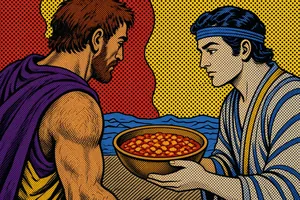
Jacob has cooked pottage when Esau comes in from the field, faint, and asks for the red food. Jacob asks him to sell his birthright that day. Esau says he is at the point to die, and that the birthright is of no profit to him. He swears, sells it, and eats the bread and the pottage of lentils. The chapter closes with a hard line: “thus Esau despised his birthright.”
The 12 Tribes retells this sale as the moment the rights of the firstborn, including a double inheritance and the spiritual lead of the family, pass to Jacob. The blessing itself is taken later, in Genesis 27, with Rebekah’s help. Between those two chapters, Genesis 26 follows Isaac in Gerar, among the wells, and under the same king Abraham once faced.

