
Table of Contents
The Sea of Galilee
Recent excavations along the shores of the Sea of Galilee have revealed significant discoveries. At the site of El-Araj, archaeologists unearthed Roman artifacts, proving that the current water levels of the lake are consistent with those from 2,000 years ago. This finding challenges prior theories that the lake was significantly higher in ancient times.
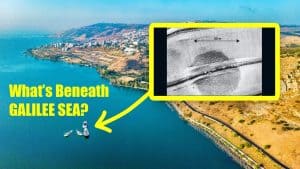
Using sonar technology, researchers identified a massive underwater structure beneath the lake. This cone-shaped formation, made of boulders and comparable in age and size to Stonehenge, rises to a height equivalent to a six-story building. The origin and purpose of the structure remain unknown.
The Sea of Galilee is surrounded by key biblical locations, such as Bethsaida, Capernaum, Chorazin, and Magdala, where historical and religious events occurred.
Mount Hermon
Mount Hermon, the highest point in Israel, is suggested by scholars as the possible site of the Transfiguration of Jesus. Its height and seclusion align with the biblical account better than Mount Tabor. Additionally, Mount Hermon is associated with the Genesis narrative of the Nephilim, beings described as offspring of angels and humans. Alternative interpretations suggest these beings were human descendants of Seth who intermarried with Cain’s lineage.
Naftali Mountains
The Naftali Mountains, located in northern Israel, were home to the tribe of Naftali. These hills, rich in historical and biblical significance, were described in Deuteronomy 33 as a land of favor and blessing. Historically, the mountains served as a defense point, protecting the northern frontier of ancient Israel.
The Valley of Gehenna
Known as the Valley of Hinnom, this area holds a dark history as a site of child sacrifices to the god Molech in ancient times. The valley’s infamy led to its association with hell in Hebrew tradition. Nearby, Akeldama, the “Field of Blood,” is linked to the death of Judas Iscariot after his betrayal of Jesus. Visitors to the valley report a lingering sense of foreboding, reflecting its tragic past.
The Dead Sea
The Dead Sea, the lowest point on Earth, is shrinking at an unprecedented rate, losing approximately 1.2 meters (3.94 feet) of water annually. As the water recedes, freshwater springs emerge, forming new pools that support fish and bird life. These sinkholes, filled with fresh water, are transforming the landscape into an evolving ecosystem.
Mount Gilboa
Mount Gilboa is historically significant as the site where King Saul and his son Jonathan died in battle. King David cursed the mountain, wishing it to remain barren. While reforestation efforts have brought new life to parts of the mountain, areas remain untouched, seemingly reflecting the curse. Beneath the mountain, warm springs are accessible throughout the year.
St. George Monastery
Located in the Judean Desert between Jericho and Jerusalem, St. George Monastery has been a place of seclusion for monks for over 1,500 years. The road adjacent to the monastery is identified with the biblical parable of the Good Samaritan, highlighting its historical and symbolic significance.
Tiberius
The city of Tiberius, on the shore of the Sea of Galilee, is mentioned in the Gospel of John as a significant urban center during Jesus’ time. Today, the city offers serene views and insights into the biblical era.
The Negev Desert
The Negev Desert served as the backdrop for the Israelites’ 40-year journey. This arid region now hosts one of the world’s largest solar power stations. The biblical account of survival in this unforgiving terrain highlights miracles such as manna and water from a rock.
Mount Arbel
Mount Arbel overlooks the Sea of Galilee with steep cliffs and expansive views. It is thought to have been a place of prayer and solitude for Jesus. The mountain is also a historical site where Jewish rebels resisted Roman forces, leaving behind ancient caves and fortifications.
Acre
Acre, a coastal city, has a rich history encompassing the Canaanite period and the Crusades. It served as a key port and military stronghold. The city, mentioned in the Book of Judges, was never fully conquered by the Israelites. Visitors can explore Crusader tunnels and walk along the ancient walls.
The Western Wall
The Western Wall in Jerusalem is a sacred remnant of the Second Temple. Recent excavations have uncovered artifacts from the First Temple period, including rings and tools. Below the wall, tunnels have been identified that some believe may lead to hidden chambers containing temple treasures. Efforts to explore these tunnels continue with advanced robotics.
Conclusion
The locations highlighted in this video reflect the deep historical and spiritual layers of Israel. These sites are featured in the 2025 calendar released by Sergio & Rhoda in Israel, with proceeds covering only production and shipping costs. For further information, visit snrisrael.com.
Comments are closed.