
Table of Contents
- Early Exploration and Theories in Egypt (2000s)
- National Geographic and Media Opposition
- Publication and Further Research (2004–2016)
- ‘Oumuamua and Modern Scientific Parallels (2017)
- Ancient Egypt’s ET Lineage and the Lion People
- Museum Encounters and Temple Visits
- The Role of Lion Deities
- Comparative Iconography Across Civilizations
- The Activation of the Neocortex
- Egyptian Temple Imagery and Ascension Codes
- Genetic Intervention Hypothesis
- Connections to Akhenaten, Nefertiti, and Tutankhamun
- Lion Symbolism in Israelite Traditions
- Watchers, Nephilim, and the Celestial Lion Tribe
- Lion People as Light Beings
- Lion People in Egyptian and Jewish Religious Intersections
- The Seven-Rayed God and Gnostic Parallels
- Christian Symbolism and the Lineage of the Lion People
- Final Conclusions
Early Exploration and Theories in Egypt (2000s)
In the early 2000s, the speaker began presenting a series called Egypt: Shadow of Atlantis, exploring the relationship between Atlantis and ancient Egypt. This included analysis of the Edfu Creation Texts, which describe light beings who arrived on Earth, founded a civilization on an “island of the egg,” and later preserved a relic before a cataclysm. These beings returned post-cataclysm to restart civilization.
The texts were translated by Dr. Eve Raymond of Manchester University and contained narratives of formless light beings initiating civilization, later taking physical form. A central question raised was whether this text could be the Egyptian source for Plato’s Atlantis story.
National Geographic and Media Opposition
National Geographic later involved the speaker in a program titled Atlantis: Is It Real?, which strongly contested the speaker’s interpretation and presented critical counter-narratives. This encounter underscored resistance within mainstream archaeology and Egyptology to alternative historical perspectives.
Publication and Further Research (2004–2016)
Following the media appearance, the speaker published the book Starwalkers and the Dimension of the Blessed, detailing links between the Edfu texts and Atlantis. Research continued for over a decade, culminating in the analysis of von Neumann probes—hypothetical space-traveling, self-replicating artificial intelligence vehicles. These probes closely resembled the formless light beings of the Edfu texts.
In 2016, an article titled Ancient Alien Artificially Intelligent Astro Chickens was published, comparing scientific discussions of von Neumann probes with the symbolic elements found in the Edfu text.
‘Oumuamua and Modern Scientific Parallels (2017)
In 2017, the interstellar object ʻOumuamua entered the solar system, exhibited unusual behavior, and exited at an accelerated speed. Harvard astrophysicist Avi Loeb proposed it could be an artificial object, possibly a von Neumann probe. The speaker noted this mirrored the formless beings in the Egyptian texts, suggesting Earth might have been visited by such probes in deep antiquity.
Ancient Egypt’s ET Lineage and the Lion People
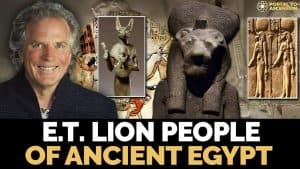
The presentation shifted toward the lion people—beings connected to ancient Egypt’s pantheon, specifically Sekhmet, Bastet, Mut, and Tefnut. These deities, often represented as feline or leonine, were described as possibly originating from other star systems and capable of shapeshifting or taking on physical form.
Museum Encounters and Temple Visits
A pivotal moment was a visit to the British Museum, observing references to cats as divine incarnations. In temples such as the Sekhmet Chapel at Karnak, visitors reportedly experienced intense sensory and metaphysical phenomena.
Repeated encounters with Sekhmet statues, particularly in Luxor and Karnak, were described as highly significant. Experiences included feelings of physical contact and auditory anomalies within enclosed temple chambers.
The Role of Lion Deities
Deities like Tefnut and Mut are said to embody wholeness and perfection. These lion goddesses were associated with resurrection oil, anointing rituals, and symbols of eternity. Several statues and inscriptions depict these beings transmitting knowledge and initiation rites to pharaohs, particularly Seti I and Ramses II.
Comparative Iconography Across Civilizations
Beyond Egypt, lion-human hybrid deities appeared in:
- India, in the form of Narasimha, the lion-man avatar of Vishnu.
- Mesopotamia, where goddesses like Inanna/Ishtar were associated with lions.
- Canaanite traditions, where the lion goddess Qetesh (possibly linked linguistically to “kadosh,” or holy) was worshipped.
- Greek-influenced Egypt, with temples such as Kom Ombo preserving hybrid lion imagery.
The speaker highlighted a continuous cultural motif involving lion deities or beings from Anatolia to Mesopotamia, the Levant, and Egypt.
The Activation of the Neocortex
Research into neurological evolution was brought into the discussion. The speaker proposed that beings such as the lion people played a role in activating the human neocortex approximately 200,000 years ago, with further developments around 75,000 and 40,000 years ago.
These neurological shifts coincided with:
- The appearance of complex art and tools.
- Creation of the lion-human sculpture in Germany (~30,000 years ago).
- Increased symbolic and spiritual cognition.
Egyptian Temple Imagery and Ascension Codes
Scenes at Abydos and Karnak depict rituals involving Sekhmet and Ptah initiating Seti I into ascension mysteries. Ptah is shown writing divine codes into Seti’s hand while he stands within what is interpreted as a symbolic brain or tree of life.
Ptah is identified as the god of craftsmanship and technology, possibly involved in modifying human DNA to facilitate ascension. Sekhmet is described as his consort and co-participant in these efforts.
Genetic Intervention Hypothesis
Discussion of chromosome 2 fusion supported the idea of intentional genetic manipulation in human origins. Scientific observations indicate this fusion did not occur naturally. The speaker connected this to ancient accounts of divine beings (e.g., Ptah and Sekhmet) who might have altered human DNA.
Connections to Akhenaten, Nefertiti, and Tutankhamun
The line of Akhenaten and Nefertiti is linked to lion symbolism. Nefertiti adopted visual iconography connected to Tefnut, reinforcing ties to feline deities. Tutankhamun’s throne, described as a lion throne, continues the lineage.
Lion Symbolism in Israelite Traditions
The tribe of Judah, from which King David and King Solomon descended, is called the lion tribe. Solomon’s throne is said to have featured lion sculptures and mirrored artistic features found in Egypt.
Solomon referenced Mount Hermon as the Lion’s Den, a location associated with the descent of the Watchers—angelic beings from the Book of Enoch.
Watchers, Nephilim, and the Celestial Lion Tribe
The Book of Enoch describes 200 Watchers descending to Mount Hermon, mating with human women, and producing Nephilim. These Watchers were originally light beings who took on physical form, paralleling the lion people’s depiction.
The fall of these beings is attributed to their transition from light bodies to physical bodies. The New Testament references the same idea, stating the angels left their original habitation and now exist in a lower state.
Lion People as Light Beings
Art from Christianity and Gnosticism depicts divine beings (e.g., Christ) in light body form. The Lion’s Den in the Book of Daniel is reinterpreted as a portal where Daniel encountered celestial beings, possibly lion people.
In Jewish Midrash, Daniel’s lion protector is described as an angel in lion form, echoing resurrection narratives where stones are rolled away by radiant beings (e.g., the angel at Jesus’s tomb).
Lion People in Egyptian and Jewish Religious Intersections
The Egyptian city of Leontopolis, also known as the City of the Lions, hosted a duplicate of Solomon’s Temple during the diaspora. There, the goddess Bastet was worshipped as the lion lady.
The Book of Enoch, possibly authored by the Essenes, may have originated from this community. These Jewish mystics viewed celestial beings as guides to ascension, aligning with Egyptian lion symbolism.
The Seven-Rayed God and Gnostic Parallels
The Essenes also developed the concept of the seven-rayed god, linked with Chnubis, a lion-serpent deity. Gnostic texts describe this being as a lion-headed serpent of illumination, reflecting themes of transformation and divine knowledge.
Christian Symbolism and the Lineage of the Lion People
In Christian art, lions symbolize Christ’s resurrection and power. The New Testament connects Jesus to the lion of Judah, linking him to this celestial lineage. Mary is often shown seated on a lion throne, reinforcing this motif.
Final Conclusions
The speaker proposed that:
- The lion people are a celestial lineage of beings who came to Earth to assist in human spiritual evolution.
- They were responsible for activating human consciousness and providing the codes of ascension.
- Their presence is preserved across multiple cultures—from ancient Egypt and India to Mesopotamia and Judeo-Christian traditions.
Humanity, according to this interpretation, is the inheritor of the lion lineage, walking the path of resurrection, ascension, and immortality.
End of Transcript Summary
Comments are closed.