
Table of Contents
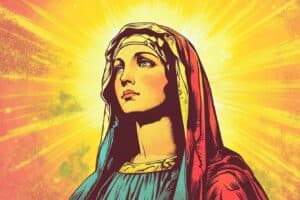
Maria, also known as Mary in English, is a central Christian figure as the mother of Jesus Christ. Her life and significance are deeply rooted in religious traditions and texts.
Name and Titles
- In Hebrew: Miriam.
- Titles: The Virgin Mary, Mother of God (Theotokos in Greek), Our Lady.
- Panagia Gorgona
Life Events
- Birth: Tradition holds she was born in Jerusalem or Nazareth to her parents, Joachim and Anne.
- Annunciation: According to the Gospel of Luke, the angel Gabriel announced to Mary that she would conceive Jesus through the Holy Spirit (Luke 1:26-38).
- Marriage: Married Joseph, a carpenter of Nazareth.
- Motherhood: Gave birth to Jesus in Bethlehem. She raised him in Nazareth and supported him during his ministry.
Significance in Christianity
- Regarded as a model of faith, obedience, and humility.
- Celebrated in major Christian feasts, such as the Annunciation, Immaculate Conception, and Assumption.
Role in the Gospels
- Present at key moments of Jesus’ life: Nativity, first miracle at Cana, crucifixion, and resurrection.
Cultural and Religious Influence
- Catholic and Orthodox Christianity: Mary is venerated as a saint, and various Marian apparitions have been reported throughout history.
- Islam: Known as Maryam, she is honored as the mother of Prophet Isa (Jesus) and mentioned in the Quran.
Locations Associated with Mary
- Nazareth View Map: Believed to be her home.
- Bethlehem View Map: The birthplace of Jesus.
- Jerusalem View Map: Associated with her later life and the Dormition tradition.
Origin of Maria
The name Miriam (מִרְיָם) has Hebrew origins and is traditionally interpreted in various ways.
It is derived from ancient Semitic languages:
Derived from “Mar” (מר):
- The root mar means “bitter” or “rebellious” in Hebrew.
- This interpretation ties to the biblical story of the Israelites’ hardships in Egypt, which may have influenced the meaning.
Although the exact origin remains uncertain, the name is rich in historical and cultural significance, particularly in the contexts of the Bible and early Semitic languages.
6 The feminine of earth is Mi. The spirit of a mortal dwell”’ in a womb, which is his earth-body; consequently the earth is called Mother, while the Ever-Present Spirit, which impregnated earthly things, is called Father. Ah, or Pan, is earth in abstract, but Mi is earth relatively to living creatures. But the perversion of this truth is in attributing to some mortal woman the maternity of some mortal man.
In Hebrew the Mi-chal has the same origin, but masculine. Amongst the Israelites it was common for pretenders and magicians to claim a woman by the name of Mi for Mother, which, in mockery, the word Mi became Marah, signifying bitter. In derision the Mother of Jesus was called Marah by the Jews.
The Oahspe Bibble Source
Connection with the sea
The term Mar in Spanish means sea or ocean, derived from Latin Maris or Marice. These terms connect with Mary, Maria, and marine. The Hebrew equivalent of Mary is Miriam, a name sharing roots with the Igbo term niri (mermaid or water spirit), and mei, meaning water.
Miriam also appears as the sister of Moses. Moses, or Musa in Arabic, means “drawn out of water.” These linguistic and mythological patterns link back to Isis, an ancient Egyptian goddess associated with motherhood and water.
See The Mami Wata Continuum in Christianity

Mount Athos
Mount Athos is home to 20 monasteries and numerous sketes (smaller monastic communities) and hermitages.
The entire peninsula is a self-governing monastic state within the Hellenic Republic, and it is dedicated to the Virgin Mary, who is believed to be the spiritual protector of the mountain.


Comments are closed.