
Table of Contents
Vishnu is one of the principal deities of Hinduism, and he is considered the preserver and protector of the universe within the Hindu Trimurti, which includes Brahma (the creator) and Shiva (the destroyer).
Vishnu is highly revered in Hinduism and has many important aspects and attributes.
Key Aspects of Vishnu
Preserver of the Universe: Vishnu’s primary role is to maintain balance and order in the universe. He is believed to preserve and sustain life and uphold dharma (cosmic law and order).
Avatars: Vishnu is known for his ten avatars (incarnations), known as the Dashavatara, which he assumes to restore cosmic order.
10 Avatars
- Matsya (The Fish): Saves the Vedas from a great deluge.
- Kurma (The Tortoise): Supports Mount Mandara during the churning of the ocean.
- Varaha (The Boar): Rescues the Earth (personified as the goddess Bhudevi) from the demon Hiranyaksha.
- Narasimha (The Man-Lion): Destroys the demon Hiranyakashipu to protect his devotee Prahlada.
- Vamana (The Dwarf): Subdues the demon king Bali by covering the universe in three strides.
- Parashurama (The Warrior with an Axe): Eliminates corrupt and oppressive Kshatriya warriors.
- Rama (The Prince of Ayodhya): Central figure in the epic Ramayana, who defeats the demon king Ravana.
- Krishna (The Divine Statesman): Key figure in the Mahabharata and the Bhagavad Gita, who destroys the tyrant Kansa and plays a crucial role in the Kurukshetra War.
- Buddha (The Enlightened One): Sometimes included as an avatar who teaches non-violence and compassion.
- Kalki (The Future Warrior): Yet to appear, Kalki will end the present age of darkness and corruption, known as Kali Yuga.
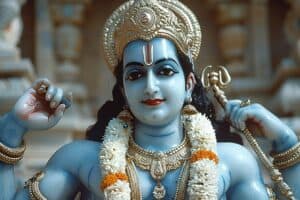
Symbols and Attributes: Vishnu is often depicted with four arms, holding a conch shell (shankha), a discus (chakra), a mace (gada), and a lotus flower (padma). He is typically shown resting on the serpent Ananta (Shesha), floating in the cosmic ocean.
Consort: Vishnu’s consort is Lakshmi, the goddess of wealth, fortune, and prosperity. She plays a significant role in his mythology and is often depicted alongside him.
Prominence in Scriptures: Vishnu is prominently featured in various Hindu scriptures, including the Vedas, Puranas, and epics like the Ramayana and Mahabharata. The Bhagavad Gita, a part of the Mahabharata, contains teachings attributed to Krishna, an avatar of Vishnu.
Worship and Temples
- Vishnu is worshiped in numerous temples across India and the world. Some of the most famous Vishnu temples include the Tirupati Venkateswara Temple, Badrinath Temple, and the Ranganathaswamy Temple in Srirangam.
- His festivals, such as Janmashtami (Krishna’s birthday) and Rama Navami (Rama’s birthday), are celebrated with great devotion and enthusiasm.
Symbolism and Influence
Vishnu symbolizes stability, righteousness, and the preservation of the cosmic order. His stories and teachings influence various aspects of Hindu culture, art, and philosophy, emphasizing the importance of duty, devotion, and ethical conduct.
Donnelly on the boar avatar
Ignatius Donnelly, the Minnesota politician who wrote Atlantis: The Antediluvian World, followed it in 1883 with Ragnarok: The Age of Fire and Gravel. He opened his chapter on legends of the coming of the comet with the Hindu story of the boar.
A being shaped like a boar
Donnelly quotes the account of a small white boar that grew in the air and fell upon the earth. In his account the boar was the comet.
The second Hindoo "Avatar" gives the following description of the rapid advance of some dreadful object out of space, and its tremendous fall upon the earth:
"By the power of God there issued from the essence of Brahma a being shaped like a boar, white and exceeding small; this being, in the space of an hour, grew to the size of an elephant of the largest size, and remained in the air."
That is to say, it was an atmospheric, not a terrestrial creature.
Ignatius Donnelly, Ragnarok: The Age of Fire and Gravel (1883), part III, chapter III, p. 132

Blacket on Vishnu and Oceanus
In 1884 W. S. Blacket published Researches into the Lost Histories of America. In chapter VI he compares the Hindoo water god with the Oceanus of Europe. In his account both names impersonate America.
Blacket on the name Oceanu
Blacket writes that Vishnu is Oceanus, and that the name itself appears in Sanscrit as Oceanu.
It has been seen that the Greeks, in their mythic system of ancient Geography, have impersonated America as the marine God, Oceanus. It is just the same with the Hindoos, in India. The sages have the same symbolism exactly. The names themselves are the same. Vishnu is Oceanus, written in Sanscrit—Oceanu.
W. S. Blacket, Researches into the Lost Histories of America (1884), chapter VI, p. 59

