
Table of Contents
Mount Mashu is a significant and mysterious mountain in Mesopotamian mythology, particularly known from the “Epic of Gilgamesh.” Here’s what is known about Mount Mashu:
Mythological Significance
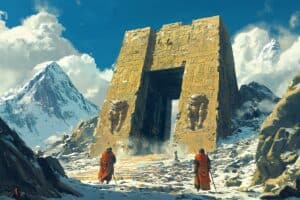
Mount Mashu is described as a mountain with twin peaks that are so high that they reach the heavens and so deep that their roots extend into the underworld.
The mountain is located at the edge of the world, where the sun rises and sets, marking the boundaries of human experience and the divine realm.
At the entrance of Mount Mashu stand two scorpion-people (sometimes described as half-man, half-scorpion creatures), who guard the mountain’s gates. These guardians are terrifying beings who have the power to strike fear into the hearts of even the bravest of heroes. However, they permit Gilgamesh to pass when he explains his quest.
The scorpion-man and his wife
In R. Campbell Thompson’s 1928 translation of the Nineveh tablets, the wardens at the gates of Mashu recognise the hero by his body:
(Then) unto his wife spake the Scorpion:
“Lo, he that cometh to us—’tis the flesh of the gods is his body.”
(Then) to the Scorpion-man answer’d his wife: “Two parts of him god-(like),
(Only) a third of him human.”
R. Campbell Thompson, The Epic of Gilgamish, Tablet IX, Luzac and Co., London, 1928, p. 42
Role in the Epic of Gilgamesh
In the “Epic of Gilgamesh,” Mount Mashu is a critical point in Gilgamesh’s quest for immortality. After the death of his friend Enkidu, Gilgamesh embarks on a journey to find Utnapishtim, the survivor of the Great Flood who has been granted immortality.
His path takes him to Mount Mashu, where he must pass through the mountain to reach the Garden of the Gods.
The Dark Tunnel: Inside Mount Mashu, Gilgamesh traverses a long, dark tunnel, representing a passage through the unknown or the underworld.
The tunnel is described as being completely devoid of light, symbolizing death, the unconscious, or a journey through a liminal space where normal rules of reality do not apply.
He must cross this tunnel to reach the world beyond, where the sun rises.
In Thompson’s account the crossing itself is the Road of the Sun:
The traverse is by the Road of the Sun by a journey of twenty-four hours, beginning with deep darkness.
R. Campbell Thompson, The Epic of Gilgamish, Tablet IX, Luzac and Co., London, 1928, p. 42
Emergence into the Garden of the Gods: After successfully passing through Mount Mashu, Gilgamesh emerges into the Garden of the Gods, a paradisiacal place filled with jeweled trees and eternal light, indicating that he has entered a divine realm beyond the normal human experience.

