
Table of Contents
Marduk is the god who won. In the Babylonian creation epic a younger god is sent against Tiamat when the others need help, and he comes out of that war as the god who orders the world and rules Babylon. That rise is the thread I kept finding. On this site Marduk turns up in creation stories, calendars, festivals, the Bible and the Anunnaki readings, and this page brings them together.
Born in the Apsu
Enuma Elish: Tablet I gives the birth of the god in the line-numbered text:
81 In Apsû was Marduk born,
Enuma Elish, Tablet I
82 In pure Apsû was Marduk born.
Mesopotamian Creation Myths names Ea and his wife as his parents and says he was given control of the four winds. The same page reads the epic as a legitimization of Marduk’s rise as the supreme god in Babylon, replacing Enlil.
The war against Tiamat
Earth was pulled from Tiamat, another planetary body and The Olympian Gods both set out the line from Apsu and Tiamat down to Ea and Marduk, and both say the younger gods, led by Marduk, defeated the forces of chaos. What Are Creation Stories? adds that Marduk fashions the world from Tiamat’s divided body. On Anunnaki gods list Anu seeks help from Anshar, who sends him to Marduk for aid against Tiamat. On Seeders of humanity Marduk uses her body to form constellations as time markers. The video Enuma Elish as a solar system story reads the whole battle as the birth of the solar system, with the asteroid belt as the remains of Tiamat.
Marduk orders the year
On The earth to spin off balance the epic is quoted on what Marduk does once the cosmos is made:
He founded the station of Nēberu [= Jupiter] to determine their bounds [= the year]; That none might err or go astray, He set the station of Enlil and Ea with it.
Enuma Elish
That page connects his work to an ideal year of 360 days. The Babylonian Calendar and the Akitu Festival in Mesopotamia show how the victory over chaos was celebrated every new year, with the statue of Marduk at the center of the rites.
The god of Babylon
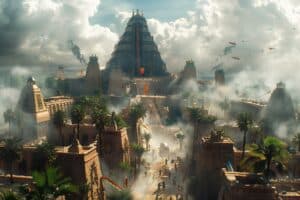
Babylon’s connection with Atlantis identifies the temple Herodotus called the temple of Zeus Belus with Marduk and the ziggurat Etemenanki. On The Mysterious Sumerian King List and Anunnaki Legacy the Esagila is his temple. Nebo/Nabu explains that Bel, the lord named beside Nebo, is likely Marduk, and The Bible: Blend and unify ‘the Gods’ into One says the Bible often calls him Bel, with Isaiah 46:1 as the example.
Firstborn of Enki
In Jim Marrs’s book quoted on Sumer: The First Known Civilization, Marduk comes to Earth as Enki’s firstborn son at the head of reinforcements. Marrs then quotes the prologue to the law code of Hammurabi:
When exalted Anu, king of the divinities [the Anunnaki], and Enlil, lord of heaven and earth, the determiner of the destinies of the land, determined for Marduk, the first-born of Enki, the dominion over the whole of humankind
Prologue to the Code of Hammurabi, as quoted by Jim Marrs
On The Real Anunnaki: What Ancient Texts Actually Say Marduk imprisons 600 Anunnaki in the netherworld, and the Anunnaki build Babylon for him. On 300 Igigi of heaven and 600 of the Apsû he is the one who created the Igigi gods.
Marduk and Nimrod
The origin of Nimrod reports that some scholars see Nimrod as a Hebrew rendering of Ninurta or Marduk. On King Hezekiah’s religious reforms Marduk is the chief deity of Babylon who also had a place in the Assyrian religious system.
Related pages
- Enuma Elish: Tablet I
- Mesopotamian Creation Myths
- Earth was pulled from Tiamat, another planetary body
- Akitu Festival in Mesopotamia
- Babylon: Gate of the Gods, the Exile and the Fall of the Great City
- Nebo/Nabu
- Anunnaki gods list
- The origin of Nimrod
For every page I tagged with marduk, see the marduk tag archive.

