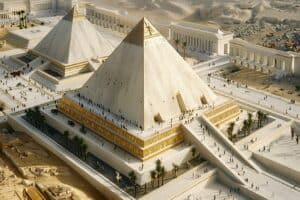
Herodotus describes Cheops (also known as Khufu) and his building of the Great Pyramid in Book 2, Chapter 124-127 of “Histories”:
Cheops’ Tyranny:
Herodotus portrays Cheops as a tyrannical ruler who oppressed his people to build the pyramid.
"Cheops brought the country into all sorts of misery. He closed all the temples, and, being desirous of knowing how many loaves the people consumed, ordered every Egyptian to bring him a certain number daily, from which the amount was ascertained.".
Histories, Book 2, 2.124
Construction of the Pyramid:
According to Herodotus, Cheops forced labor upon the Egyptians to build the Great Pyramid.
"He compelled his subjects to labor for him, some to drag stones from the quarries in the Arabian mountain to the Nile, and others to receive them and transport them to the mountain of Libya."
Histories, Book 2, 2.124
Duration of Construction:
Herodotus provides a timeline for the construction, claiming it took 20 years to build the pyramid.
"The pyramid itself was twenty years in building; its base is a square of eight hundred feet each way, and its height the same.".
Histories, Book 2, 2.124

Sacrifices and Exploitation:
Herodotus mentions that Cheops even resorted to extreme measures, such as the prostitution of his daughter, to fund the construction.
"Cheops...having exhausted his treasures, was compelled to make his daughter enter a brothel and charge for her favors.".
Histories, Book 2, 2.126
Cheops’ Successor:
Herodotus states that Cheops was succeeded by his brother Chephren, who also built a pyramid, but was less oppressive.
"After Cheops, his brother Chephren reigned over Egypt. He too followed the same practices.".
Histories, Book 2, 2.127
The twenty years of the pyramid
In Macaulay’s 1890 translation of The History of Herodotus, the same chapter gives the time spent on the pyramid itself, and the measure of its base and height.
For the making of the pyramid itself there passed a period of twenty years; and the pyramid is square, each side measuring eight hundred feet, and the height of it is the same.
Herodotus, The History of Herodotus, trans. G. C. Macaulay, Macmillan and Co., London and New York, 1890, vol. I, p. 174
Leslie on the number of pyramid builders
J. Ben Leslie set out a detailed history of Atlantis in Submerged Atlantis Restored (1911). He presents it as information given by pre-historic spirits, and he cites almost no other sources. He reports what the spirit Yermah said about the figures of Herodotus. Cazuda is his word for a pyramid.
Yermah informs us that Herodotus was vastly incorrect in his statement "that there were 100,000 men employed three months in the year for twenty years, on the construction of the Cazuda," for at no one time were there to exceed over seven hundred men employed on the entire detail of construction.
J. Ben Leslie, Submerged Atlantis Restored (1911), Teltzie XXVII, p. 249