
Table of Contents
Ur keeps turning up in my research, and almost never on a page that is about Ur. It is the city Abraham left, one of the great cities of Sumer, a pit where Leonard Woolley found a flood layer, and in one regression session it is the name of the people who built the pyramids. On this page I bring those threads together.
I keep two readings open. One is the city in southern Iraq that archaeologists have dug since the 1920s. The other is older and stranger: Ur as a word, a people or a light that some of my sources place long before Sumer. I summarize what each linked page says and leave the conclusion to you.
Those of Ur and the pyramids
The question that started this page came from the Pyramid of Giza. Dolores Cannon asked Suddi, an Essene teacher she met in regression, who put the knowledge into the pyramids. His answer was short:
D: Do you know who put the knowledge there in the first place?
S: It is said, again, that those who built the pyramids were those of Ur.
Suddi, in Dolores Cannon, Jesus and the Essenes

Suddi says “again”, so for him this was a known teaching, not a new idea. He does not say where those of Ur lived. The Sumerian city is one option. On Cities of Light (UR) I follow a second one: Ur as the Atlantean word for light, and places named Ur as traces of Atlantean survivors.
Ur of the Chaldees in Genesis
In Genesis, Ur is the home of Terah’s family. Haran dies there, and Terah takes Abram, Sarai and Lot out of the city toward Canaan.
And Terah took Abram his son, and Lot the son of Haran his son's son, and Sarai his daughter in law, his son Abram's wife; and they went forth with them from Ur of the Chaldees, to go into the land of Canaan; and they came unto Haran, and dwelt there.
Genesis 11:31 (KJV)
The full chapter with my notes is on Genesis 11. I follow Abram himself on Abraham, and the question of which god he met first on When does Yahweh enter human evolution?, where Ur is a city of many gods such as Enlil and Sin.
Abram and He-sa in Oahspe
Oahspe tells Abram’s start in a different way. In the First Book of God he does not leave Ur. He leaves a place called He-sa, where he made baskets.
God led Abram away from He-sa, his native place, where he was a maker of baskets, and took him to the ancient land of Ham, which had been destroyed by druks, before the flood, as the name signifieth; whereafter God surnamed him Abraham, and made him chief rab'bah over the Faithists of Arabin'ya.
Oahspe, God's First Book, chapter VIII, verse 3
He-sa appears only once in all of Oahspe, and the book never says where it was. It does say Abram came out of Parsi’e, that he ran away from a king’s household to live among the Listians, who made baskets in the forests, and that escaped slaves gathered around him. God then led him and 4,500 people away, out of reach of the kings. So in Oahspe Abram does not leave a great city like Ur. He leaves a hidden forest life to lead a people.
So Oahspe gives Abram another home town than Genesis does. I put the two side by side because both are about the same move: a man taken away from his native place to start something new. The whole chapter is on First Book of God, and I collected the He-sa details on Abraham.
Jesus in Ur
The Aquarian Gospel sends Jesus to Ur on his way home from Persia. He speaks to the people there as family of Abraham.
In Ur, where Abraham was born, he tarried for a time; and when he told the people who he was, and why he came, they came from near and far to speak to him.
He said to them, We all are kin. Two thousand years and more ago, our Father Abraham lived here in Ur, and then he worshipped God the One, and taught the people in these sacred groves.
Levi H. Dowling, The Aquarian Gospel of Jesus the Christ, 42:4-5
The same book calls Terah of Ur a Brahm and his son A-Brahm. I follow that name link on Abraham and Brahma.
The Sumerian city
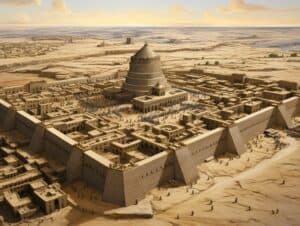
Ur was one of the most important cities of Sumer, a center for trade and the capital of the Third Dynasty of Ur. See Sumerian Cities. Its kings and the times the kingship “was carried off” to Ur are in the Sumerian King List, and Ur-Nammu and Shulgi also appear on Dynasty of Uruk.
In the reading of Jim Marrs, following Zecharia Sitchin, the moon god Sin is Nannar, firstborn son of Enlil and lord of Ur, and Abraham was a high ranking Sumerian from that city rather than a simple nomad. See Sumer, the First Known Civilization and Mount Ekur, where Nanna has his own shrine.
Mariana Giovino looks at the sacred trees of the moon god’s temple at Ur and at Woolley’s reading of the ziggurat as an artificial mountain. See Mariana Giovino, The Assyrian Sacred Tree.
Woolley’s flood layer
In 1929 Leonard Woolley dug a deep pit at Ur and found a thick bank of clean, water-laid clay under the early town. He was sure it was the Flood of Noah. Later archaeologists dated it to the end of the Ubaid period, older than the other flood layers, and saw it as a big local flood. I go through this on Did Genesis Combine Two Floods? and Excavations in southern Mesopotamia have uncovered flood deposits.
Woolley himself gave no single year for his flood. In Ur of the Chaldees (1929, p. 30) he only wrote that the ruins from before the Flood lay about (4.88 meters) below a pavement “not later than 3200 B.C.”, and he dated the royal tombs above it to soon after 3500 B.C. Newspapers made it “before 4000 B.C.” Later archaeologists place the clay layer around 3500 BC. His own assistant Max Mallowan thought it was a local flood, too early to be the flood of the Sumerian stories, which he placed around 2900 BC.
Ur in older books on this site
- Edgar Cayce on Adam: one reading lists Ur among the incarnations of Adam, next to Amilius, Melchizedek and Jesus. The editor wonders if this Ur was the man who founded Ur of the Chaldees.
- Selestor’s Men of Atlantis: the early people of Yucatan came from the “Orient” and were souls “who knew of Ur and Babylon”.
- Zénaïde A. Ragozin, The Story of Chaldea: Ur-êa and Dungi as the first kings of Ur she accepts, and Abraham’s tribe leaving Chaldean Ur.
- The Aquarian Gospel of Jesus Christ: Terah the Brahm of Ur, and Jesus teaching in Ur in chapter 42.
Related pages
- Pyramid of Giza
- Cities of Light (UR)
- Abraham
- Genesis 11
- First Book of God
- Sumerian Cities
- Sodom and Gomorrah
For every page I tagged with Ur, see the Ur tag archive.

