Table of Contents
Traditional Navajo teachings describe the Anasazi as people who worshipped the darkness. They made prayer offerings to the darkness, and many kivas served these ceremonial purposes.
The teachings include many stories about the Anasazi and their actions during their brief time in the region, estimated at less than 300 years.
When the Navajo first arrived, they found the Pueblo people and another group called the cliff dwellers. The cliff dwellers hold special significance because they became part of the Navajo. Many clan names originated from them, yet those people no longer exist as a separate group. The cliff dwellers eventually became the Navajo and developed their own clans.
The Pueblo and cliff dweller people predate the Anasazi. Today, many cliff dwellings and Pueblo structures receive incorrect labels as Anasazi. Traditional teachings stress the need to correct this error and maintain clear distinctions between the Anasazi and other groups.
Anasazi: economy relied on the slave trade
The Anasazi differed greatly from the Navajo people. Their principal economy relied on the slave trade, and they subjected people to harsh conditions. They built walls not to keep outsiders out but to keep slaves in. Severe punishments, including torture and hunger, enforced obedience.
Some pottery reflects their arrogance and mockery of the holy people. Designs show claims that they could take the heart from one dog and place it into another, with both dogs surviving. Other pottery depicts slaves mocking the holy people of the Navajo and asserting that they were more intelligent and should serve as gods.
Look it how Schlemmer describe the medical technology of the Atlantis:
In Schlemmer's book, The Only Planet of Choice: Essential Briefings from Deep Space, a compilation of earlier recorded channeling sessions, she was asked to describe numerous aspects of Atlantis, and regarding our topic, claimed, “In Atlantean medicine it was possible to replace even the true heart and the true brain. However, in your medicine you can, for example, replace an arm except that it does not have a ’true heart’ in it. [vital spark] At their time, all the vital organs could be replaced with no difficulty and without severe problems for the physical body. Also, the organs that were transplanted were far superior to those that they were replacing.”
Human sacrifices
Kivas constructed during the Anasazi era often functioned as altars for human sacrifices dedicated to the worship of darkness. These practices form part of the stories passed down through generations.
The Destruction of the Anasazi
Traditional stories and ceremonies structure events around the time before, during, and after the Anasazi. They emphasize the evil and demonic ways of the Anasazi. The Holy People caused winds and other natural forces that destroyed crops and dried up wells. These events led to the Anasazi’s complete downfall.
The Holy People sent a big wind that destroyed the crops and drove away the slaves. The slaves abandoned the Anasazi, hid in canyons, or joined other groups. After the Anasazi were no more, these people returned and resumed their lives. They were called Ayakini before the destruction and Kisani, meaning housekeepers, afterward.
In anger after the complete destruction, people shattered pottery. Large mounds of broken pieces remain visible today in many places. The Holy People also caused rocks to cave in on structures. Large boulders crashed into walls and destroyed dwellings.
The area became known as the place of crying and dying. The Navajo call it “Chaco.” It is considered a very evil place after the destruction of the people who practiced slavery and other actions described in the stories.
Construction and Physical Evidence
Many structures exhibit varied construction techniques and designs that reflect the diversity of the groups who built them. Materials often came from far distances. The walls in the area differ because different Pueblo groups and different slave groups built them. Each group followed its own approach, yet the general technique remained similar.
Walls measure about three feet thick, with an inner face and an outer face filled with rock and clay. One design uses thinner rock in a continuous row. Another uses larger rocks. Small flat pieces of rock, carried from long distances by children or elderly people, filled gaps between larger rocks.
Some walls include log poles for floor construction that pass through the walls. Others do not. These differences appear in the designs and textures of the rock. The physical evidence supports the stories about slave labor and the transport of huge logs from over 150 miles (241 kilometers) (241 kilometers (149 miles)) away.
Importance of the Teachings
It remains important among the people to know the many stories of the evil and demonic ways the Anasazi lived near them for a period of time. The traditional stories preserve distinctions between groups and the sequence of events before, during, and after the Anasazi. They also explain the physical remains, including the mounds of broken pottery and the varied structures still present in the landscape.
Chaco Canyon
Some excerpts from wikipedia:
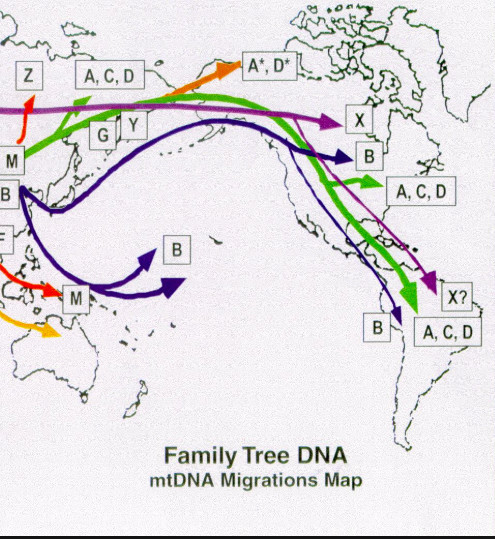
Archaeogenomic analysis of the mitochondria of nine skeletons from high-status graves in Pueblo Bonito determined that members of an elite matriline were interred here for approximately 330 years between 800 and 1130.
- All nine shared identical mitochondrial genomes (mtDNA haplogroup B2y1), which are inherited only through the maternal line. Nuclear genome data from the six best-preserved samples confirmed direct biological relationships consistent with matrilineal descent, including mother–daughter and grandmother–grandson pairs. High-precision radiocarbon dating placed the burials across approximately 330 years, from roughly 800 to 1130 CE — spanning the rise, peak, and decline of Chaco as a regional center. The individuals received elaborate burials with high-status grave goods (thousands of turquoise beads, shell trumpets, and other items), supporting their elite status. The study concludes that this single matriline maintained a central leadership or high-status role in the Chacoan polity for over three centuries.
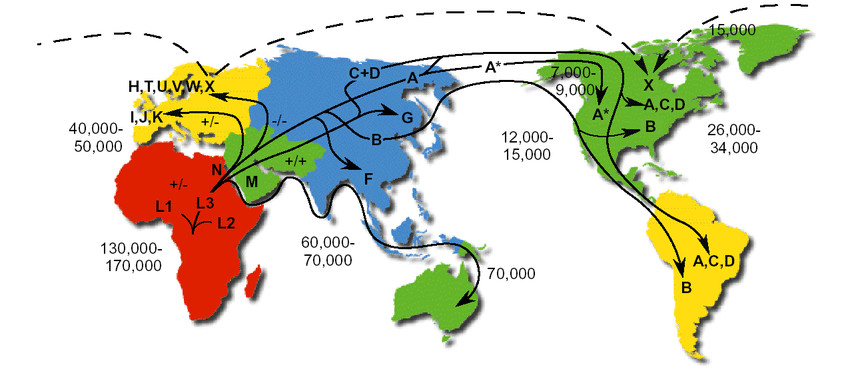
- Like other Native American mtDNA haplogroups, B2 traces to ancestral populations that migrated into the Americas from Beringia (the land bridge region between Siberia and Alaska) thousands of years ago. These lineages diversified within the Americas after the initial peopling events. B2 itself is defined by a set of mutations (including the characteristic 9-base-pair deletion in the mtDNA control region in many definitions of the broader B4b/B2 lineage). The more specific B2y1 represents a later branch that arose in the Americas. Exact age estimates for B2y1 are not widely published in detail, but the broader B2 clade expanded within the Americas roughly 15,000–20,000+ years ago, with subclades continuing to diversify over subsequent millennia.
- It is found in indigenous populations from Mesoamerica through Central America and into parts of South America. In the United States Southwest, it appears at low frequency among various Native American groups, consistent with the 2017 study’s note that the B2 haplogroup occurs at low frequency among Southwest Native Americans.
- B2 appears across many indigenous populations in Mexico, including:
- Central Mexico: High presence among Nahua (various subgroups, e.g., Xochimilco, Zitlala), Otomí, Purépecha (Tarascan), and Mixtec groups.
- Southern Mexico: Common in Mixtec, Triqui, and Maya populations (Yucatán and surrounding areas).
- Western and other areas: Documented in West Mexico samples and ancient remains, such as Aztec-period individuals from Tlatelolco.
- Northern Mexico: Present in groups such as Tarahumara and Pima, though sometimes at varying frequencies compared to central-southern regions.
Some scholars suggest that violence and warfare, perhaps involving cannibalism, impelled the evacuations. Dismembered bodies dating from Chacoan times were found at two sites in the central canyon. Yet Chacoan complexes showed little evidence of being defended or defensively sited high on cliff faces or atop mesas. Only several minor sites at Chaco have evidence of the large-scale burning that would suggest enemy raids.
After brief reconnaissance work by Smithsonian scholars in the 1870s, formal archaeological work began in 1896 when a party from the American Museum of Natural History based in New York City—the Hyde Exploring Expedition—began excavating Pueblo Bonito. Spending five summers in the region, they sent more than 60,000 artifacts back to New York and operated a series of trading posts in the area.
Only in 1929 did a Judd-led team find the “missing link”. Most of the beams used at Chaco were cut between 1033 and 1092, the height of construction there.
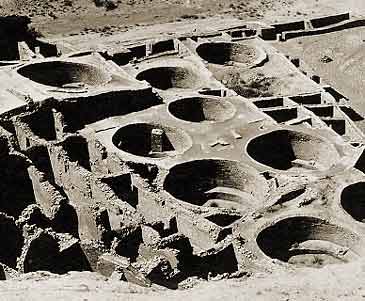
The Chacoans used masonry techniques unique for their time, and their building constructions lasted decades and even centuries. As architectural forms evolved and centuries passed, the houses kept several core traits. Most apparent is their sheer bulk; complexes averaged more than 200 rooms each, and some enclosed up to 700 rooms.
Houses generally faced the south, and plaza areas were almost always girt with edifices of sealed-off rooms or high walls. Houses often stood four or five stories tall, with single-story rooms facing the plaza; room blocks were terraced to allow the tallest sections to compose the pueblo's rear edifice.
Structures known as kivas were built in proportion to the number of rooms in a pueblo. One small kiva was built for roughly every 29 rooms. Nine complexes each hosted an oversized great kiva, each up to 63 ft (19 m) in diameter. T-shaped doorways and stone lintels marked all Chacoan kivas. Although simple and compound walls were often used, great houses were primarily constructed of core-and-veneer walls: two parallel load-bearing walls comprising dressed, flat sandstone blocks bound in clay mortar were erected. Gaps between walls were packed with rubble, forming the wall's core. Walls were then covered in a veneer of small sandstone pieces, which were pressed into a layer of binding mud. These surfacing stones were often placed in distinctive patterns. The Chacoan structures altogether required the wood of 200,000 coniferous trees, mostly hauled—on foot—from mountain ranges up to 70 miles (112.65 kilometers) (110 km) away.
Turquoise was very important to the people of Chaco. About 200,000 pieces of turquoise have been excavated from the ruins at Chaco Canyon, and workshops for local manufacture of turquoise beads have been found. The turquoise was used locally for grave goods, burials, and ceremonial offerings. More than 15,000 turquoise beads and pendants accompanied two burials at Pueblo Bonito. Some researchers found data supporting existence of widespread trade of the turquoise.
Comments under the videos
My uncle(Navajo) use to tell a story of the great gambler who came from the south(Mexico) and took over Chaco. When the Navajos(Dine’) came across Chaco, they notice them practicing dark magic and had enslaved the pueblos. They also talked about them eating people and a lady who use to make human jerky. The Navajos raided them and freed the slaves(Pueblos) who went on to create other villages within New Mexico and Arizona. Some of the slaves married into the Navajo tribes. I don’t remember everything but this was what I was told. If you tell pueblos this they become upset.
It is "Aná Sà Á Zí … "The different people"
Post is based on this video from Navajo Historian, Wally Brown and other sources.
Other sources