
Table of Contents
- Timeline
- Timeline and chronology
- Introduction to the Rmoahal race
- Theosophical context and primary sources
- Birthplace, colour and height
- Migrations and mixing
- The northern branch
- Glacial epochs
- The two great glaciations
- Links to Atlantis and open questions
- Conclusion
- Sources
- Link to Atlantis
- The Rmoahal race and Genesis 2
Timeline
William Scott-Elliot writes that a minor glacial epoch occurs about every 30,000 years, and that Atlantis saw two major glaciations. The first was during the Rmoahal era, about 3,000,000 years ago, and the second in the Toltec era, about 850,000 years ago.
The Rmoahal are one of the stranger chapters in the hidden history of humanity that Theosophy tells. They are a race of towering giants who stand between the last of Lemuria and the empires of Atlantis. In this account they are the first sub-race of the Atlantean root race. They mark the shift from semi-etheric to fully physical human bodies.
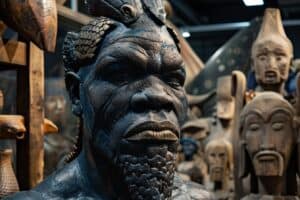
They stood (3.05 to 3.66 meters) tall and had mahogany-black skin. They lived among steaming swamps, fought the last Lemurians and moved with the great glacial upheavals. Their story comes mainly from two Theosophical writers, Helena Blavatsky and William Scott-Elliot.
Timeline and chronology
In Scott-Elliot’s chronology the Rmoahal arise between four and five million years ago. Their birthplace is a spur of Lemuria near what he calls the Ashanti coast. It is a hot, moist land of swamps and large animals. The first great glacial epoch falls in their days, about 3,000,000 years ago.
They later migrate to the southern shores of Atlantis and fight the Lemurians there. By the first map period, about one million years ago, the northern branch has become a fair people. Afterwards they blend into the later Atlantean sub-races, such as the Tlavatli and the Toltec.
This makes the Rmoahal an early bridge in the Atlantean root race. They come after the Lemurian decline and before the later sub-races.
Introduction to the Rmoahal race
The setting is a prehistoric world of dense jungle and tall ferns. Giants (3.05 to 3.66 meters) tall with mahogany skin lived there among huge beasts.
Theosophy calls the Atlanteans the Fourth Root Race and the Rmoahal its first sub-race. The Lemurians before them were more ethereal. The Rmoahal stand for the turn of humanity to full physical bodies, driven by instinct, emotion and a warrior spirit.
Theosophical context and primary sources
In Theosophy, humanity evolves through seven root races. Each root race divides into sub-races. The Atlanteans, the Fourth Root Race, follow the Lemurians, the Third, and the Rmoahal are the first Atlantean sub-race.
Helena Blavatsky outlines this order in The Secret Doctrine (Vol. II). William Scott-Elliot’s The Story of Atlantis (1896) supplies the physical details. Rudolf Steiner also wrote about this stage. He tied it to the growth of memory and vivid sense-impressions in the soul.
Birthplace, colour and height
Scott-Elliot dates the race to four or five million years ago, on a spur of Lemuria at the Ashanti coast of today. He says they were dark, (3.05 or 3.66 meters) tall at first, and slowly grew smaller over the centuries.
Now the period represented by Map No. 1 shows the land surface of the earth as it existed about one million years ago, but the Rmoahal race came into existence between four and five million years ago, at which period large portions of the great southern continent of Lemuria still existed, while the continent of Atlantis had not assumed the proportions it ultimately attained. It was upon a spur of this Lemurian land that the Rmoahal race was born. Roughly it may be located at latitude 7º north and longitude 5º west, which a reference to any modern atlas will show to lie on the Ashanti coast of to-day. It was a hot, moist country, where huge antediluvian animals lived in reedy swamps and dank forests. The fossil remains of such plants are to-day found in the coal measures. The Rmoahals were a dark race--their complexion being a sort of mahogany black. Their height in these early days was about (3.05 or 3.66 meters)--truly a race of giants--but through the centuries their stature gradually dwindled, as did that of all the races in turn, and later on we shall find they had shrunk to the stature of the "Furfooz man."
William Scott-Elliot, The Story of Atlantis (1896), The Rmoahal Race

Migrations and mixing
Scott-Elliot says the Rmoahal moved to the southern shores of Atlantis. There they fought the sixth and seventh Lemurian sub-races. Part of the tribe went north. The rest intermarried with the black Lemurian aborigines, so no pure blood was left in the south.
The northern branch
The northern branch reached the promontories near Iceland. Over many generations it grew lighter in colour, and its descendants came under the Semite kings.
The remainder of the race, however, reached the extreme north-eastern promontories contiguous with Iceland, and dwelling there for untold generations, they gradually became lighter in colour, until at the date of the first map period we find them a tolerably fair people. Their descendants eventually became subject, at least nominally, to the Semite kings.
William Scott-Elliot, The Story of Atlantis (1896), The Rmoahal Race
A document on ancient Africa adds that their size made them bodyguards for chieftains. Myths of giant protectors in many cultures may echo that role.
Glacial epochs
In Scott-Elliot’s account the ice shaped their fate. The great glaciation of Rmoahal times invaded most of the continent. It drove all life toward the equator. Even then, northern peoples could come back in summer to hunt and went south again each winter.
The two great glaciations
Twice in the history of Atlantis, Scott-Elliot says, the ice covered most of the continent. The first time was in Rmoahal days, about 3,000,000 years ago, and the second in the Toltec era, about 850,000 years ago.
But in addition to these, there were two occasions in the history of Atlantis when the ice-belt desolated not merely the northern regions, but, invading the bulk of the continent, forced all life to migrate to equatorial lands. The first of these was in process during the Rmoahal days, about 3,000,000 years ago, while the second took place in the Toltec ascendency about 850,000 years ago.
William Scott-Elliot, The Story of Atlantis (1896), The Rmoahal Race
Links to Atlantis and open questions
The Rmoahal pass into later Atlantean groups. Their size invites comparison with the Rephaim and Nephilim of the Bible and with giants in African folklore. On this site they fit as an early form after the Anunnaki genetic work and before the empires of Atlantis.
Whether to read them literally or as allegory stays open. Theosophy often reads its races symbolically. Yet the physical detail in Scott-Elliot reads like a description of real people. These accounts are symbolic yet rooted in esoteric transmission. Some channeled sources, such as readings of the Akashic records, see the early races as prototypes in humanity’s genetic alterations, possibly influenced in later phases by higher beings like the Anunnaki or Elohim.
Conclusion
In these accounts the Rmoahal were the first giants of physical form among humans. They were dark-skinned and powerful, and they stand between Lemuria and Atlantis.
The full interactive 1,000,000-Year Human History Timeline includes the Rmoahal migrations and the root-race connections. It comes with membership in a private community. Get the Timeline on Gumroad
Sources
Blavatsky, The Secret Doctrine (Vol. II)
Scott-Elliot, The Story of Atlantis (1896)
Steiner lectures on root races
Link to Atlantis
The “Rmoahals” were black skinned and stood between (3.05 to 3.66 meters) tall. They waged continuous war with the remaining Lemurians. As time went on, some of them moved to the North of Atlantis, where their skins became lighter and their stature shorter. Because of their huge stature, the chieftains of Ancient Afrika used the Rmoahals as bodyguards. Source
The Rmoahal race and Genesis 2
One reading on this site sets the Rmoahal beside the second chapter of Genesis. In it, Lilith stands for the latest Lemurian period.

After the man names the animals, the LORD God puts him into a deep sleep and takes something from his body.
And the LORD God caused a deep sleep to fall upon Adam, and he slept: and he took one of his ribs, and closed up the flesh instead thereof;
Genesis 2:21, King James Version
On this reading the moment may mark the turn from the first sub-race to the second.

